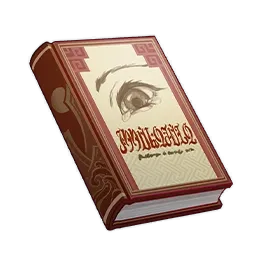
Perinheri is a two-volume Fontaine Book Collection released in Version 4.5, sold at Hubel's newsstand in the Court of Fontaine at 1,500 Mora per volume. Its alternative title is Hleobranto Innamorato. The preface to each volume is candid about what it is: "the author of the first edition claims to have based this tale on a legendary story known throughout Khaenri'ah, but there are none left who can verify this. It is an anthological work produced over several generations at this point."
The Special Thanks footnote at the close of Vol. 2 documents the editorial chain. The 1st edition drew on Mr. Denon's archaeological studies into Khaenri'ah; Mr. Jean Figeac's continued writings and refinements supplied the ending in the 2nd; Mrs. Jean Figeac and Mr. Jean Figeac fils corrected typos in the 3rd; the 13th compiled Karl Ingold's records "Investigations into an Abandoned City"; the 14th drew on Mr. Karasawa's assistance with natural history; and the 15th added Mr. Yun's notes on Liyue culture. A Narzissenkreuz Ordo interactable in the Tower of Ipsissimus identifies that Mr. Karasawa as Eichi Karasawa, an Inazuman scholar turned romance novelist. [1] [2] [12]
Vol. 1: the Crimson Moon Dynasty and the orphanage at the hearth
Vol. 1 opens in "very ancient times indeed," when "a crimson moon shone down upon the subterranean realm, and not the dark sun of latter days." The "crimson moon" here is the Crimson Moon Dynasty era of Khaenri'ah, and the "dark sun of latter days" is the Eclipse Dynasty that followed it. That two-dynasty structure of Khaenri'ah's history is attested directly on the page. [1] [3] [13]
Vol. 1's central disclosure follows. Because the Kingdom's "unique position" caused "things from outside this world" to leak into it, including children "who may have come from some destroyed world," a sage suggested to the great ruler that an orphanage be founded for such children. The sage's words point straight at the Descenders: "In anticipation of the arrival at their Kingdom of gods from beyond the so-called ocean - or rather, the arrival of beings who could transcend the gods - they founded an organization, an orphanage to take care of such children. In latter days, the orphans of the Kingdom and those who wandered in from outside were accepted as well." That phrase, "beings who could transcend the gods," lines up with the Descenders described in AQ Chapter III: Act V, A Toast to Victory, where the Traveler is a Descender and their sibling is not. [1] [5] [9]
The induction ritual follows. Perinheri's first memory is being asked by the grown-ups to crawl through a dark corridor filled with coal ash, "designed for the passage of children in the first place." When he reaches the end, the exit has not opened, and the grown-ups coldly ask, "Are you dead?" They keep asking until he finally shouts, "Yes, I'm dead!" Then they ask, "Did you see it, then?" Perinheri sees an illusion in the dark: "The crimson moon, hanging high in the pitch-dark night sky, suddenly turned around, revealing itself to be a titanic, horrified eye." The adults open the door, embrace the soot-covered child, and pronounce: "You have traversed the fire of two worlds within the hearth, and here you are reborn."
This orphanage "may be related to the House of the Hearth's origins," and Arlecchino's Character Story 5 carries Pierro's implication that the present-day House continues that same organisation from the Crimson Moon era. The hearth pronouncement reads as the likely source of the modern House's name, even though canon never formally closes the question of whether the two institutions are one and the same. [1] [4] [8] [11]
Vol. 1 closes on the line that marks the change of dynasty: "Though the crimson moon set, and the dark sun descended into a yet darker dusk, that transcendental person from beyond who the Kingdom orphanage was awaiting never arrived." The turn from Crimson Moon to Eclipse is right there on the page, and the Descender the orphanage was founded to receive never came during the Crimson Moon era. Khaenri'ah did eventually receive a presumed Descender, the Traveler's sibling, 500 years before the present, during the Eclipse Dynasty under King Irmin. Among the orphanage's graduates, Vol. 1 names Perinheri as "the leading figure amongst their ranks," bested only by his best friend Hleobrant. [1] [7]
Vol. 2: Angelica's witch-reveal and the curse of the Kingdom
Vol. 2 opens with the orphanage receiving Angelica, a foreign princess from a nation defeated by Deus Auri, the Latinate cognomen for Morax / Rex Lapis / the Geo Archon of Liyue. Vol. 2 Note 1 spells out the Liyue identification: "Note that the ancient people of Liyue did not use such names. Now that I consider it, her name may have been 'Lady Miaoyin' (Lady of Wondrous Sound) or 'Tianwang Nu' (Servant of Tianwang)." Daughter of a priestly line who refused to submit to the new Liyue god, Angelica "drifted, wandering through the gates of their Kingdom," declared she would marry only the mightiest knight, and provoked Hleobrant into an escalating series of duels against other knights. Vol. 2's roster of Crimson Moon knights, ranked by Angelica herself, names Njord (who walks with the Darksprites), Alf (the greatest warrior in the Universitas Magistrorum), an Alberich-clan commander of half the knights, and Perinheri the undefeated. [1]
The Vol. 2 climax is the primary text for how the curse works. As Perinheri pursues the deranged Hleobrant beyond the Kingdom's borders, Hleobrant clutches his face and his words "gradually grew more like the howling of a wild beast." Angelica explains: "Hleobrant is the descendant of those who forsook their god and came to the Kingdom. This is why the Kingdom's obstinately pure-blooded aristocracy persists. This is the price of betraying your own god. As for you, Perinheri, you are one who drifted there. Thus, you bear no such curse. You may not have the nobility to shoulder a world, but you too have your own destiny." This sets up the reading of the hilichurl curse: the curse Ronova later lays on full-blooded Khaenri'ahns at the Cataclysm has an earlier precedent, one that strikes those who left their god and came back. Angelica then reveals herself as a witch who has outlived her own god: "I betrayed no one, not for a moment, until my god died, so I too bear this curse not... I am freedom, that which has broken free of fate." [1] [6]
Vol. 2 Note 2 is the key disclosure on the shift between the two dynasties: "The black wolves of the first edition. Archaeological work on Khaenri'ah indicates that this must have been a type of warbeast created using alchemy. Alchemy and the Beastmaster Knights were a mainstay during the Crimson Moon Dynasty, but interest in mechanical engineering during the Eclipse Dynasty would cause it to fall behind." The note sets out how the Kingdom's priorities changed: the Art of Khemia and the Beastmaster Knights anchored the Crimson Moon era, while mechanical engineering and Ruin-Machine technology took over under the Eclipse Dynasty. It is also the source for the Darksprites being black-wolf warbeasts made with alchemy in the Crimson Moon era. [1] [7] [10]
The limits of a legendary retelling
This is not primary-text testimony. Its preface is explicit: "there are none left who can verify this. It is an anthological work produced over several generations." Vol. 1's hearth-ritual and Vol. 2's witch-reveal are a legendary retelling preserved through Mr. Denon's archaeology and Jean Figeac's later embellishments, not a contemporary Khaenri'ahn document. Doctrinal claims drawn from Perinheri have to respect that it is framed as a legend.
The House of the Hearth's origin stays unproven. The orphanage "may be related to the House of the Hearth's origins," and no more than that. Arlecchino's Character Story 5 carries Pierro's implication of continuity, yet the primary text never closes the question. Whether the modern House is the same institution carried across the Crimson Moon, Eclipse, Cataclysm, and Fontaine transitions, or a refounding from the Fatui era wrapped in a story of unbroken tradition, stays open per the House of the Hearth page.
It anchors neither the Cryo Sovereign nor the Five Sinners. Vol. 2's knights of the Crimson Moon era (Njord, Alf, an Alberich-clan commander, Perinheri) do not overlap with the Five Sinners (Rhinedottir, Vedrfolnir, Surtalogi, Hroptatyr, Rerir) or with the seven Sovereigns. The Crimson Moon knights are a separate, earlier group from the Eclipse-era Sinners who emerge later.
Nor is it a literal Orlando adaptation. The story is "likely inspired by" Boiardo's Orlando Innamorato and Ariosto's Orlando Furioso; the alternative title Hleobranto Innamorato and the parallel of Angelica arriving from the far side of the world are echoes of structure, not scene-for-scene borrowings. The Khaenri'ah content belongs to neither Boiardo nor Ariosto.
For all that it disclaims its own historicity, the tale is the in-game gateway to the Crimson Moon Dynasty era of Khaenri'ah, the orphanage at the hearth that may be the original House of the Hearth, the tradition of waiting for a Descender that predates the Sibling's arrival, and the curse on those who betray their god, which foreshadows the hilichurls.