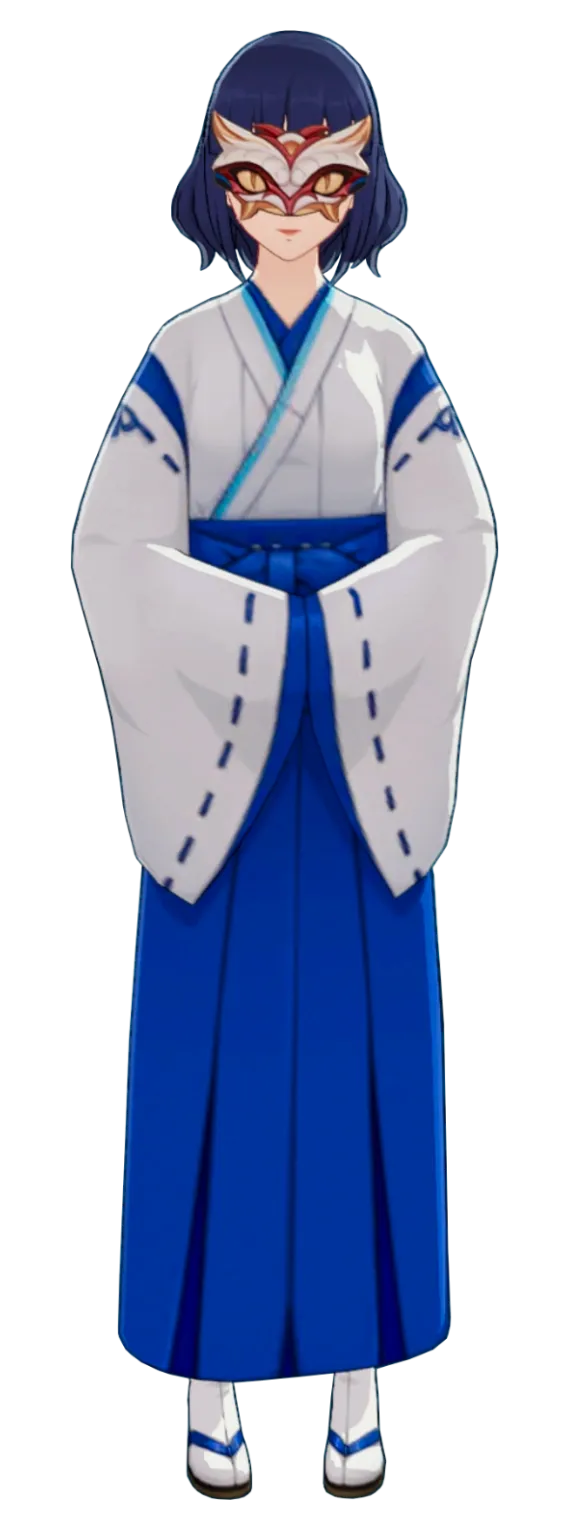
The Vassals of Watatsumi were a pre-Cataclysm Enkanomiya order of half-human, half-snake familiars created by the Watatsumi Omikami, the serpent-god also venerated as Orobashi in present-day worship on Watatsumi Island. [1] They were the serpent-god's familiars. They defended the people of Enkanomiya against the Bathysmal Vishaps, could translate between humans and reptiles, and held a deep connection to the Dainichi Mikoshi, the artificial sun. That connection was said to be strong enough for them to destroy it by willpower alone.
At the close of Three Realms Gateway Offering: Aftermath, Sangonomiya Kokomi explains: "Vassals of Watatsumi typically take on a half-human, half-snake form, symbolizing that they are the familiars of our serpent god. At least, they used to. Over time, the vassals gradually became identical to humans - all except for the pupils of their eyes." [2]
Origin and biological foundation
The Vassals of Watatsumi were created with the Watatsumi Omikami's own divine power: "They were created with Orobashi's power, and when Orobashi perished, the Vassals of Watatsumi ceased being born." [1] Because the serpent-god's own power made them, the Vassals were religious figures, the god's familiars, rather than a clan lineage with an administrative role.
They began as half-human, half-snake, a form that per Kokomi symbolised their role as the serpent god's familiars. [2] Over time they evolved to be identical to humans. The only remaining sign that they were not human was their thin, vertical, reptile-like pupils. [1] [2]
No primary text gives a Vassal's lifespan. Each Vassal came from the Watatsumi Omikami's creative power, one at a time, rather than from bloodline descent, which is why the order ended when the god's power ran out. Per Kokomi, no Vassals were born after the creation of Watatsumi Island.
Institutional capabilities
The Vassals defended the people of Enkanomiya from the Bathysmal Vishaps. [1] It was a religious and military duty of protection, carried out on the Watatsumi Omikami's side against the primordial-elemental Bathysmal Vishaps. In Erebos' Secret Eboshi speaks of "their war against us," and Fandom says the serpent-god's rule "reduced the threat of the Bathysmal Vishaps," so the threat was already there when it came. [15] [4]
They could also communicate between humans and reptiles, including serpents, Bathysmal Vishaps, and other reptilian creatures. [1] [3] Of the last Vassal, Kokomi says: "She was going to be the one who could communicate between the vishaps and the humans." [2] As translators, the Vassals mediated between Enkanomiya's humans and its Bathysmal Vishaps.
The Dainichi Mikoshi is Enkanomiya's artificial sun, built by the Sage Abrax (per Erebos' Secret Topic 4). The Vassals were said to hold a connection to it deep enough that, in theory, they could destroy it by willpower alone. [1] [7] Tsumi describes it at the Mikoshi: "This tower seems to hear my wishes... I just need to think the thought and it will change its brightness. And if I so desire, it will collapse before me. With the cognitive equivalent of a click of the fingers, I could destroy this source of great pain for the vishaps." [2] The connection reflects a bond that the Watatsumi Omikami's creative power set between the Vassals and the apparatus Abrax built, after the god had reorganised the Enkanomiya court.
The three-pendant institutional accountability framework
Per Kokomi's closing explanation at Sangonomiya Shrine (Three Realms Gateway Offering: Aftermath, Movement 4), the pendant is "a relic from back in the very beginning, when the Watatsumi Omikami reorganized the court and reformed Enkanomiya. The three pendants were given to the Dainichi Mikoshi, the Sangonomiya line, and the Vassals of Watatsumi." [2] [16]
Pendant recipient | What the sources say | Contemporary status |
|---|---|---|
Dainichi Mikoshi | The artificial sun, built by the Sage Abrax; it has "the power to bring light to the dark depths," per Erebos' Secret, and in Three Realms Gateway Offering Enjou says Tsumi will use its power "to suppress the Sangacorallia" [15] [16] | The artefact survives, and the Sentou Ceremony tradition is preserved but weakened. The encounter between the Outlander and Tsumi over the pendant fragments in Three Realms Gateway Offering: Aftermath confirms the apparatus still works. [7] |
Sangonomiya line | The Sangonomiya Clan, which led Watatsumi Island after the evacuation; today Sangonomiya Kokomi is Divine Priestess | Kokomi gives its pendant fragment to the Outlander: "Watatsumi Island doesn't need it anymore." [5] [16] |
Vassals of Watatsumi | Half-human, half-snake familiars created by the Watatsumi Omikami, who defended against the Bathysmal Vishaps and translated between humans and vishaps | Declined almost to extinction. Tsumi, whom the events strongly suggest is the last Vassal, complicates the picture: she says, "I grew up with the vishaps." [1] [16] |
As Kokomi puts it: "The original intention was that the common folk, the officials, and the divine vassals would all hold each other accountable. But today, only the common folk have flourished, while the other two bloodlines have declined. So the pendant is of little use anymore." [2]
Kokomi does not say which pendant stood for which of the three groups, how the pendants were meant to make the groups answer to one another, or who the common folk who "have flourished" were. The "divine vassals" are most likely the Vassals of Watatsumi, given the name, but she does not pair the pendants with the groups one by one. The only reason she gives for the pendant's "little use" is that "the other two bloodlines have declined." [16]
Cohort termination event
As Kokomi recounts: "The Watatsumi Omikami exhausted its power to create Watatsumi Island, and after that, it grew weaker and weaker. No more Vassals of Watatsumi were born after that." [2] [4]
The Vassals ended after the evacuation, in the era when Watatsumi Island was created. Building the island drained the serpent-god's creative power, and from then on it was too weakened to create any more Vassals.
Their end came before the Heavenly Principles forced the Watatsumi Omikami to sacrifice itself. Per Erebos' Secret Topic 2, the serpent-god grasped "a truth that came before its own existence" through contact with Byakuyakoku's people, and heaven (the Heavenly Principles) then "forced" it to sacrifice itself so that truth would stay unknown. The Vassals had already ended when the god's power ran out, and the coerced sacrifice came afterward. If Tsumi is the last Vassal, as the events strongly suggest, she was therefore born before the serpent-god's death at Ei's hands, which Fandom places near the end of the Archon War, about 2,000 years ago. [4]
The sources tie three groups to the Watatsumi Omikami, but only the Vassals are said to have been created by it: [4] [1]
- Vassals of Watatsumi: a religious order of familiars, "created with Orobashi's power" in Fandom's words, and born no more after the god spent its power creating Watatsumi Island.
- Sangonomiya line: the civil administrators of the era of the island's creation and the evacuation. No source calls the line the god's creation. Kokomi says only that it received one of the three pendants when the god "reorganized the court and reformed Enkanomiya," and Fandom says the clan worships Orobashi because it "taught them how to farm and smelt after discovering them in the Dark Sea." [16] [4]
- A "second servant": Eboshi says that only by using Watatsumi Omikami's life force to awaken "its second servant" could "this raw, raging elemental power" be converted (per Erebos' Secret Topic 1). She does not name it. In Three Realms Gateway Offering, Tsumi says the Watatsumi Goryou Matsuri uses "the serpent god's life force to awaken its second familiars: the Sangacorallia," creatures "that break down raw, primitive elemental energy into the milder elemental energy of the human realm." The two descriptions match, so the second servant is probably the Sangacorallia, though no single line says so. It is not Orobashi, which is the serpent-god itself. [15] [16] In Chapter VII Act V, telling the leaders of the nations that "We've dealt with the same phenomenon before on Watatsumi Island," Sangonomiya Kokomi says the Watatsumi Goryou Matsuri "awakens the Sangacorexes using the Watatsumi Omikami's life force," and that "The Sangacorex has the ability to convert Light Realm energy back into elemental energy, rendering the land fertile again." Ei answers that "The Serpent is dead, and few Sangacorexes remain." No line says whether Sangacorex and Sangacorallia name the same creatures. [20]
The Dainichi Mikoshi is not the god's creation either. The Sage Abrax, also called Aberaku, built it before the god arrived, to protect Byakuyakoku from the Bathysmal Vishaps. Corrupt nobles later had it worshipped as a god under the Sunchildren, and Orobashi's rule ended that worship. [7] [4] When the god reorganised the court, the Mikoshi received one of the three pendants. [2]
The last Vassal of Watatsumi
In Kokomi's own words: "But the records do mention the very last of the vassals... All our hopes were placed onto her. She was going to be the one who could communicate between the vishaps and the humans. But when she was just an infant girl, she and her guardian shrine maiden were attacked by vishaps at the border of Enkanomiya. Her whereabouts have been unknown ever since. Most believe she died that day. But some believe she was raised by the vishaps." [2]
The biography of the last known Vassal breaks down as follows:
- An infant girl at the time of the attack, not yet inducted into any role under Sangonomiya leadership.
- Accompanied by a guardian shrine maiden, the protector the Sangonomiya clan assigned to her.
- Attacked at the Enkanomiya border by Bathysmal Vishaps. In a reversal, the Vassals' original enemy thwarted the Sangonomiya plan to raise a translator between humans and vishaps.
- Both the shrine maiden and the infant Vassal went missing together and have been unaccounted for since.
- Under the other reading ("some believe she was raised by the vishaps"), the vishaps kept the infant Vassal alive through the shared ancestry that the Watatsumi Omikami's creative power gave Vassal and Bathysmal Vishap alike.
Under the Sangonomiya reading, Tsumi is the last of the Vassals of Watatsumi. Fandom says the events "strongly suggest" it, and its Tsumi page adds that "there is currently no basis to confirm Tsumi's origin." [1] [3] Her life matches Kokomi's account of the last Vassal, attacked as an infant:
- She has the Vassals' vertical pupils, hidden by a snake mask she wears because "I just don't want to scare anyone."
- She has held the third pendant fragment, the Vassals' own, which "has been with me for as long as I can remember," and it matches the fragments the Outlander assembles at Movement 3, one issued by the Sangonomiya and one recovered from the Dainichi Mikoshi.
- She can alter the Dainichi Mikoshi by wishing; as she puts it, "this tower seems to hear my wishes".
- She grew up with the vishaps and taught herself from books: "My only possessions were this pendant and a few boxes of books. I learned human language and writing from them. But not long after that, Enkanomiya was left without a single human being." [16]
- She only recently made contact with humans, through tending the wounded of the Sangonomiya Army during the Three Realms Gateway Offering event.
In the event itself, the darkness came from Enjou, who had rebuilt the Towers of the Void and brought forth a darkness laced with abyssal energy that the vishaps did not know was poisonous to them. Using what she had learned from the leftover books and scrolls, Tsumi protected the Dainichi Mikoshi with the Sentou Ceremony, which awakened the Sangacorexes and brought light into the area. As she explains it, "The Sentou ceremony used to be used to chase vishaps away." She then guided the Traveler in restoring the three border towers. After his defeat, Enjou claimed that the darkness left inside the Dainichi Mikoshi was hers, a decoy: it set the Traveler on him in revenge for his betrayal, while she rescued kin trapped beneath the tower and moved to shut down the source of Bloodbranch Coral so that no more vishaps would be killed. When the Traveler confronted her, she said she could destroy the tower simply by willing it, yet could not bring herself to do so. [3]
At the Dainichi Mikoshi, after the pendant recognition, Tsumi makes her decision: "There is a saying in your human books that I've never understood until right now. 'People belong where they are born, but creatures belong where they are fed.' I am a vishap, not a human. So I'm going back to where I belong.... I guess the Dainichi Mikoshi isn't my concern. But we'll be back one day." [2]
Tsumi chose to stay with the vishaps despite the pendant-fragment recognition and her confirmed connection to the Dainichi Mikoshi. Her status after the event is not revisited on-screen, and her parting warning of an eventual return remains an open thread in the primary text.
The Enjou-vs-Kokomi competing institutional reading
Three Realms Gateway Offering: Aftermath offers two incompatible readings of Tsumi's vertical pupils:
- The Sangonomiya reading (Kokomi). Tsumi is the last Vassal of Watatsumi, per the classified Sangonomiya record. The legend of the vishap people, or Reptilians, is "pure fiction. There is no evidence for their existence anywhere among Sangonomiya's classified documents." [2]
- The Abyss Order reading (Enjou). Tsumi is a Reptilian, a vishap person. In the Enkanomiyan folk legend, the defeated Bathysmal Vishaps evolved to imitate their human victors and infiltrated Enkanomiya's high-ranking positions; their vertical pupils were the only tell. [6]
Enjou's legend of the vishap people has support in a second text. Per The Byakuyakoku Collection Vol. 4, Enkanomiya's pre-Cataclysm research records on the Bathysmal Vishaps "ceased after they discovered budding evidence of the existence of vishap people." [9] That is an internal Enkanomiyan document, and it could support either reading. Either it confirms that the vishap people existed, or the classified Sangonomiya record, inherited with the archives in the evacuation to Watatsumi Island, supersedes the internal Enkanomiyan documents.
The story leaves the conflict open on purpose. The Sangonomiya reading, with Tsumi as a Vassal, fits the pendant-fragment evidence the Outlander handles directly. The Enjou reading, with Tsumi as a vishap person, fits her choice to stay with the vishaps and her own "I am a vishap, not a human." The story settles the matter through the side Tsumi chooses rather than through the evidence, so both readings remain compatible.
Connection to other institutional cohorts and cosmological frameworks
The Watatsumi Omikami created the Vassals, and it also caused their end when creating Watatsumi Island exhausted its power. Later, the Heavenly Principles forced it to sacrifice itself. Erebos' Secret covers the cosmology of pre-Cataclysm Enkanomiya. There Eboshi says that Watatsumi Omikami "fell into this place, beyond the jurisdiction of the heavenly order," once "heaven's powers of prohibition would gradually weaken"; the place beyond that jurisdiction is Enkanomiya. [4] [15]
The Sangonomiya line is the Vassals' sister group in the three-pendant framework. Its Divine Priestess held its pendant fragment until she gave it to the Outlander, and today the line bridges pre-Cataclysm Enkanomiya and the post-Cataclysm administration of surface Inazuma; for the present Divine Priestess, see the Dracaena Somnolenta Chapter. The Dainichi Mikoshi is the third member, the artificial sun built by the Sage Abrax. The Vassals' wish-driven connection is bound to it, as Tsumi's disclosure in Three Realms confirms, and Erebos' Secret covers its construction.
Orobashi is the serpent-god itself, the Watatsumi Omikami. It is the focus of worship on Watatsumi Island today, and Ei slew it near the end of the Archon War, about 2,000 years ago, per Fandom; in the Dracaena Somnolenta Chapter Kokomi says only that the Shogun "struck down our protector deity." [4] [19] The "second servant" that Eboshi says Watatsumi Omikami's life force awakens (per Erebos' Secret Topic 1) is probably the Sangacorallia, the "second familiars" Tsumi describes in Three Realms Gateway Offering. Eboshi calls the Bathysmal Vishaps "primordial elemental beings, unbent and unbowed by the power that came from the heavens owing to their living deep underwater," and explains the Holy Soil phenomenon as "the expansion of their habitat." No source dates the Holy Soil to after the Cataclysm: in From Dusk to Dawn in Byakuyakoku, on the eve of the move to the surface, Aru already speaks of "the threat of Holy Soil that the Vassals of Watatsumi warned us of." If Tsumi is the infant lost in the border attack, the vishaps reversed their original role as the Vassals' enemies by raising her; Kokomi says only that "some believe she was raised by the vishaps." [8] [15] [16] [17]
Per the Kitsune Saiguu page, the Mt. Yougou group, organised by the Kitsune Saiguu from several kinds of yokai, is the parallel regional anchor in Inazuma. The Vassals' work combined religion and engineering at the scale of Enkanomiya; Mt. Yougou's combined religion and folklore at the scale of Narukami. The Four Winds of Mondstadt are a further parallel. Barbatos entrusted the safety of Mondstadt to the Four Winds, as the Watatsumi Omikami gave its pendants to the three groups (see the Four Winds page).
The post-Cataclysm Tri-Commission of Inazuma (Tenryou, Yashiro, Kanjou) is read as a descendant of the three-pendant framework, carried over by the Sangonomiya line (openTheories[2]); for the Tri-Commission today, see Ayato's Cypressus Custos Chapter. The serpent-god died by Ei's hand near the end of the Archon War, about 2,000 years ago, per Fandom, which adds that "Orobashi's remains were left to rest throughout the island." [4] In the Dracaena Somnolenta Chapter Kokomi says only that the Shogun "struck down our protector deity," and Orobashi's Legacy mentions "the two wards at the Serpent's Head and Jakotsu Mine" but no bones. [19] [18] The Cataclysm (500 years pre-AQ) came long after that death and after the Vassals had ended; see Khaenri'ah and The Abyss. The Abyss Order supplies the competing reading through its operative Enjou and its arc of alliance with the Bathysmal Vishaps and betrayal; see Abyss Order for that context.
Deep dive
The Vassals, the three-pendant framework and the account of the god's exhausted power all come from Three Realms Gateway Offering: Aftermath, an event quest of the V2.5 event Three Realms Gateway Offering. [2] Erebos' Secret is the source for the cosmology of pre-Cataclysm Enkanomiya, for Eboshi's account that Watatsumi Omikami fell into Enkanomiya, "beyond the jurisdiction of the heavenly order," and for the Sage Abrax as the Mikoshi's builder. In Orobashi's Legacy, Kaji repairs the wards on Yashiori, including one at the Serpent's Head, after "the people from Sangonomiya destroyed the ward that suppressed the soul of the serpent god"; the quest says nothing of a caretaker tradition or of a date. Sangonomiya Kokomi, the present Divine Priestess, tells the history of the three pendants at the close of Three Realms Gateway Offering: Aftermath; in the Dracaena Somnolenta Chapter she says the Shogun "struck down our protector deity," whom Fandom names as Orobashi. See also the Sangonomiya Kokomi page. [15] [18] [16] [19] The Kitsune Saiguu page covers the parallel regional group at Mt. Yougou. The Four Winds page covers the parallel in Mondstadt that Barbatos entrusted, and the Inazuma page gives the context for the region and for the Tri-Commission's inheritance. For the wider cosmology, see Heavenly Principles on its jurisdiction, and The Abyss on the doctrine that the Abyss is poison to elemental beings, which lies behind the betrayal between Enjou and the Bathysmal Vishaps.