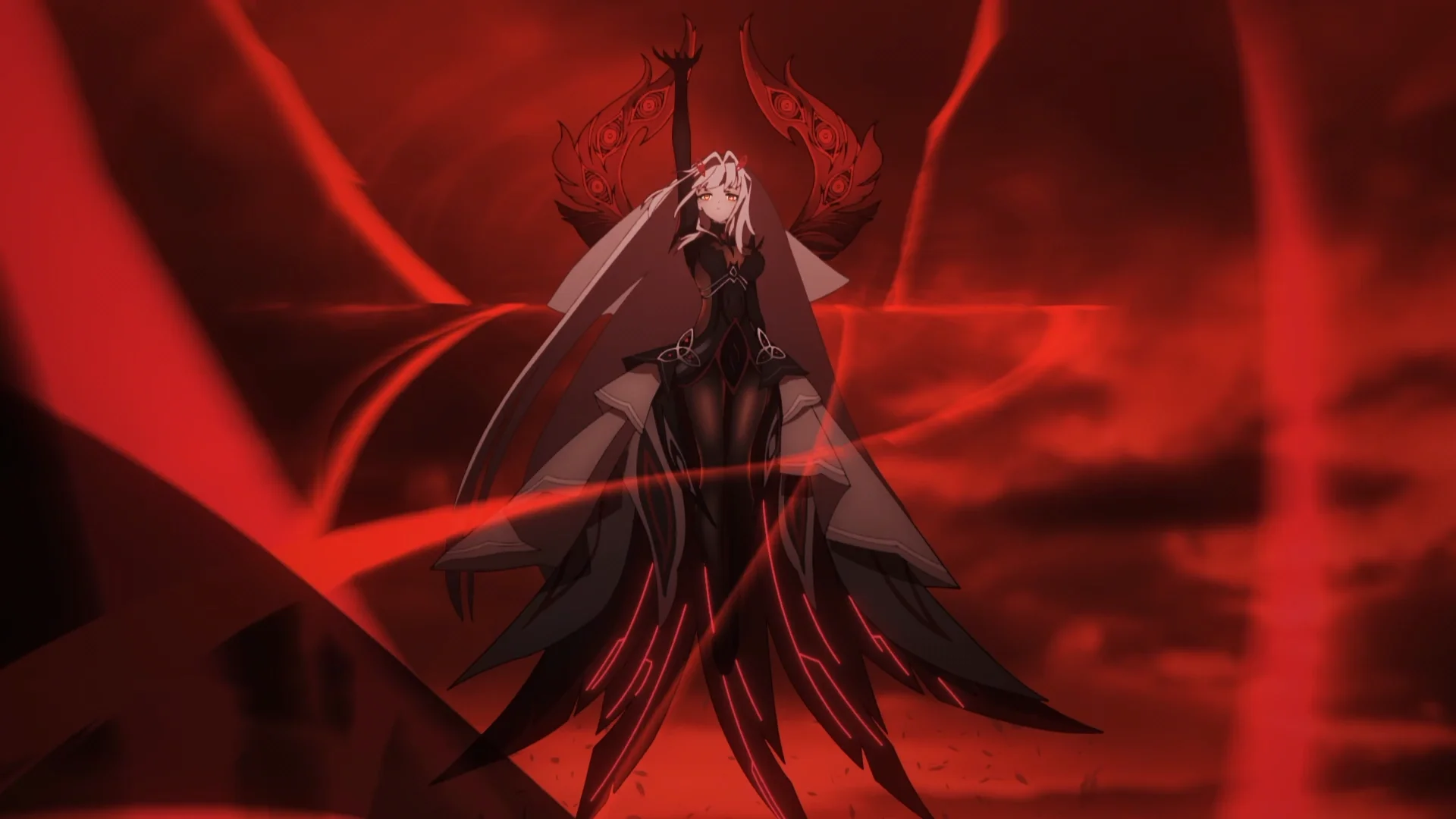
The Authority of Death is the power Ronova wields as the Ruler of Death, one of the Four Shades who govern Teyvat's laws for the Heavenly Principles beside Naberius (Life), Istaroth (Time), and Asmoday (Space). [1] Capitano, who carried one of her curses for five centuries, summed it up: "The Ruler of Death can freely define the form of death, or grant immortality to anyone she desires. Her power is a rule in and of itself." [2] In Chapter VII, Naberius and Pierro both call it "the Authority of Death," and Rhinedottir speaks of an "Authority of Life" beside it. [5]
The work of death
In Act II, still wearing Alyosha's appearance, Ronova separates her work from killing: "murder is when mortals usurp my authority. Death is my jurisdiction." "After the physical body dies, the soul must return to the Ley Lines for that person's 'death' to be considered complete," and her work "encompasses the entire process of death." Descenders fall outside it. Her power "only allows me to temporarily separate your soul from your body," she tells the Traveler, since "The Ley Lines of Teyvat would not accept you." [3]
Natlan's rules
In a sequence set in Mavuika's memories (Chapter V Act IV), Ronova tells Xbalanque, the first Pyro Archon, "The rules are now written into the Night Kingdom." When he asks for more, she warns that "If the wielder of this power cannot conquer their fear, countless innocent lives will be claimed in their stead, for only then can the price be paid," and adds, "Those are the rules." She agrees, but as "merely a Shade" she asks him to "Keep this a secret": if questioned, she will claim "That treacherous Xbalanque stole my power." [6]
Natlan's warriors live under those rules. The Ode of Resurrection "only works on those who bear an Ancient Name," and only after victory, though "All you need is for one person to return victorious." The Night Kingdom "only accepts the souls of Natlan," and Mavuika guesses that "The Ruler of Death likely wanted to prevent the Ode of Resurrection from being abused." [6] [7] [8]
The Lord of the Night, who built the Night Kingdom "under her guidance," calls her help "an expression of love, as well as an act of reparation," and says she "was seen as having significantly overstepped her authorities as a Shade." When Mavuika drew on Ronova's power against the Abyss, Ronova came to collect: "Mavuika, as the price for using my power, I shall now bear witness to your death." [9] [8]
The curse of immortality
Eide, the name Chlothar Alberich goes by, describes the Cataclysm this way: "we pure-blood Khaenri'ahns were declared the 'greater sinners.' Upon us, the gods placed the curse of immortality... But those whose ancestry belonged to the domains of other gods were punished with the curse of the wilderness as they fled, turning them into monsters." The hilichurl beside him is his son, Caribert. Eide credits "the gods" with the first curse and names no one for the second, which the Hilichurls page covers. [10] [11]
The curse of immortality is the one tied to Ronova by name. Capitano bore it "because of her," and said Khaenri'ahns were "cursed to suffer endless physical torment, cursed to witness the demise of everything we held dear. But, most of us were innocent." Dainsleif calls her "the one who inflicted the Curse of Immortality upon me." In Fandom's transcript of the final battle's cinematic, Pierro remembers the casting: "I saw neither pity nor pleasure / In the Ruler of Death's eyes." [12] [5] [13]
Capitano also turned it on her. Offering his life for Mavuika's, he argued that "the curse of immortality would negate the very death you seek," and told her, "Forsake one of your rules — the choice is yours." The cutscene's description gives her choice: "To sustain the curse of immortality, the Ruler of Death relinquishes her demand for the price of 'death.'" Citlali adds that Capitano "granted the Lord of the Night eternal life by fusing his existence with hers." [12] [8]
The Curse of Death
Chapter VII adds a second curse. Ronova tells Mitya and the Traveler they "simply met the criteria to trigger my Curse of Death." Mitya reads it as "blocking" Snezhnaya's technological progress: when "moments of technological progress occur, all life in the vicinity is taken away." Earlier reports of "widespread temporary memory loss" among Armory Palace staff, he decides, were brief deaths. [3]
The Korolevskiy Theater showed its limits. Angels had once altered its Ley Lines in a way that "hindered their ability to accept ordinary souls," and souls that die by the curse and miss "a short window of time" will "remain forever suspended between life and death, no longer subject to the authorities of either." The obstruction also capped how many souls those Ley Lines could take each day. Mitya guesses two; Ronova replies, "That much is obvious, even to a fool." [3]
Act III explains the revivals. In a prism memory, Rhinedottir warns that "To punish humans with death without the Heavenly Principles' approval would be a grave sin in their eyes." Ronova has found a gap: "during this period of slumber, Celestia only monitors our actions periodically. As long as we complete the death and resurrection process in the interval between two monitoring periods, no sin will be incurred." Rhinedottir agrees to do the reviving. [4]
Reclaimed
Act IV closes the gap. While Ronova kills everyone at Rankova Zorya, Rhinedottir is at tea in a hall where the Tsaritsa's amplified Cryo power has slowed time, and "the window of resurrection that Ronova and I agreed upon to bypass the Heavenly Principles' monitoring system" passes unnoticed. Naberius judges that "The Authority of Death has most likely been reclaimed." A directive from Celestia orders Rhinedottir to revive the dead, and she spares her host, citing Celestia's close watch on her and Naberius: "I'd rather not have the Authority of Life reclaimed as well." [5]
Ronova waits for a resurrection that never begins. "They stripped it from me, just like that," she says, then: "Now... I can kill without further consequence." After her defeat, Pierro says Snezhnaya "achieved its goal in the moment that her authority was reclaimed by Celestia." [5]
The Traveler draws a rule from this. The Curse of Immortality "was a permanent curse placed by Ronova under the judgment of the Heavenly Principles back then," while the Curse of Death "was never authorized by the Heavenly Principles," so "when her power was taken back, the curse was undone along with it." That is the Traveler's inference; neither Ronova nor Celestia states it. [5]
Whether Ronova survived is uncertain. Pierro allows that she may have escaped undetected, but "even so, she will have sustained fatal and irreversible damage." Fandom's transcript of the closing cinematic, which is not in the dialogue record, has her emerge "at the point of death" before a Nail of Retribution: "So... This is what death feels like." She infuses the "Eitr" into the Nail as "my parting gift," and the scene does not show what becomes of her. [5] [13]
Death and the Crimson Moon
Act IV also gives the authority an older history. Explaining why a Delusion's exchange of life force for power "comes under the authority of Death," Arlecchino says: "Long ago, the authorities of Life, Death, Time, and Space all belonged to the moons. Of the three, the Iridescent Moon received the greatest share of the authority of Death." After the moons' demise the Heavenly Principles "redistributed them between the Four Shades under a new system of rules," but "the broken Crimson Moon merged with the Abyss, which simulated its former authority," so the authority of Death "resides within the Crimson Moon and its people's bloodline." [5] The passage implies, without stating, that the Crimson Moon is the broken Iridescent Moon; see Three Moons and Crimson-Moon-blooded.
Khaenri'ah's scholars had found the same power. A notebook left by Hroptatyr, "The Wise," one of the Five Sinners, records that "The Crimson Moon does possess an authority related to Death," with which "it's possible to avoid death entirely." He meant it to save his teacher, Professor Mimameith, and named it the "blessing of immortality" before crossing that out for "The Curse of Immortality": "'Immortality' of this kind offers only endless pain and suffering." The name matches Ronova's curse, but Act IV never connects the two. See also Universitas Magistrorum. [5]
The Fatui's new Delusion taps the same source, and at maximum output the prototype drew on "another of the Crimson Moon's authorities besides Death alone." Inside Hroptatyr's prism memory, his younger self asks, "How can you hope to reject death and seize authority over it at the same time?" He sketches a way to "use the remaining authorities of the Crimson Moon as a conductor" in a weapon "that kills its user after a single use," and Pierro answers that "the future me can use it." The Delusions page follows the result. [5] [14]
Still open
- Who holds the Authority of Death now. It was "reclaimed," and no source names a new holder.
- Whether Ronova survived Act IV.
- Whether the Curse of Immortality outlasts her loss of authority. The Traveler thinks so; no later scene shows it.
- Whether Hroptatyr's research has anything to do with the curse Ronova laid.
- How Arlecchino's account fits the older one, in which the Heavenly Principles created the Shades during their first war on Teyvat (see Four Shades).
- Who laid the curse of the wilderness. Eide does not say.