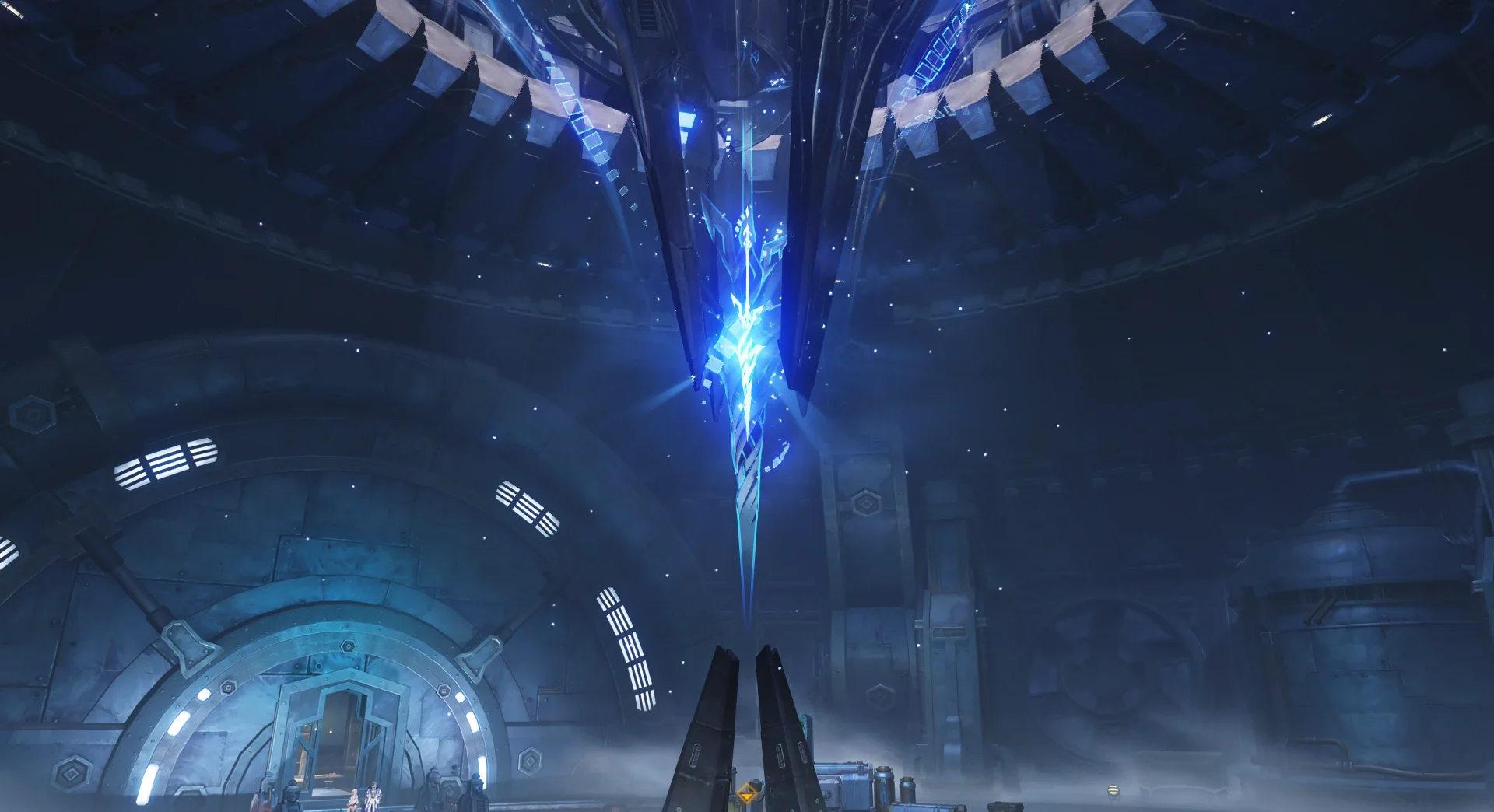
Project Mistilteinn is the weapon the Fatui are building for a confrontation with the Heavenly Principles, who rule Teyvat from Celestia. It is overseen by Pierro, the Jester, and its lab lies deep inside the Armory Palace, the Fatui's weapons and research complex in Glupov, Snezhnograd. Snezhnaya's energy rationing, Project Stuzha, exists to feed it. Pierro also calls it "the Mistilteinn Project." [2] [1] [11] [6] [15]
The name comes from a sword in the Icelandic Hrómundar saga Gripssonar, and the word also means "mistletoe" in Icelandic; the Chinese and Japanese names translate as "Mistletoe Project." [1]
First hints
Columbina heard the word before Chapter VII began. Looking back on her years among the Harbingers, she says "the term 'Mistilteinn' often seemed to come up in connection with Project Stuzha." [3]
In Act I, Mitya, an energy expert transferred from the Energy Commission, lets slip over tea that "The Armory Palace needs a brand-new energy source — not the power of the Light Realm, and not elemental energy," and that "the only thing that meets the requirements is the power contained within Stellar Linchpins." His scarf, which seems to have a mind of its own, chokes him off before he can say what the energy is for. Paimon, who has been ill since entering Snezhnaya, feels a strange power coming "from roughly the same direction as the Armory Palace." [4]
Odette, a Fatuus who had broken into the lab, fills in more in Act II: "The ultimate goal of this energy experiment is to create a weapon for the final battle. The weapon's construction was completed in Nod-Krai. Now, all that remains is to arm it with a sufficiently powerful energy." The development and experiments, she adds, "are overseen by Lord Pierro, 'The Jester,' and the lab is located deep within the Armory Palace." [5]
What Pierro reveals
At the end of Act II, Pierro lays out the structure. "Project Stuzha is a series of measures enacted to consolidate our nation's resources, the greater purpose of which... is to serve Project Mistilteinn." The Fatui's research bureau in Nod-Krai was part of it too: "Researching kuuvahki was merely a facade. Its core objective was to use local resources and research findings to build 'Mistilteinn' itself." When the Traveler calls it a weapon for the final battle against the Heavenly Principles, Pierro does not disagree. [2]
He explains why ordinary power will not do. Kuuvahki, Nod-Krai's moon-linked energy, "alone will not break through Celestia's defenses." The Heavenly Principles are "accustomed to combating the power of the Light Realm," and elemental energy was converted into that form by the Heavenly Principles themselves. So the Fatui "set our sights on the form of energy associated with the Third Descender and the Stellar Linchpins," and by "reverse engineering the Stellar Linchpins to extract the energy within, we have obtained a source of 'anti-Celestia energy.'" That energy is what made Paimon sick: she is, Pierro says, one of Celestia's creations. [2]
Paimon then asks to see the weapon. In Fandom's description of the scene, a large sword-like entity appears at the center of a machine. Pierro says that "While the technology is not yet fully developed, it has nevertheless reached the stage where Celestia's creations are unable to damage it." [2]
Stalled by the Curse of Death
The obstacle is Ronova, the Ruler of Death. Mitya works out the rule in Act II: "What she's doing is 'blocking' Snezhnaya's technological progress, preventing us from possessing any means with which to threaten the Heavenly Principles." Any "ideas, research, or experiments that lead to technological progress can trigger the curse," and when he ran the final-phase experiment early, everyone present died and later came back. He recommends suspending "the experiments and Project Mistilteinn until further notice," and Pierro agrees to "put the project on hold... until the Ruler of Death has been eliminated." [2] [12]
At her court in Act III, the returned Tsaritsa agrees that while the curse lasts, "continuing with this research would be a waste of resources," and sets the order of business: "Before we can face the Heavenly Principles directly, we must first deal with Ronova." Sandrone suggests moving the research to the bureau in Nod-Krai, and Mitya answers, "The curse afflicts us directly. Wherever we go, death will follow us." Back at the Armory Palace, Pierro says the Ruler of Death "has forced us to suspend both our energy research and the Mistilteinn Project." A memory recovered by the palace's giant prism then shows why the dead keep returning: Ronova kills, Rhinedottir, the Ruler of Life, revives them, and the dead must be raised before Celestia's next periodic check. [6] [13]
The Seals of Life
The first counter-plan came from two Harbingers. Pantalone asks whether the Druzhna commander Vesna, who carries a small share of the Ruler of Life's power, could use it "to directly counteract the power of death." Sandrone proposes another route: "What if we could use the Ruler of Life's authority to extract life force from living beings?" Vesna draws out a bubble of life force and names it: "This must be the 'life force' that Sandrone was talking about. I like to call it a 'Seal of Life'." Each seal comes from a cherished memory, and Sandrone warns that if one is damaged, "the memories inside will disappear along with the life force." The Tsaritsa assigns Mitya to help Sandrone research "how it may be used to fight the Ruler of Death. This is now our single most important task." [6]
When word spreads, Pantalone opens collection to the public: "Donation will be obligatory for government officials and nobles. Everyone else, you may visit the Northland Bank to participate in the initiative should you feel so inclined." The seals are to be kept in the bank's "most secure vault," with interest paid on deposits. So the bank can collect without her, Vesna says, "with a little help from Sandrone, I divided my power further to create this beacon." [7] [16]
The collection was also bait. Pantalone warns that gathering seals "on such a grand scale will inevitably alert the Ruler of Life," and the Tsaritsa says she had anticipated as much; he concludes that "collecting the Seals of Life is the ostensible plan, but the Ruler of Life herself will be the key to its success." A creature carrying the Ruler of Life's power raids the bank's vault, Rhinedottir appears, refuses outright to help against Ronova, and agrees to meet the Tsaritsa in seven days. She reclaims Vesna's power and returns the seals, and the next morning "the Veche announced that the Seals of Life had fulfilled their purpose." [8] [13]
Clearing the way
Act IV runs two efforts side by side. Pierro and Arlecchino test a new model of Delusion meant to give the Fatui "a power to rival Ronova's own." Mitya, meanwhile, plans to turn the Korolevskiy Theater into a laboratory, because souls there linger before returning to the Ley Lines: "even if the Curse of Death gets triggered, there's still a chance of completing the experiment in the afterlife." He agrees with Dainsleif that the plan counts on Ronova not leaving it to chance, and Pierro's instructions to the Traveler are to wait during Mitya's equipment delivery "until Ronova appears and kills everyone... then, stall her." [9] [10]
At Zapolyarny Palace, the Tsaritsa keeps Rhinedottir talking while her amplified Cryo power slows time in the hall, so the agreed window for reviving Ronova's victims passes unnoticed. "The Authority of Death has most likely been reclaimed," Naberius concludes, and Ronova, stripped of it, is defeated in the fight that follows. Pierro sums it up: "Snezhnaya achieved its goal in the moment that her authority was reclaimed by Celestia." The Traveler realizes that Ronova had imposed the curse "on her own initiative" without the Heavenly Principles' authorization, so it ended with her authority. [10] [14]
Mitya states the result: "Now that the blockade on Snezhnayan technology has been lifted, Project Mistilteinn can finally move forward." A few days later, "as verified by research staff from the Armory Palace, the restrictions on Project Mistilteinn have also been lifted." [10]
Too slow for the Hallowing
When the Holy Soil phenomenon begins in Act V, the project is the first remedy the council in Snezhnograd weighs. Pantalone asks whether "the plan to kill the one in the high heavens" might turn the tide, and Mitya thinks it might, "at least in principle," because "The Nails of Retribution are creations of the Heavenly Principles, after all." Time is the problem. "Well, without Ronova around to interfere, Project Mistilteinn can now resume," Pantalone says. "The question is... how long will it take?" Mitya's answer: "Testing is already underway, and we've dedicated every available resource to the project. But factoring in time for troubleshooting and final application... we'll need another two months minimum." Pantalone's reply is "...Then we're back to square one." [23] [25]
The council moves on to other remedies (a rumored lifeform that turns Light Realm energy back into elemental energy, destroying the Nail, and finally an appeal to the Hexenzirkel) without giving up on the weapon. Before closing the meeting the Tsaritsa tells Pantalone to "mobilize the Northland Bank's emergency energy reserves — testing must proceed at maximum pace," a task he and Pulcinella are to see to personally. [23]
In Act VI the Armory Palace's research is still under way, though the act never names the project. Paimon wishes that "the Tsaritsa's weapon were ready, then we could all stop worrying about the Hallowing." Mitya admits that "Our research isn't progressing fast enough. Passing the trials is still looking like our best bet at this stage," but he has "cried for help so loudly that I expect all of Teyvat heard me," and "the smartest helpers around" are on their way. Valeriy says his own job is "to ensure the project proceeds smoothly." The fae lord Noy shares "a substantial amount of ancient technology and information" with Mitya, with "no particular overlap with the Armory Palace's current energy project" by Valeriy's account, and judges that "this research project stands, undoubtedly, to become the most significant of its generation." [24] [26]
Stellar Linchpins and the Stellar Glimmer reactions
The Third Descender's power also shows up in ordinary combat. The official Version 7.0 Special Program says the Third Descender, arriving in ancient Snezhnaya, brought a power that surmounts Teyvat's rules and can turn the world's Elemental Reactions into new ones. [17] Fandom groups the two named results as the Stellar Glimmer reactions. In Stellar-Conduct, Cryo meets Electro and leaves a Starlight Prism that sustains a Polestar Field; in Stellar Swirl, added in Version 7.0, Anemo meets Cryo and forms a Stellar Vortex that explodes for Cryo damage after a delay. [18] [19] [20] Like the Lunar Reactions of Nod-Krai, they need an enabling character in the party, but no released text gives the two families a shared source, and nothing ties Stellar Glimmer to kuuvahki or the Three Moons.
The reactions and the weapon share a Third Descender and Linchpin context, and the sources say no more than that. Pierro ties energy extracted from Stellar Linchpins to anti-Celestia research; neither he nor the Special Program says that Stellar Glimmer damage is itself anti-Celestia energy. [2] [17] How individual Linchpins arise is open as well. Sandrone's profile says her Linchpin activated Alain Guillotin's inheritance and gave her a second life, and in Sunny Summer Fontinalia Fatui researchers believe a Linchpin's manifestation resolves impurities tied to the Third Descender's remains, which the dialogue presents as a working theory rather than a manufacturing history. [21] [22]
Still unexplained
Chapter VII never shows what Mistilteinn does or how it would be used against the Heavenly Principles. Act V gives the only timeline, "another two months minimum," and Act VI does not say whether the Armory Palace's energy research is the same project or how far it has come. The chapter does not say whether the Seals of Life research produced anything, or whether Project Stuzha's rationing will return to power the next phase; in Act V the Tsaritsa turns to the Northland Bank's emergency reserves instead. Ronova's fate is also open: Pierro says that unless she escaped undetected, "she will have sustained fatal and irreversible damage," and in Act V his view, passed on by Pantalone, is that she "is almost certainly dead by this point." [10] [15] [23] [24]