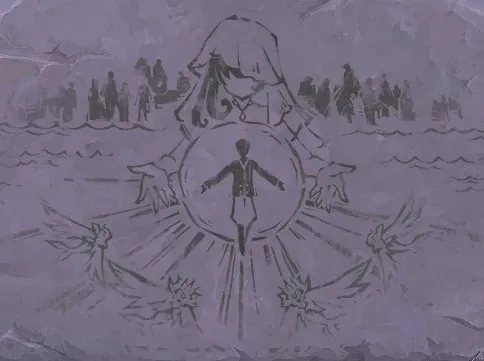
Fontaine, as the player meets it during the Archon Quest, is a place of opera-trial spectacle, the Oratrice, and a Hydro Archon (Focalors / Furina) who is not what she appears to be. The clean reading treats Focalors as Fontaine's Archon and the destruction of the Hydro Throne in AQ IV Act V as the end of her arc. Both halves of that are true. Both also hide the figure the whole arrangement actually rests on.
That figure is Egeria, the first Hydro Archon. She is not counted among the Sovereigns: Fandom's Seven Sovereigns table lists the original Hydro Dragon as "Unknown," "Succeeded by Neuvillette," and calls her creation "an exception," a replacement "heart" for the Primordial Sea. [26] Primary text treats her, not Focalors, as the one who made Fontainan humans what they are, drafted the laws Fontaine still runs on, founded the institutions Focalors's regime later inherited, and bequeathed the Hydro Authority that did not return to a Sovereign's body until five centuries after her death. Her work is what the present Fontainan order stands on.
A new heart for the Primordial Sea, engineered by a Shade
Egeria's origin predates the Archons. Per Hymns of the Far North Vol. 1, after the Hydro Dragon was removed from his position as the "heart" of the Primordial Sea, Naberius, one of the Four Shades and the Shade of Life now fused with Rhinedottir, created Egeria as the Primordial Sea's new heart. Despite the Heavenly Principles' alien origins, her substance and essence were formed entirely from material originating in Teyvat, and at the time no divine duty had been assigned to her. [2] [1] [27]
Egeria was not a god installed from outside the system; she was engineered from inside it, from the same Teyvat material as the beings she would later create from her own waters. Her later titles (Mistress of Many Waters, Sovereign of the Waters, Ruler of Rivers and Seas, Queen of All Waters, Mother Goddess) are titles of rule over water, not a seat among the dragon Sovereigns. The Gnosis and her ascension as Hydro Archon grafted an Archon's authority onto a being already cosmological in origin. [4] [3] [5]
The Oceanid lineage and the act Celestia named a sin
A legend preserved in the Ancient Natural History Excerpts at the Institute of Natural Philosophy says the first Oceanid was born after Egeria shed the "first tear," and all the others came from it. [1] [30] In Life Flows On (II), the last part of the Wishful Drops event quest, the Oceanid scout Endora says her kind "once spread far and wide to rivers, streams, and ponds all over the continent" and "largely served as Fontaine's spies," but that the previous Archon "had no plan to speak of. She merely wished to connect everyone in the world, in much the same way as all water is connected." Endora calls Rhodeia of Loch "the most renowned of us Lochfolk scouts, and also the strongest." [31]
Some Oceanid followers eventually wanted to live on the surface, envying human life, and Egeria fulfilled the request herself. How she did it is the primary-text origin of present-day Fontainan humans. In Masquerade of the Guilty, Neuvillette describes it: "She poured Primordial Seawater into the Oceanids' blood vessels, creating humanoid mimics in the process." [8]
This is the act that "partitioned Fontaine." The Fontainan human population is a humanoid version of her own Oceanid followers, carrying Primordial Sea water in place of ordinary blood and made by her personally, rather than an existing humanity she laid an Archon order over. The present-day effect of Fontainans dissolving into water, in force until AQ IV Act V, is what that engineering reverts to under cosmological stress.
Celestia did not approve. In the quest Neuvillette says that "the Hydro Archon never received permission from the Heavenly Principles to create a new "human" race," and that "the Hydro Archon and all of her creations came to shoulder the original sin of "appropriating the power of the Primordial Sea."" [8] Fandom's Egeria page goes further: Celestia "deemed it a sin and sentenced her to be sealed for her crimes, claiming that a prophecy would come to dissolve the people of Fontaine in order to wash their sins away." No line in Masquerade of the Guilty says she was sentenced or sealed; her return "from her primeval prison" comes from the artifact text below. [1] The prophecy that Fontaine's people will dissolve begins here, with Celestia's verdict on this sin, not with Focalors. In When All Return to the Waters it is still going around Fontaine. Neuvillette passes on a rumor rather than his own speculation: "Rumors have it that this prophecy is rooted in the last words the former Hydro Archon left to the world before she passed away," and "If the rumors were true, then perhaps this prophecy is the "conundrum" left to Furina by her predecessor." [10]
Return from the primeval prison, and Egerian law
Next came Egeria's return. Per the artifact Ancient Sea's Nocturnal Musing, after Remuria was destroyed by conflicts and rebellions, Celestia commanded Egeria to return from her primeval prison to take over Remus's position. [6] She gathered the survivors, mediated their feuds, and instructed them to build new cities around flowing springs, commencing an era guided by law which has endured to the present day. The Gnosis followed, and Archon status as one of The Seven. [1] [7]
The post-Remuria timing is reinforced in the Fontaine World Quest chapter Canticles of Harmony (Version 4.6). Per the Remuria record there, drawn from The History of the Decline and Fall of Remuria, "the survivors turned to 'barbarism and annihilation' until the Hydro Archon Egeria appeared and settled the conflicts between the remaining Remurians and the Fontainian tribes, taking over as Fontaine's God." That fixes Egeria's rise to Hydro Archon as a post-Remuria event, with Remus (the Remurian emperor and god-king, not a Hydro Archon) as the ruler before her in Fontaine, and Focalors's role as Archon coming strictly after both. [29]
The Egerian legal era anchors present-day Fontainan jurisprudence, the era guided by law the Iudex office still inherits. It may also include the law the Sigewinne Story Quest brought out in primary text, an ancient Fontainan prohibition against changing species to human form. At the close of the Nereides Chapter, at Sigewinne's teacher's empty tomb, Neuvillette dates the law only to "Long before I became Iudex" and says, "But now, it seems more likely that the law was nothing more than an insurance policy," a way for Egeria to keep her people "insulated from the truth." Tying the law to Egeria, and that motive, is his present reading. [12] [22] [32]
The two fit together. Egeria made the Fontainan humans from her own Oceanid followers, an act of water engineering that Celestia named a sin. If Neuvillette's reading is right, the prohibition is the legal cover for that secret, since any further change of species into human form would risk exposing the Oceanid origin of the original Fontainan humans. Its only on-screen enforcement is the Sigewinne case: her change from melusine to human by potion, her sentence to the Fortress of Meropide, and her decision to remain in human form after release. [12] [21]
Meropide as Egerian institution
The Fortress of Meropide is the same kind of artefact, a present-day institution whose current role (Wriothesley's prison for the convicted) has overgrown its Egerian foundation. Per AQ IV Act IV Part 3 Secret Keepers and Forbidden Zones, Egeria exiled criminals from her nation; some begged forgiveness; she granted them redemption by ordering them to guard her secret beneath the waves. The Fortress was built as their living place, its main purpose to stop the path leading to the Primordial Sea, though this was eventually forgotten over time. [9] [1]
Two of Egeria's acts therefore follow from her turning Oceanids into Fontainan humans, the first on Neuvillette's reading. The species-change law keeps the truth of that origin from the surface; the Meropide foundation keeps anyone from walking the path back to the Primordial Sea. Both predate Focalors's regime. The Fortress still stands under the order Neuvillette inherited after AQ IV Act V; whether the law is still in force is not stated.
Focalors as successor-substitute
Set against this foundation, Focalors's position is unusually flat. In Masquerade of the Guilty she says the prophecy was "thrust upon me by my dearest predecessor," Egeria, and that "as one of The Seven, she also knew full well that... one defies the Heavenly Principles at one's peril." Of the succession itself she says only, "I can only assume that's why Egeria chose me as her successor," and that she did not choose it "any more than I chose to be one of her Oceanid familiars." [8] The motive is Fandom's reading: Egeria "assigned Focalors, one of her Oceanid followers, to be her successor, hoping that she would be able to concoct a plan to deceive Celestia." [1]
That is the frame for the whole 500-year arc of Focalors and Furina. Focalors was not Egeria's peer; she was one of the Oceanid followers, installed as a substitute Hydro Archon, and her answer to Celestia's prophecy of dissolution was sleight of hand on an Archon's scale. The Oratrice, the arrangement that made Furina a mortal vessel, and the 500-year trial are what she built for it. AQ IV Act V is what happens when that plan finally plays out: the Hydro Throne is destroyed, Focalors's deception over the prophecy resolves, and the Authority held in the Archon's seat returns where it was always meant to be, to a Sovereign's body.
Death at Tunigi Hollow, and the Amrita anchor
Egeria did not live to see any of it. Per the Vibrant Pinion primary text, five hundred years ago, during the Cataclysm, Egeria was among several gods who went to Tunigi Hollow to fight the forces of the Abyss spewing from the rift there. She was slain, and her body became the pure dew of the Amrita. Greater Lord Rukkhadevata grew the Harvisptokhm from the Amrita to anchor Egeria's consciousness in the Gaokerena lotus within. [7] The Oceanids, who refused to recognise Focalors as the new Hydro Archon, eventually made pilgrimage to the Harvisptokhm in search of their former god, then dispersed back across Teyvat to continue Egeria's command in exile per Pale Fire. [11]
Wider community readings sometimes attach the Sustainer of Heavenly Principles directly to Egeria's death (the Sustainer being Asmoday, the Shade of Space). Primary text does not assert that; the disclosure names the forces of the Abyss rather than a Shade as her killer. The reading stays open.
The return of Egerian Authority through Neuvillette
What follows, the return of the Authority, is the part canon spells out most cleanly. Neuvillette is not Egeria's child: shown her image on the slate, he says, "Egeria, then... I had never met her, but her appearance here does match the records." AQ IV Act V is the moment the Authority comes back: Focalors says her plan "was all done to return the authority of the Hydro Archon to the Hydro Dragon of this planet," Neuvillette's full power as the Hydro Sovereign is restored, the effect of Fontainans dissolving into water is abolished, and the Authority Egeria bequeathed to a Sovereign's body finally returns to one. [8] [20] Welkin Moon Act IX is the first confirmation from a fellow Sovereign: Apep says at the Heart of Oasis that she can sense "the Hydro Dragon has wrested his authority from the hands of the usurpers," and adds, "Though we have yet to meet, I know that we are both preparing for our revenge day and night." She names only "the Hydro Dragon," never Neuvillette. That opens the arc in which the dragons reclaim their Authority. [14] [25]
Two artefacts tied to Egeria carry forward through this transition. The first is the species-change prohibition, which Neuvillette ties to her. The Sigewinne case is told after AQ IV Act V, at her teacher's empty tomb, but there he speaks of the law in the past tense ("there was an ancient law"), so whether it still binds anyone is not stated. [32] And the melusines, born from Elynas's wounds roughly 400 years ago per Ancient Colors WQ Act III and discovered and championed into Fontainian citizenship by Neuvillette, became a successor species in the Sovereign line under his recognition per Character Story 3, "a new sort of Hydro Vishap species." The post-Vautrin she/her-pronoun law and the harsh punishments for treating melusines as monsters, won through Carole's sacrifice and the Vautrin trial in the Diluvies Chapter, form the species-protection layer above that older prohibition. [13] [18] [24]
The Pahsiv worked example: Vishap, Sovereign, Melusine
The continuum of Hydro beings beneath present-day Fontainan cosmology is the clearest demonstration that Egeria's reach as a maker of beings extends past the Fontainan humans she made from Oceanids. Per The Byakuyakoku Collection Vol. 4 and the Bolteater Bathysmal Vishap Archive description, the Bathysmal Vishaps of Enkanomiya were the pure-Hydro stock from which a new Hydro Sovereign should have been born once the previous Sovereigns' power faded. The Vishaps broke that lineage by deliberately selecting for genetic traits, diversifying into Rimebiter (Cryo) and Bolteater (Electro) strains alongside the pure-Hydro Primordial strain, and so forced the fallback the Enkanomiyan prophecy foretold, a rebirth in human form: "the new Dragon of Water will definitely descend in the form of a human." Neuvillette is that prophecy fulfilled. [15] [16] [19]
Pahsiv, a unique Primordial Bathysmal Vishap living in Erinnyes Forest, completes the continuum by changing form. She can take Melusine form at will, keeping her vertical, Vishap-style pupils across the shift. [17] [18] The Bolteater Archive from after AQ IV Act V shows the same continuity in how the races recognise one another: "Though the Dragons of Water that have returned to their complete form still see them as one of their own, they are closer to another race." The Melusines are the most defensible reading of the "another race" the Archive does not name. [16]
Egeria sits at the centre of the continuum. The pure-Hydro line of Bathysmal Vishaps was the stock from which the next Hydro Sovereign should have been reborn; the Oceanids she instituted from the Primordial Sea were her extension into Fontaine; the Melusines Neuvillette later championed are the post-Cataclysm successors through which the Vishap continuum now reads. Pahsiv's shapeshift shows that these are not fixed categories. The Primordial Bathysmal Vishap, the Melusine, the Hydro Sovereign in human form, and the Fontainan humans made from Oceanids all read as different expressions of the same Hydro dragon-kin stock.
What we know
- Naberius created Egeria as the new heart of the Primordial Sea after the Hydro Dragon was removed; her substance was formed entirely from material of Teyvat. [2]
- Egeria created the original Fontainan human population by pouring Primordial Seawater into the blood vessels of her Oceanid followers, the act that "partitioned Fontaine." [8]
- The act became the "original sin" she and her creations shoulder, since she "never received permission from the Heavenly Principles"; Fandom adds that Celestia sentenced her to be sealed, which the quest does not say. The Fontainan-dissolution prophecy originates here, not with Focalors. [8] [1] [10]
- She returned from her primeval prison at Celestia's command after Remuria's fall, was awarded a Gnosis, and ascended as Hydro Archon. [6] [7]
- Neuvillette now thinks the ancient prohibition against changing another species into a human was most likely hers, "an insurance policy" to keep her people "insulated from the truth" (Sigewinne's Nereides Chapter). [12] [32]
- She founded the Fortress of Meropide to stop the path to the Primordial Sea; its secret purpose was eventually forgotten. [9]
- She chose Focalors, one of her Oceanid familiars, as her successor and left her the prophecy; deceiving the Heavenly Principles was Focalors's plan, and Fandom reads it as the purpose of the appointment. [8] [1]
- She died at Tunigi Hollow during the Cataclysm fighting the Abyss; her body became the Amrita; Rukkhadevata anchored her consciousness in the Harvisptokhm. [7]
- Neuvillette is not her child; he says of Egeria, "I had never met her." AQ IV Act V returned "the authority of the Hydro Archon to the Hydro Dragon of this planet," and in Welkin Moon Act IX Apep senses that "the Hydro Dragon has wrested his authority from the hands of the usurpers." [8] [14]
- The reforms Neuvillette led after Vautrin (the she/her-pronoun law and harsh punishments for treating melusines as monsters) form the species-protection layer above the older species-change prohibition that Neuvillette ties to Egeria. [13] [18]
What we don't know
- What "truth" the prohibition kept Fontaine's people "insulated from," if Neuvillette is right. The likeliest referent is the turning of Oceanids into humanoid forms, though no line in the Nereides Chapter makes that link; whether the secret has further layers is not on screen.
- Whether the Sustainer of Heavenly Principles was directly responsible for Egeria's death at Tunigi Hollow. Primary text names the Abyss as the immediate combatant; the reading of the Sustainer as the Archon's killer comes from the community and is not grounded in canon.
- Whether the species-change prohibition operates symmetrically in both directions. The Sigewinne case is the only on-screen enforcement; whether human-to-melusine change is similarly prohibited is not addressed.
- What Egeria's "last words" actually were. The Fontainan-dissolution prophecy is rooted in them, per a rumor Neuvillette repeats, but their full text has not been disclosed.
The casual version: the Hydro Archon who matters most for Fontaine's cosmological foundations is not the one whose execution you watched at the end of Act V. It is the one who made the Fontainan people what they are, drafted the law that conceals what they are, founded the Fortress designed to keep them from finding out, and bequeathed an Authority that finally returned to a Sovereign's body in the same act that ended her successor's career.
Related
The melusines have their own race page, as do the Bathysmal Vishaps whose pure-Hydro line was broken by deliberate Cryo and Electro diversification. See also Neuvillette, the Hydro Dragon whose Authority returned in AQ IV Act V; Sigewinne, the melusine whose human form Fandom calls an exception; the melusine glossary entry; the Seven Sovereigns throne roster; the Four Shades, among them Naberius who created Egeria; and Fontaine itself.