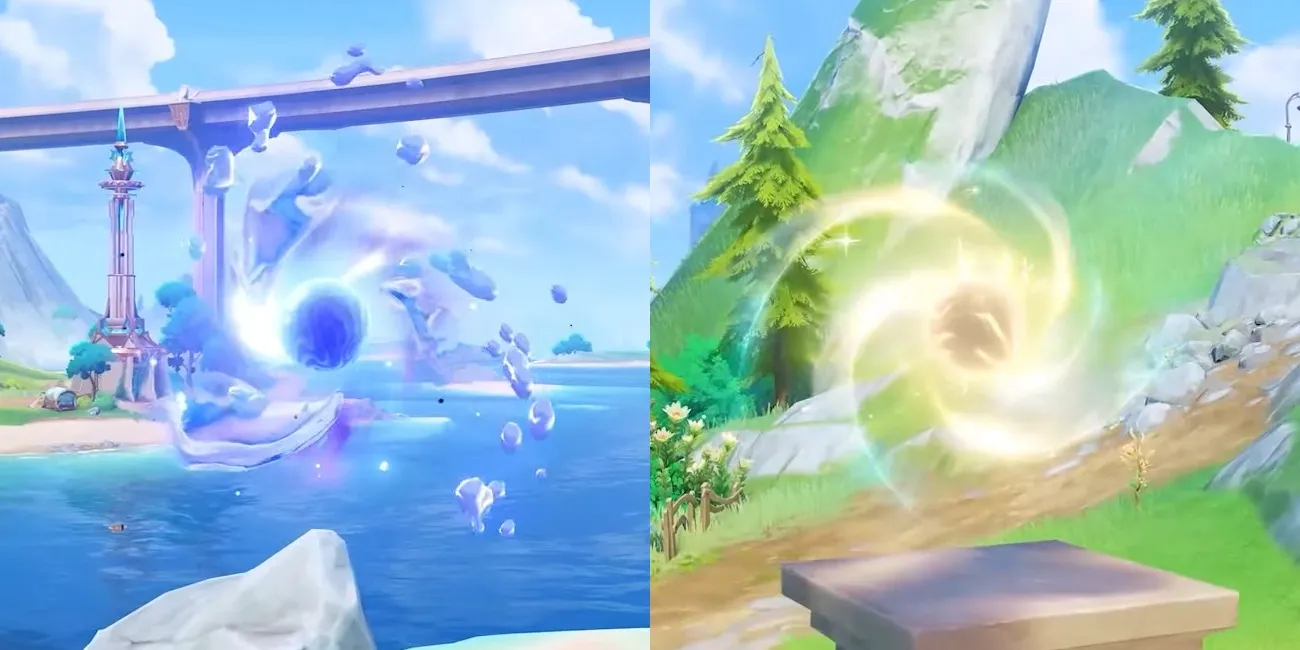
Arkhe is the dual-energy system of Fontaine. Every life-form, every clockwork meka, and every measurable bit of the region's earth, air, and watery veins carries one of two opposing properties, Pneuma or Ousia. When the two meet, an Annihilation reaction fires and releases more energy than either carried alone. The region's machine civilisation runs on it, and it is the reason the Fontainian Vision's geometry looks the way it does. [2] [1]
In its own words, the dualism is what powers many clockwork meka. The Tutorial Pneuma, Ousia, and Their Mutual Annihilation locates the properties geographically, in the life-forms, earth, air, and watery veins of Fontaine, and describes the power supplies of clockwork meka as unstable: they settle into one of the two states and can be overloaded by a hit of the opposite. [2]
The two halves
Half | Greek root | Gloss | Vision-shape | Follow-up attack |
|---|---|---|---|---|
Pneuma | πνεῦμα | breath; spirit; soul | Spiritbreath Thorn shape | Spiritbreath Thorn (pierces) |
Ousia | οὐσία | essence; substance | Surging Blade shape | Surging Blade (descends) |
The etymology points to the matter / antimatter analogy outright: when the two meet they mutually annihilate, releasing energy proportionate to what was destroyed. [1] Arkhe itself (ἀρχή) is the Ancient Greek term for the beginning, origin, or first principle of the world, the cosmological flavour the naming evokes. [3] [4]
The two halves are symmetric in mechanism but asymmetric in what they encode. Pneuma is the breath-and-spirit half: light-glow visuals, downward-piercing attacks, an ascending feel. Ousia is the essence-and-substance half: dark-engulf visuals, descending blade attacks, a settling feel. Neither is higher than the other.
Annihilation, Pneumousia Blocks, and Pneumousia Relays
In the world, the dualism shows up most often as Pneumousia Relays that must be brought into a Balanced (green-light) state. A relay is the Annihilation reaction turned into civil engineering: one sitting in an Ousia-aligned state must be hit with a Pneuma energy block (and vice versa) to flip into balance, and only a balanced relay opens whatever seal it gates. [5]
The Outlander first meets the mechanic in the Fontaine 4.0 starter World Quest Aqueous Tidemarks, given by Virgil at the Court of Fontaine Statue of the Seven. That chain opens onto the wq-questioning-melusine-and-answering-machine Marechaussee Phantom case study and is where the Pneumousia mechanic gets introduced on first arrival in Fontaine. [5]
The same Annihilation reaction powers (and disables) Fontaine's Clockwork Meka. Per the Tutorial, the power supply of these meka is unstable, resulting in Pneuma or Ousia-aligned energy states; attacks with the opposite alignment can be used to overload and disable their power supplies. [2] By the same mechanic, Pneuma- and Ousia-aligned Breacher Primuses are stunned in their stressed state by a hit of the opposite alignment. [1]
Innate Arkhe and the Fontainian Vision
The Vision's geometry discloses its bearer's innate Arkhe. Pneuma-aligned Fontainians carry the Spiritbreath Thorn basic Vision shape; Ousia-aligned Fontainians carry the Surging Blade shape. [3] [4]
At certain intervals, after one of a Fontainian's combat talents fires, the innate Arkhe releases a follow-up: a Spiritbreath Thorn that pierces (Pneuma) or a Surging Blade that descends (Ousia). These follow-ups carry the character's element but do not apply elemental effects. The alignment runs parallel to the elemental Vision system rather than replacing it. [1]
The known Fontainian roster splits as follows. Pneuma: Lyney (Pyro), Charlotte (Cryo), Emilie (Dendro), Neuvillette (Hydro), Freminet (Cryo), and the Hydro Traveler. Ousia: Lynette (Anemo), Navia (Geo), Wriothesley (Cryo), Clorinde (Electro), Sigewinne (Hydro), Chevreuse (Pyro), Escoffier (Cryo). [1]
Furina is the exception among the Archons. Her Vision carries Seats Sacred and Secular, the only case among the Seven Archons that is both Pneuma and Ousia. Her Charged Attack toggles her current alignment mid-fight, and her Spiritbreath Thorn or Surging Blade follow-up alternates with it. The starting state is Ousia. [18] [1]
Underwater: the water carries it deeper
Underwater in Fontaine, the infusion mechanic changes. Most Fontainian characters' attacks default to their innate Arkhe underwater without needing Pneumousia Blocks at all, per the Tutorial Underwater Pneumousia Energies. [1]
Here the Tutorial's geographic framing is at its strongest. The properties are in the life-forms, earth, air, and watery veins of Fontaine, but the watery veins carry the property at a higher density than surface air or earth. The density is high enough that the engineering used on the surface (Pneumousia Blocks, Relays, infused-block attacks) becomes redundant once a Fontainian dives. Fontaine sits over the Primordial Sea, the wellspring most life in Teyvat first originated from, and the underwater Arkhe density reflects that. [6]
How Arkhe fits Fontaine's origins
The Arkhe dualism does not stand alone. It sits inside Fontaine's larger story of origin and prophecy, which is anchored on the Primordial Sea and the Hydro Sovereign throne.
According to the Egeria deep-dive and the Primordial Sea record, Naberius created Egeria as the Sea's new heart after the Hydro Dragon was removed from that role, and Egeria later became the first Hydro Archon. Egeria took water from the Primordial Sea and inserted it into her Oceanid followers' blood vessels to give them humanoid forms on land. The Heavenly Principles judged the act Original Sin and decreed the Fontainian dissolution prophecy: one day the water level would rise and dissolve the people of Fontaine to wash away that sin. [6] [13]
The prophecy resolves at AQ IV Act V, and the Fontaine region page and the Apocalypse Part 4 and Finale primary text give the sequence. The All-Devouring Narwhal emerges in the Opera Epiclese to consume Fontainians, because they have Primordial Seawater for blood. Focalors executes herself to fulfil the Heavenly Principles' demand, which restores Neuvillette's Hydro Sovereign Authority. Neuvillette declares the Fontainians' sin absolved, turning their false-blood bodies into true human bodies. The Sea engulfs the Court but no longer dissolves the people. [9] [17]
The Arkhe dualism is the background of that whole story. The Pneumousia property that the Tutorial card locates in the life-forms, earth, air, and watery veins of Fontaine runs through the post-Egeria world the dissolution prophecy operated on. It stays in place after Neuvillette's Authority is restored. The Sword of Narzissenkreuz, the Pneumousia Relays, the innate-Arkhe Visions, and the default Arkhe infusion underwater all persist into Fontaine after AQ IV Act V. [2]
Melusines: not Egeria-derived, and the Marechaussee Phantom pairing
The Melusine lineage is not a by-product of Egeria's Oceanid-to-human chain. Per the Melusine record and the Melusines race page, the Melusines were born from the wounds of the great beast Elynas during the battle between the Marechaussee Hunter and the Narzissenkreuz Ordo roughly 400 years ago. In that battle someone triggered an explosion that drove clockwork meka components through Elynas's body, and the Melusines were eventually born from these wounds. [7] Egeria's Oceanid-to-human form-change concerns Fontainian humans, not the Melusines. The two origins run parallel in Fontaine, not in sequence.
That parallelism matters here because the Marechaussee Phantom, Fontaine's special detective force, is mostly composed of Melusines. Their senses of perception exceed ordinary human limits, which makes them unusually suited to investigation. [8] [11] Read against the Tutorial card, which locates Pneumousia properties in life-forms, earth, air, and watery veins, Melusine perception turns the Arkhe property into routine evidence work: reading Pneumousia traces, telling Pneuma glow from Ousia glow, and triangulating Annihilation reactions. The contemporary case study Questioning Melusine and Answering Machine shows the pairing at work. Melusine investigator Talochard drives the perception side of the casework, and the Mek Curve gives technical help. [22]
On the Vision side, the case study is Sigewinne. Fandom counts her as an exception among melusines, with a "special body" that makes her physiologically similar to a human. [7] To save a sick human friend she took a potion her human teacher gave her, breaking an ancient law against transforming another species into a human, which Neuvillette now thinks most likely served Egeria; she served a sentence in the Fortress of Meropide for it and stayed afterwards as head nurse. [24] Her Vision is Ousia-aligned (a Surging Blade follow-up on her Bolstering Bubblebalm Elemental Skill). Her character story has it turn up among thank-you gifts after an inmate's funeral, "as if the gods themselves had seen all her deeds"; no source read says whether any other melusine holds a Vision, or ties hers to her human form. [20] [13] [25]
The Narzissenkreuz Ordo and Arkhe
The Narzissenkreuz Ordo was a secret society in Fontaine, founded over 400 years ago by Rene de Petrichor and Jakob Ingold of the disbanded Narzissenkreuz Institute. Rene gathered followers from the Institute of Natural Philosophy, and the Ordo made its headquarters at the Tower of Ipsissimus. [23] [12] Their plan for surviving the prophesied destruction of Teyvat was to merge the wills of countless people into one transcendental being, much like a Descender. [12] The Ordo's tie to Arkhe is a theory. This wiki reads its research as an early form of the Pneuma-Ousia framework, four centuries before the modern Court of Fontaine codified the mechanic; the link rests on synthesis rather than in-game text.
The Sword of Narzissenkreuz was a ceremonial sword the Ordo used in a ritual to separate the mind from the body. As a weapon, its Hero's Blade passive supplies an Arkhe when the equipping character does not have one: Normal, Charged, or Plunging Attacks release a Pneuma or Ousia energy blast (type determined by the sword's current state) once every 12 seconds. [10] It is the only attested cross-form Arkhe artefact among weapons. It lets a non-Fontainian wielder trigger Annihilation reactions on Pneumousia-aligned targets without first acquiring a regional alignment. Reading the sword as the Ordo's Arkhe research in weapon form is part of the same theory. Its lore describes the mind-and-body ritual and does not mention Pneuma or Ousia.
The Marechaussee Phantom has its own ties to the Ordo's history. After the Narzissenkreuz Institute disbanded, once its Director and Vice Director went missing during the cataclysm, the Phantom recruited some of its members, including Alain Guillotin and Mary-Ann Guillotin. The Ordo's founders came from the same disbanded Institute. Years later the Court of Fontaine had the Phantom investigate the Ordo, which culminated in a fierce battle at Elynas, the battle that also produced the Melusines. [8] [23] [11] Whether the present-day Phantom's work draws on any Ordo research is part of the same theory, and no source says it does.
Etymology and the Heavenly Principles' vocabulary
The naming draws on the same Greco-Roman cosmological vein as the Heavenly Principles' highly technical vocabulary across Teyvat. Arkhe (ἀρχή), Pneuma (πνεῦμα), and Ousia (οὐσία) are all Ancient Greek philosophical concepts, alongside Phanes (the name of the Heavenly Principles), Celestia, cataclysm, and the wider Fontainan vocabulary (Egeria = Roman nymph; Focalors = Goetic demon; Iudex = Latin for judge; Marechaussee = French for gendarme). [1]
This is a pattern of vocabulary, not ontology. Highly technical cosmological terms skew Greco-Roman across Teyvat, which points either to the Heavenly Principles' aesthetic preference or to a pre-Phanes religious order's vocabulary surviving in what the Court of Fontaine inherited. The Arkhe dualism belongs to that vocabulary.
What this concept is not
- It is not an elemental energy. Pneuma and Ousia attacks do not apply elemental reactions. The Arkhe alignment runs parallel to the elemental Vision system, not in place of it. [1]
- It is not the Vision-distribution mechanism. Visions are granted by Celestia via the Statues of the Seven. The Arkhe alignment is disclosed by the Vision's design but is a property of the Fontainian themselves, not of the distribution system. [1]
- It is not the Primordial Sea's substance. The Primordial Sea is the medium and origin most Teyvat life arose from; the Arkhe dualism is a property found in Fontainan life-forms, earth, air, and watery veins, not the Sea's substance itself. The two are continuous but distinct. [6] [2]
- It is not derivable from Egeria's creation work. Egeria gave Oceanids human form using Primordial Seawater as a blood substitute, and that chain produced Fontainian humans. Melusines were born from Elynas's wounds, not derived from Egeria. Neither chain creates the Arkhe dualism; the Pneumousia property pre-exists both. [7] [13]
- It is not any of the three things called the Loom of Fate. The Arkhe mechanic is a regional Fontainan dualism. It is not the Abyss Order's constructed device (the Sibling's project), not the pre-Cataclysm Khaenri'ahn concept of cosmological engineering, and not the speculative reading of the Loom as the Heavenly Principles' operating system. [16]
Deep dive
Fontaine's wider region is mapped at Fontaine. Neuvillette's place as the Hydro Sovereign is covered at Seven Sovereigns, and Egeria, the first Hydro Archon, at the Egeria deep-dive. The Melusine-led institution that the Arkhe property supports is the Marechaussee Phantom. The Narzissenkreuz Ordo, whose tie to Arkhe remains a theory, is covered at Narzissenkreuz Ordo and in the Ann of the Narzissenkreuz quest chain. The dissolution prophecy that the dualism pervades, and the authority that decreed it, sit with the Heavenly Principles.