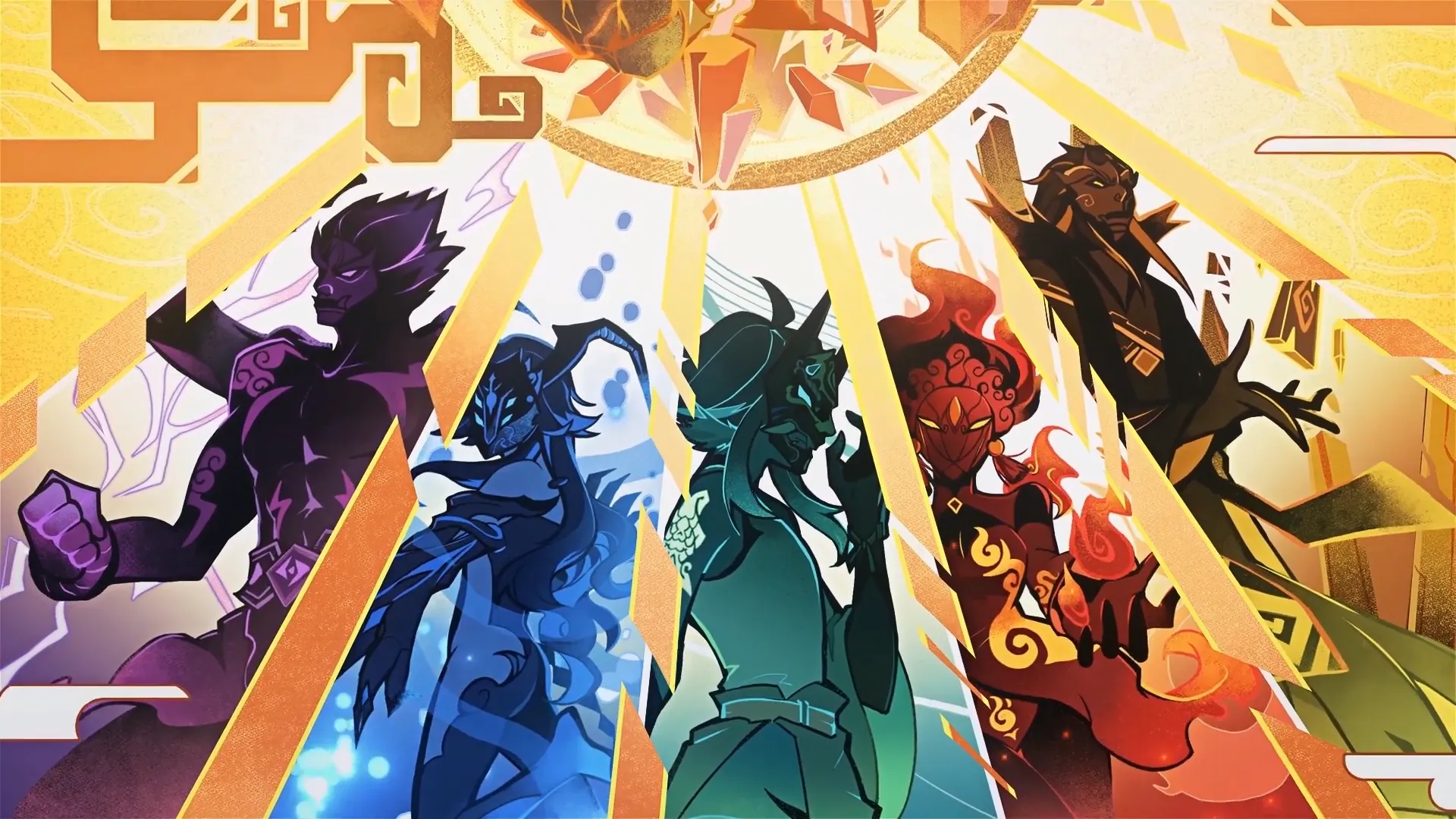
The Yakshas are a martial branch of Liyue's Adepti, not Sovereigns. They differ from the Sovereigns in group, in era and in origin. It is one of the distinctions the wiki holds against the fan reading that collapses "ancient martial Liyue group" into "pre-Heavenly-Principles dragon-kin." The point is clearest through karmic debt, the mechanism behind the group's tragic arc. The companion deep-dive on the aranara, Marana, and the Outlander draws the parallel. There the worked example was the Sumeru aranara set against the Sovereign Apep; here it is the Liyue Yakshas set against the Sovereigns the Liyue region also hosts. [3] [14]
The Five Yakshas
The Yaksha roster is five, all named, per the in-game book Yakshas: The Guardian Adepti, the Yaksha record, and the Yakshas lore page: [2] [1] [3]
Yaksha | Element | Titles | Status |
|---|---|---|---|
Alatus / Xiao | Anemo | Golden-Winged King; Conqueror of Demons; Vigilant Yaksha; General Alatus | Alive; sole surviving operational Yaksha |
Bosacius | Electro | Marshal Vritras; eldest Yaksha; leader of the Five | Deceased (Chasm; Nameless Yaksha) |
Indarias | Pyro | General Musatas | Deceased |
Bonanus | Hydro | General Chizapus | Deceased |
Menogias | Geo | General Kapisas | Deceased |
The Five are the strongest Yakshas, not the complete group. Pervases, a junior Yaksha who died in the Archon War and later manifested in Xiao's Alatus Chapter via Mortal Lingering, is one named Yaksha outside the Five. [12] [3]
The Yakshas sit inside the broader Adepti, not alongside them. Per the Adepti page, Morax (Prime of Adepti, 众仙之祖 zhòngxiān-zhī-zǔ "ancestor of the adepti") is the ancestor of the modern adepti, and he summoned the Yakshas as a specialised martial branch. The Yakshas were summoned under the same contract of the Mighty and Illuminated Adepti that holds the broader group together; they did not sign a separate deal. Their military titles (Marshal Vritras; Generals Musatas, Chizapus, Kapisas, Alatus) are layered over their adeptus names. [4] [13]
By race, the placement is just as clear. Per the Adepti race page, the adepti are illuminated beings, mostly 仙兽 xiānshòu (illuminated beasts) and gods, all of them beings of the Human Realm from after the Heavenly Principles arrived. Yakshas share that footing with Cloud Retainer, Madame Ping, Moon Carver and Mountain Shaper. They are not a separate race; they are a specialisation within the adepti. [5]
What the Yakshas were summoned to cleanse
The Yakshas were not summoned to cleanse the leftover power of the Sovereigns from the war before the Heavenly Principles. They were summoned to cleanse the resentment of lesser gods Morax fought and defeated after the Heavenly Principles had already remade the world and moved elemental Authority into the Archon system. The whole reading turns on this distinction. [2] [9]
The in-game book Yakshas: The Guardian Adepti is unambiguous about what set it off: defeated gods' bitter souls refused to pass on, took flesh as daemons, and ravaged Liyue, so Rex Lapis summoned yakshas to purge them. The "defeated gods" are the lesser gods Morax fought during his rise in the Archon War: Osial the Overlord of the Vortex, Havria the Goddess of Salt, Marchosius the boar-god (later revived as Guoba), Chi the God of War of Tollan, Tao Dou, and the broader set of lesser gods from before Liyue Harbor. [2] [11] [10]
That residue is not on the level of a Sovereign. The Sovereigns (Apep, Xiuhcoatl, the original Hydro Dragon whom Neuvillette later succeeded, and the other elemental seats) were defeated by the Primordial One in the forty-year war, at an unknown time before the war of funerary flame, which ended about 6,000 years ago. [6] [8] The Yakshas exist because of the lesser gods' collapse during Morax's rise, not because of the far older fall of the Sovereigns when the Primordial One arrived. [9] [10]
How karmic debt destroyed the Five
Karmic debt is the occupational hazard of long-lived divine cleaners in Liyue. Per the Yaksha record and Xiao's Alatus Chapter SQ, the yakshas' endless battle with monstrous manifestations stained them with debt that wore away their souls and sanity. The in-game book describes the burden as incalculable: hearts filled with darkness and hatred, with no reward, no resolution and no escape from suffering. [1] [2] [12]
The collapse runs as follows. Indarias (Pyro) was driven mad by accumulated karmic debt and slain by Bosacius. Bonanus (Hydro) was driven mad by karmic debt and is deceased (a paired death with Menogias after karmic corruption is implied). Menogias (Geo) is deceased. Bosacius (Electro), eldest and leader of the Five, sealed his treasures in Minlin, disappeared, and went mad. During the Cataclysm the bloodshed of Khaenri'ahn monsters drew him to the Chasm, where he died as the Nameless Yaksha alongside Boyang and Rongzhao while sealing the incursion with the Fantastic Compass. Alatus / Xiao alone remains active at Wangshu Inn. Zhongli still quietly helps him bear his karmic debt through the adepti contract, which has outlasted Morax's retirement in AQ I. [3] [13]
Their cleanup work was poisoning the Yakshas at the deepest level, and the group's near-total collapse is the price it paid.
Yakshas vs Sovereigns: two different kinds of being
The Yakshas and the Sovereigns differ on three points. All three are clear in primary text.
- Group. Yakshas are adepti of the illuminated-beast kind, called into being by Morax's contract of the Mighty and Illuminated Adepti; they are beings of the Human Realm from after the Heavenly Principles arrived. Sovereigns are the original draconic rulers of Teyvat's seven elements, born from elementally pure vishaps in the Light Realm before the Heavenly Principles. The two have no overlap. [5] [9]
- Era. Sovereigns predate the Heavenly Principles' arrival. Yakshas were summoned by Morax after his rise in the Archon War. That places them in the second of the two great events the deep-dive on the Sovereign-to-Archon transition walks through, roughly four thousand years after the first (the Primordial One's forty-year war). [10]
- Origin. Sovereigns are born from elementally pure vishaps in the Light Realm (per the Seven Sovereigns page and The Byakuyakoku Collection Vol. 4). Yakshas are summoned by Morax and bound by a contract; they were called by an Archon from among illuminated beasts of the era after the Heavenly Principles, not reborn from elementally pure vishaps. [9]
The confused reading collapses three completely separate things into one. It holds that the Yakshas fought in the war against the Sovereigns before the Heavenly Principles, or that they hold the authority of a Sovereign, or that the resentment they cleansed includes leftover Sovereign power. The distinction matters because that collapse is easy to fall into and expensive to recover from.
The one figure in Morax's biography who comes close to a Sovereign is Azhdaha, a Geo-aligned draconic king who woke from long slumber beneath Nantianmen and befriended Morax. Erosion and mining in the Chasm later drove him mad, and Morax, Moon Carver, Mountain Shaper and a third unknown adeptus sealed him under the Dragon-Queller at Nantianmen after a battle that began in the Chasm. [7] The Yakshas were not part of that sealing; the broader adepti were. Even this one near-Sovereign exception in the Liyue story falls outside the Yakshas. [10]
Where the Yakshas sit within Liyue
Liyue is the clearest example of the layered mix the Yakshas belong to. Four kinds of being run through the nation: humans (the species that came after the Primordial One, for whom the Heavenly Principles built the Human Realm); adepti (where the Yakshas sit, as Morax's martial branch); sovereigns (Azhdaha, close to a Sovereign rather than a true one); and gods (the lesser gods from before the Archon War whose defeat seeded the cleanup the Yakshas were summoned for). The Yakshas occupy one of those cleanly: the adepti, under Morax, beside the senior adepti, and clearly distinct from the sovereigns and the gods. [11]
The Yakshas, then, are illuminated beasts from after the Heavenly Principles arrived, contracted by Morax to clean up the residue of lesser gods defeated after the Archon War. Coming after the Heavenly Principles separates them from the older Sovereigns. Their contract with Morax separates them from the broader adepti, who organise themselves. And the residue they clean up, left by lesser gods after the Archon War, separates them from leftover Sovereign power.
Open questions
Primary text leaves several questions about the Yakshas' cosmology unresolved:
- Bosacius's current state. He died sealing Khaenri'ahn monsters inside the Chasm as the Nameless Yaksha. Primary text does not finally rule whether he is terminally deceased or operationally deceased (his consciousness preserved inside the seal as a guardian's residue). [3]
- The total number of Yakshas. The Five are the strongest; Pervases is the one named Yaksha outside the Five. The size of the broader group and how fast karmic debt thinned it are unspecified.
- Karmic debt versus ordinary erosion. Karmic debt is distinct from the generic erosion adepti suffer, but whether it is a separate substance, a measure of metaphysical load, or a corruption close to Forbidden Knowledge is left undefined.
- Whether Sub-Space Creation extends to Yakshas. The ability of the Mighty and Illuminated Adepti to create abodes is granted by Rex Lapis; whether the Yakshas inherited it or operated under a narrower contract is open.
Related
The Liyue Yakshas page (the Five Yakshas roster, Pervases, Bosacius's Chasm sacrifice, the karmic-debt mechanism) is The Yakshas. The broader body of adepti the Yakshas belong to is covered at The Adepti. The separate Sovereigns are covered at Seven Sovereigns, and the two great events that the Yaksha summoning follows from are set out in The Sovereign-to-Archon transition. The four-part mix of beings in Liyue is laid out at Liyue, Xiao's own story is his Alatus Chapter, and the companion essay that applies the same approach to the Sumeru aranara is Marana, the Queen-Aranyani rewrite, and the Outlander who remembered.