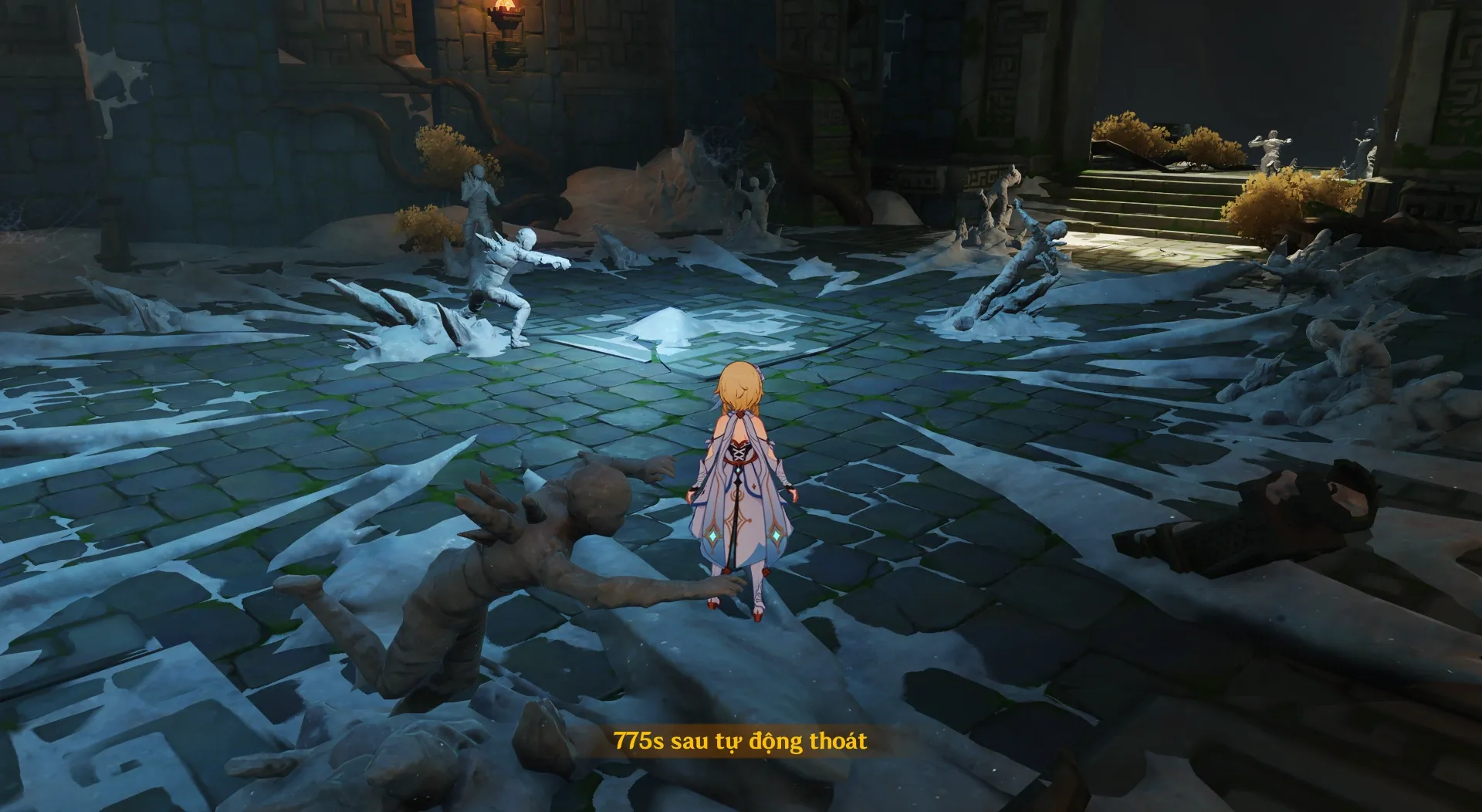
Liyue lesser deity, the God of Salt, who lived in the region of Liyue before and during the Archon War (not the Cataclysm era; she belongs with the Liyue gods of the Archon War, per the Gods, Liyue, and Guizhong pages). She was slain by the first and last king of her own people at her final sanctuary, Sal Terrae, before the game's events; her body dissipated into salt, and the surge of released power turned her adherents nearby into salt as well
Overview
Havria was the gentle God of Salt in Liyue before the Archon War.
She refused to fight in the Archon War and lost all her land but Sal Terrae.
Her own people's king killed her, turning everyone nearby to salt.
She was a lesser deity, not one of the Seven Sovereigns.
Her story is revealed in Zhongli's Story Quest, Sal Flore.
Havria (Chinese 赫乌莉亚 Hèwūlìyà; Japanese ヘウリア Heuria) was the God of Salt, a Liyue lesser deity from before and during the Archon War, known for her gentleness and her relative weakness. Those two qualities led to her death, and the killers were her own people rather than rival gods. [1] When the Archon War broke out she refused to take part. She fled with her people across Liyue, made countless concessions to other gods, and eventually lost all her lands but one tiny plot in what is now Sal Terrae (Salt of the Earth) in Bishui Plain. [2] There she sheltered war refugees and argued for peace between the gods. Centuries later her people's first and last king slew her with a sword to mark his decision to take a more militaristic stance. The surge of divine power released at her death turned everyone in the surrounding area into salt, her body dissipated into salt traces, and the city "fell and turned to salt" in the same instant. [1][4][3] Her name reaches the player for the first time in Zhongli's Story Quest Historia Antiqua Chapter Act I, (V1.1).
1.
Havria - Genshin Impact Wiki (Fandom) · external ↗
2.
Sal Terrae - Genshin Impact Wiki (Fandom) · external ↗
3.
Sal Terrae (Civilization) - Genshin Impact Wiki (Fandom) · external ↗
4.
Archon War - Genshin Impact Wiki (Fandom) · external ↗
5.
Customs of Liyue - Genshin Impact Wiki (Fandom) · external ↗
6.
Diary of Roald the Adventurer - Genshin Impact Wiki (Fandom) · external ↗
7.
Historia Antiqua Chapter - Genshin Impact Wiki (Fandom) · external ↗
She is the God of Salt, a Liyue lesser deity, named alongside Guizhong, Marchosius (later revived as Guoba), Chi, Tao Dou (Bune), Zibai, the Mistress of Chenyu Vale, and Osial among the gods from before the Archon War whom Morax lived alongside or subdued, "known for her gentleness but also for her relative weakness, two qualities that ultimately led to her demise."[1][10][11]
She refused to take part in the Archon War "due to her kind nature and relatively weak powers," and she and her people "fled between different parts of Liyue to escape the war, making countless concessions to other gods and eventually settling in a tiny plot of land in what is now known as Sal Terrae."[1][4] Per Diary of Roald the Adventurer Vol. 1, she was "the gentlest of the gods" and sheltered the dispossessed. [18]
She was slain by the first and last king of her own people, not by a rival god. Per the Sal Terrae civilisation page the king "executed Havria" either "believing her to be too weak to be a worthy god or wishing to grant her a merciful death."[3] Per the Archon War page his motives were "to demonstrate their decision to take a more militaristic stance, and to spare her the agony of defeat and destruction at the hands of another god."[4]Customs of Liyue Vol. 1 renders the same event as folklore: she was "ruthlessly murdered by one of her own followers."[17]
The moment of her death turned the surrounding area to salt. Per the Havria page: "Havria's body dissipated, leaving nothing but traces of salt, and the people who can't escape from the place are transformed into salt themselves."[1] Per the Archon War page: "the surge of power that emerged from her body turned anyone who had been in the area into salt."[4] Per Diary of Roald Vol. 1 the city "crumbled like salt into the earth," and rumour holds her body still resides in the ruins, "turned to salt, [yet] maintaining her posture from the moment she was struck by the king's sword."[18]
The survivors who escaped were taken in by Morax at Liyue Harbor and founded Yinyuan Hall "with a distorted version of events."[3][4]
Her salt-relics kept their special properties for millennia and were returned to the sea by Zhongli at the close of Historia Antiqua Chapter Act I, at the highest peak of Guyun Stone Forest, "so that humanity would not seek the power of a long-dead deity."[10][9]
What primary text leaves unstated:
Her origin before the Archon War. The records place her "in the region of Liyue before and during the Archon War" but do not specify how she came to be. Descent, inheritance, deification, and construction are all attested ways of becoming a god per the Gods page, and primary text pins her to none of them. [1][10]
Whether other Salt-cult sites existed beyond Sal Terrae. Primary text names Sal Terrae as her "last piece of land, and the place where she met her doom," and the records describe her ceding land "between different parts of Liyue," but no other Salt-cult site is named. Sal Terrae is the only sealed domain attributed to her in V1.0+. [1][2]
The full identity, fate, and motive of the king. Per the Havria page: "many rumors and myths about her death emerged from that; some say that her body can still be found in its death throes, while the king lived to the end of his days in solitude, or committed suicide out of guilt."[1] The Archon War page and Customs of Liyue Vol. 1 give a split motive (both "her kindness could not help them survive the Archon War's brutality" and "to spare her the agony of defeat and destruction at the hands of another god"), but the king's name is never disclosed. [4][17]
The full content of the "distorted version of events" Yinyuan Hall was founded on. Yinyuan Hall exists in Liyue Harbor as the institution the Sal Terrae survivors left behind, but the distorted history it preserves is not described in primary text as of V1.0+. [4]
Archon War, not the Cataclysm
Havria died during the Archon War. Per the Havria page she "lived in the region of Liyue before and during the Archon War" and was slain at Sal Terrae centuries into her people's flight from that war, entirely within the span of the Archon War. The Archon War page narrates her death in its section on the war in Liyue, alongside Morax's defeat of Orobashi (who fled to Inazuma); the whole arc is pre-Cataclysm. The Cataclysm struck roughly 500 years ago and killed, among others, Egeria at Tunigi Hollow, Makoto in Inazuma, and much of the generation of gods in Mondstadt, Liyue, and Sumeru, a separate wave of god-deaths thousands of years after the one Havria belongs to. [14][1][4]
The Guizhong page draws the same distinction. The gods who died in the Archon War (Guizhong, Havria, the original Lupus Boreas / Andrius's predecessor, Decarabian, Chi, and the wider set of gods from before the Archon War killed across the war's long span) are a separate group from the gods who died in the Cataclysm (Egeria, Makoto, Rostam, Bosacius/Boyang, Nabu Malikata, and so on). Havria belongs to the first. Mixing up the two is a recurring error that earlier sessions caught, and this page does not repeat it. [12][14]
Havria is not a Sovereign
Per the Seven Sovereigns and Gods pages, the Sovereigns include Apep (Dendro) and Azhdaha (a Geo-adjacent draconic king, placed next to the missing Geo seat), while Osial is a god rather than a Sovereign; the Cryo Sovereign seat stays formally unnamed (Surtalogi is not the Cryo Sovereign). Havria belongs among the lesser deities, the same group as Guizhong, Marchosius (as Guoba), Chi, Tao Dou (Bune), Zibai, and the Mistress of Chenyu Vale, not among the Sovereigns. [15][10]
God, Sovereign, and Archon are separate ranks. Havria is a lesser deity from before and during the Archon War. Her refusal to fight cost her every territory but Sal Terrae, and her own people killed her at the end. She is not an Archon (the Archons are the survivors of the Archon War, per the Seven Archons page) and not a Sovereign (the Sovereigns are dragon-kin from before the Archon War, born from elementally pure vishaps in the Light Realm). [16][15]
Zhongli's Story Quest: Sal Flore
Havria's name is first revealed in Zhongli's Story QuestHistoria Antiqua Chapter Act I, Sal Flore, released in patch 1.1 with prerequisite AQ Chapter I Act III A New Star Approaches. A Fatui-registered archaeology consultant named Kliment hires Zhongli to lead an expedition through Guyun Stone Forest and Sal Terrae; a second archaeologist, Wanyan, attaches herself to the trip on her own initiative. The expedition unseals Sal Terrae's Of Mysteries and Salt domain via Electro Elemental Monuments arranged in a Geo-aligned sequence Zhongli recites from memory. [7][9]
Inside the ruin, the chapter reveals three things the source pages do not: [9]
The broken sword the expedition recovers is the weapon the king used; a statue of the killer is preserved in a salinised pose at the site.
Havria did not retaliate. Her power was sufficient to salinise everyone in the chamber at the moment of her death, but she did not direct that power at her killers; the salinisation was a passive bleed-off, not an act of will. The followers who survived fled to Liyue and were taken in by Morax.
The killers, fearful of Havria's wrath even after the murder, returned to the temple to break the sword in case her vengeance was still pending. It was not. Havria was a benevolent god; her people murdered her because she could not understand what they needed.
Wanyan turns out to be a follower of Havria's cult, searching for evidence that Morax killed the God of Salt; the ruin does not support her thesis and she runs. Kliment, the Fatui operative, breaks the contract Zhongli set at the ruin entrance and is dismissed without ceremony. At the act's close, in the sub-quest Farewell, Sweet Salt, Zhongli meets the Outlander at the highest peak of Guyun Stone Forest and returns Havria's salt-relics to the sea"so that humanity would not seek the power of a long-dead deity."[10][9]
Trivia and etymology
Two threads cluster around trivia and etymology. [1]
The flower-ball wedding custom. Per the Havria page and Customs of Liyue Vol. 1: "It is said that Liyue's Flower Ball custom may have originated from Havria giving out bunches of flowers to her people as either a blessing or a simple gesture of comfort."[1] Per Vol. 1 she "once handed out bunches of flowers to her people as a blessing," and her followers carried the custom across Liyue after her death. The alternative theory traces the custom to Mondstadt's Ludi Harpastum festival; Vol. 1 presents both without resolution. [17] The attribution is may and some say, not confirmed history.
Ars Goetia etymology. Per the Etymology section: "Following the theme of gods in Genshin Impact being named after demons in the Ars Goetia, Havria could possibly be a corruption of Havres, another name of the 64th demon, Flauros."[1] The Ars Goetia primary text (Mathers 1904) reads: "The Sixty-fourth Spirit is Haures, or Hauras, or Havres, or Flauros." The variants Hauras / Haures / Havres likely arose from copyists mistaking the first two letters of "Flauros," written too closely together, for an "H."[8] This matches the wider naming convention across Barbatos, Morax, Baal, Buer, Paimon, Naberius, Marchosius, Andrius, Focalors, Decarabian, and others, with Marchosius (from Marchosias) and Morax himself sitting in the same Liyue tradition. Per the source's own "could possibly be a corruption of" wording, the derivation through Havres and Flauros is hedged, not confirmed.
Adeptus' Temptation salt. A minor third thread comes from the in-game Teyvat Food Notes entry for Adeptus' Temptation: "Havria's powers have enhanced the flavor of sea salt from around Guyun Stone Forest," evidence, centuries after her death, for the principle that gods cannot be completely destroyed. [1]
The salt-relic residue
Havria's case is a key example for the Gods page's principle that "even if a god's physical form is destroyed, their consciousness is worn away, and they are considered 'dead,' their emotions and power remain."[19] The preservation of her salt-relics is one of five examples of a post-death residue that the game has not formally named, alongside Marchosius revived as Guoba (power placed into the land), Boreas at Wolvendom, the Inazuman Tatarigami left by Orobashi on Yashiori Island, the transformation of wildlife into Consecrated Beasts, and the Capitolium ruins protected by Remus's will. [10] When Zhongli returns the relics to the sea at the close of Sal Flore, he is managing that residue on her behalf. The seal on Sal Terrae described by the Ancient Stele ("Salt seals the ruin within, none uninvited may enter in") keeps it contained, and the Of Mysteries and Salt domain remains sealed in present-day Liyue. [2]
Havria's story sits beside Guizhong's, as the other Liyue lesser deity of the Archon War era, and her afterlife runs through Zhongli, who took in the Sal Terrae refugees and returned her relics to the sea. The primary text lives in Zhongli's Story Quest, the Historia Antiqua Chapter (the Sal Flore reveal, the broken sword, the revelation that she did not retaliate), in the in-game books Customs of Liyue and Diary of Roald the Adventurer, and in the Liyue region and Gods pages. She is neither a Sovereign nor an Archon, and she died in the Archon War era, not the Cataclysm era.