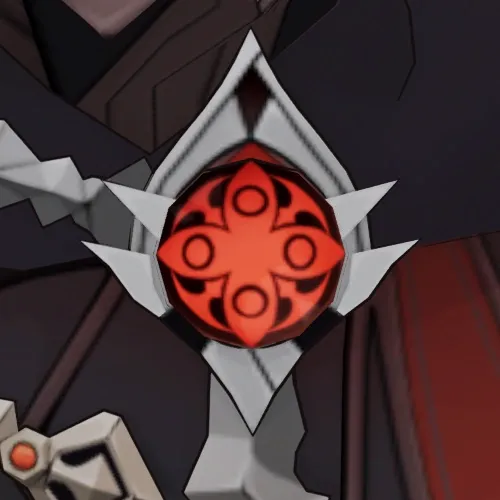
A Delusion is the Fatui's manufactured Vision-replica, a powerful elemental artifact distributed by Snezhnaya that lets a wielder command one of the seven elements without ever crossing Celestia's threshold. [1] A Vision goes to a mortal whose ambition or grief the Heavenly Principles judge exceptional. A Delusion can be used by anyone, Vision-bearer or not, and canon calls it more powerful still. The cost is punishing. Delusions drain the user's vitality, age the body, and can backfire lethally. The Fatui know this. They distribute them anyway.
The Chinese name for the artifact is 邪眼 Xié Yǎn, "Evil Eye," a deliberate inversion of the Vision's 神之眼 Shén zhī Yǎn, "Eye of God." [1] The English pun runs in parallel: a "delusion" is a false belief held in the face of facts. That wordplay is the artifact's design statement.
What canon attests
- What goes into a Delusion is dead divinity. Knowledge about Delusions is scarce even within the Fatui, yet the current consensus is that the artifact "appears to utilize the remains of deceased gods and other powerful beings." [1] Two cases are attested in primary text. The Inazuma Delusion Factory on Yashiori Island used Crystal Marrow, the substance that carries Tatarigami, distilled from the remains of the slain god Orobashi. [5] Crepus' Mondstadt Delusion was created alongside Barnabas' experiments injecting "archon residue," the remains of gods from before the Seven-Archon era, into human test subjects like Collei. [12]
- Distribution works on two levels. At the top, Delusions are scarce: "few members beyond the Eleven Fatui Harbingers possess one, and they are personally granted by the Tsaritsa herself," per Viktor in the Mondstadt commission Tales of Winter. [2] At the bottom, the Fatui have been secretly distributing mass-produced Delusions among commoners of the seven nations as a parallel programme. [1]
- The element is not bound to the bearer's Vision. Childe's Hydro Vision sits in the same casing as a mass-produced Delusion, but his Delusion is Electro. The orb visibly recolours to Electro purple, with a Fatui insignia replacing the Hydro symbol, when the Delusion is unleashed (most clearly during the Enter the Golden House fight). [10] [1] A Delusion grants its own element no matter whether the bearer has a Vision, or what that Vision is.
- The Knights of Favonius found a forensic tell. Their burnt Delusion-research report, salvaged by Jean, Lisa, and Amber, revealed that Delusions emit the smell of Mist Grass upon use. [12]
Inazuma: the Delusion Factory and the Watatsumi distribution
The Inazuma Archon Quest Chapter II Act III Omnipresence Over Mortals lays out the Delusion programme as an instrument of war. [3] Under cover of the Sakoku Decree, the Fatui colluded with the Tenryou and Kanjou Commissions, the first to feed the Raiden Shogun false information, the second to supply Crystal Marrow from Yashiori Island. That Crystal Marrow was funneled into the Delusion Factory at Yashiori, manufactured into mass-produced Delusions, and secretly distributed among the Watatsumi resistance. The goal was to destabilise Watatsumi and the Shogunate at once and leave Inazuma open to Fatui influence.
The cost was visible. Gorou confiscated a Delusion from a Watatsumi soldier and brought it to the Traveler because resistance soldiers were aging fast and dying. The clearest case was the young Watatsumi soldier Teppei, who used a Delusion despite never having received a Vision and died from its effects. [4]
The resistance razed the Delusion Factory after the Traveler's raid. The Balladeer, better known by his post-defection identity, the Wanderer, was revealed there as the sixth of the Eleven Fatui Harbingers running the Inazuma operation. [3] Signora was executed by the Raiden Shogun shortly afterward, at Tenshukaku, after losing a duel before the throne to the Traveler; her Cryo Delusion was a special case, discussed below.
Side-effects
Per Inazuma testimony, the side-effects fall into three named modes:
- Vitality drain and rapid aging. Watatsumi soldiers who used Delusions aged fast as their vitality drained, and Teppei is the fatality case. [4] The same mechanism operates outside Inazuma. Yelena (Fontaine, below) was aged by extended use until she could no longer flee, and Kirya was aged "to around Edgar's age," roughly twenty years, by a much shorter exposure. [9]
- Backfire. Crepus' Delusion backfired on him in combat with Ursa the Drake, killing him outright in the manga's rendition. [6] Kaeya's character story preserves a different reading, in which Diluc killed his father to end his suffering after the backlash left him in agony. Canon has not chosen between them. [7]
- Mind-warping. Signora's memories of her past were suppressed when she received her Delusion, and the "delusion" Pierro framed it with convinced her to join the Fatui. [1] [8]
Severity depends on the user. Crepus and Teppei died soon after taking up a Delusion. Diluc used Crepus' for three years with no obvious physical consequence, possibly because he was already a Vision-bearer, though canon does not commit. Watatsumi soldiers were unequally affected for reasons canon attributes to "too little information." Fatui personnel like Childe and Signora show no ordinary side-effects, but neither is an ordinary human: Childe has Foul Legacy conditioning in Abyssal magic, and Signora's Crimson Witch transformation predated her Delusion. Canon does not have enough data to say whether Fatui field operatives suffer what civilians do.
Why Signora's Delusion was different
Signora's Cryo Delusion is the exception that breaks the usual reading. Per the Pale Flame: Stainless Bloom artifact text and the Tenshukaku archive, hers was created with the Tsaritsa's "grace" specifically to suppress, not amplify, her flame power. As the Crimson Witch she had transformed her body with that power, and it would otherwise consume and kill her. [8] It is the only attested Delusion whose function is suppression rather than elemental access.
Childe and Foul Legacy
Childe's case is the cleanest illustration of the Delusion's load when combined with Abyssal magic. Pierro "pinned" the Delusion on him when he was elevated to Harbinger. [10] He shows no ordinary Delusion side-effects, yet he has suffered repercussions specifically when using it alongside Foul Legacy Transformation, the Abyss-magic combat technique he learned from Skirk during his three-year apprenticeship in the Abyss. [11] [1] That combination is the only named situation in which Childe pays a price for using his Delusion.
Fontaine: the post-Childe-trial cleanup
The Fontaine arc Floral Debt, Blood Due (Emilie's Pomum de Ambra Chapter Act I) is the clearest post-Inazuma case of a Delusion in civilian hands outside Snezhnaya's control. [9] A renegade Fatuus named Yelena defected from Snezhnaya with her brother Kirya, took her Delusion with her, and settled in Fontaine. There she used it to grow flowers with distorted elemental energy and produce the wildly profitable "Auguste" perfume, 10 million Mora a bottle. Extended use aged her until she self-immolated to destroy the evidence. Kirya inherited the Delusion, aged "to around Edgar's age" in a much shorter window, and spent the time he had left assassinating his sister's associates before Emilie and the Traveler stopped him.
Once a Delusion leaves the Tsaritsa's hands, it is no longer under tight Snezhnayan supply-chain control. The mass-production programme left enough surplus that defectors could carry one abroad and operate on their own for decades.
Chapter VII: the authority of Death and a new model
Version 7.1's A Rekviem for the Underworld explains, from inside the Fatui, how a Delusion works. Facing a direct fight with Ronova, Pierro is developing a new model, and he is candid about the old ones: "The Delusions used by the Fatui have always been an unfinished product that drains the user's life force." Within the Fatui, he adds, "they are allocated on a strictly voluntary basis," issued on application "for important missions or emergencies." [16] [18]
Arlecchino explains the principle. "Technically speaking, the ability of a Delusion to drain its user's life force in exchange for power comes under the authority of Death." Long ago the moons held the authorities of Life, Death, Time, and Space, and "the Iridescent Moon received the greatest share of the authority of Death." After the moons' demise the Heavenly Principles reclaimed those authorities and redistributed them "under a new system of rules," but the broken Crimson Moon merged with the Abyss, so the authority of Death "resides within the Crimson Moon and its people's bloodline." That makes her, as a Crimson Moon descendant, "the key to completing the Delusion." The wiki's Three Moons page covers the moons themselves. [16] [19]
Pierro says this line of work "first began long ago," once the Fatui learned that Peruere survived from the Crimson Moon lineage. The prototype tested in Act IV is meant to fix the old problem: a researcher says it "will only draw on the regenerable portion of the user's life force, ensuring there is no long-term impact upon their lifespan." At maximum output, though, it "inadvertently drew upon another of the Crimson Moon's authorities besides Death alone," which "can induce hallucinations and cause the user to lose control over their power." The Traveler purified the surge before it harmed Arlecchino, and she judged the whole approach "much too conservative." [16]
Pierro takes the point ("Perhaps our understanding of the Authority of Death is still far too superficial... It is time to make some trade-offs"). The notebook of Hroptatyr, "The Wise," records the same finding from five centuries earlier: "The Crimson Moon does possess an authority related to Death." After meeting the young Hroptatyr inside a prism memory, Pierro says, "I now have a new plan to complete the Delusion project." [16]
Fandom's summary of the act says Pierro's new Delusion overpowers Ronova in the final battle, and Fandom's Delusion page calls the upgraded form the "Eye of the Fatui"; the dialogue itself does not name it. Dainsleif says the battle "took an exceptionally heavy toll on his mind and soul": "To wield the immense power that he did, one always has to pay an irrecoverable price." Arlecchino, meanwhile, is waiting for "the experiments for the revised Delusion project" to begin. [17] [1] [16]
What canon has not surfaced
- The Tsaritsa's reasons. Canon does not state why Snezhnaya runs the Delusion programme as a whole; the Tsaritsa's wider plan stays uncertain. Pierro's Act IV statement that Delusions are "allocated on a strictly voluntary basis" concerns members of the Fatui, not the mass-produced units distributed abroad.
- How the two accounts fit together. The remains-of-gods account describes what Delusions are made from, while Arlecchino's Act IV explanation describes why their life-for-power exchange falls under the authority of Death. No source explains the manufacturing process that connects them.
- The full supply chain. Two source materials are attested: Crystal Marrow from Orobashi, and archon residue from unnamed gods who predate the Seven-Archon era. What went into Signora's and Arlecchino's Delusions is never specified.
- Whether Fatui personnel suffer ordinary side-effects. Neither Childe nor Signora displays the standard drawbacks, but neither is a control case. The Cicin Mage, Pyro Agent, Mirror Maiden, and Operative rosters have no surfaced side-effect data.
- How Crepus died. The manga (a fatal backfire) and Kaeya's character story (a mercy kill by Diluc) disagree; canon does not adjudicate.
The Vision system the Delusion inverts is covered at Visions. As a Harbinger token of office it belongs to the Eleven Fatui Harbingers, and the wider anti-Celestia project of Pierro and the Tsaritsa that it serves runs through The Cataclysm.