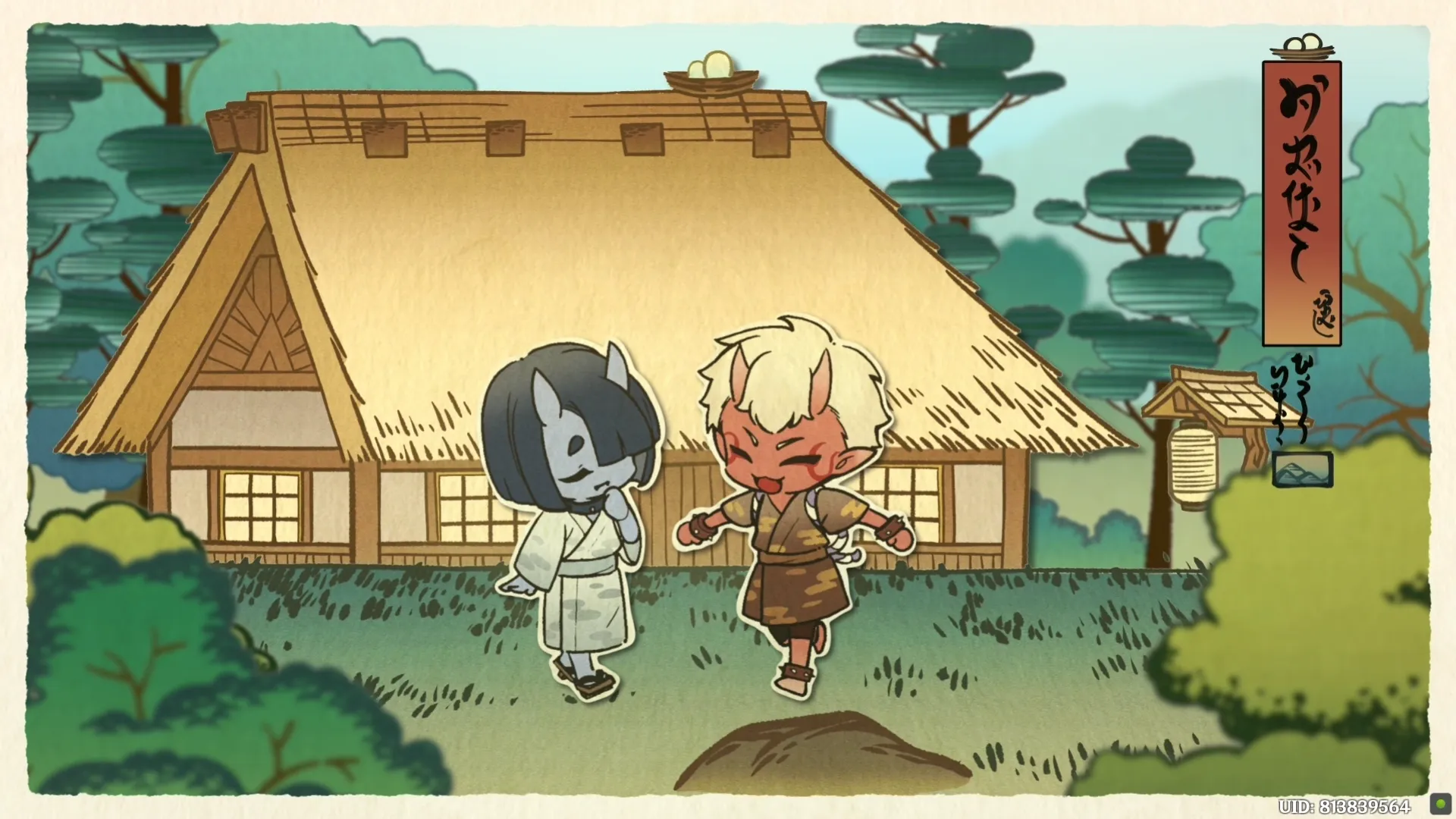
Oni are Inazuma's tall, horned yokai, far stronger than most humans. They are one of several kinds of Inazuman yokai in the post-Cataclysm world, alongside the kitsune, the Tengu, the Mujina, and others, but the oni hold the densest primary-text record of any single kind outside the kitsune-saiguu line. [1] [19]
The oni as a species are distinct from Itto, the only playable Crimson Oni, and from the Tri-Commission, the post-Cataclysm Inazuman state. The Tri-Commission runs the institutions, Itto runs the Crimson Oni's civic life within and partly against them, and the oni as a people predate both. [14] [18]
What an oni is
Per the Oni record and the Mask of the One-Horned weapon-text, the oni are a kind of youkai native to Inazuma. They are tall (larger builds than most humans), long-horned, and far stronger than ordinary people. [1] [4]
Before the Cataclysm, the oni had completely blue or completely crimson skin without markings, the two colours the Blue Oni and Crimson Oni names come from. As they had children with humans over the post-Cataclysm centuries, their skin came to resemble human skin; present-day oni paint markings on their skin and horns to show their tribe, the painting itself a measure of how thinned their blood has become. [1] [4]
Three things matter:
- Their blood thins through marriage with humans. Per the Mask of the One-Horned weapon-text: "Since the events of the cataclysm, the blood of the oni has diluted with each passing day." This is ordinary inheritance, oni having children with humans over the 500 years since the Cataclysm, not a divine curse like the one that turned Khaenri'ahn humans into hilichurls. By the present day the full-blooded oni are a vanishing minority. [1] [4]
- They're allergic to beans. Per Yukio's NPC dialogue and the Mask of the One-Horned weapon-text, oni are supposed to be allergic to beans, which are lethal in large amounts. For part-oni the allergy is much weaker, thanks to their thinned blood; Itto, the lone exception, has the purest blood of any oni alive. [10] [1] The bean weakness also echoes the real-world Japanese Setsubun holiday the game's design draws on.
- Principles and pride. Per Shiki Taishou in the Yummy! Barbecue Under the Stars web event: "the oni clans value their principles and pride very much." That pride runs underneath the Blue-Crimson pact below and Itto's role as the Crimson Oni's public face today. [9]
The oni live fully within Teyvat's ordinary order: recorded by Irminsul, able to hold Visions (Itto's Geo Vision makes him an allogene), speaking the common tongue, and governed under the Tri-Commission with the Raiden Shogun at its head. They are not an outsider like the Traveler. [21]
Two sub-tribes: Crimson and Blue
The oni organise around their two tribes.
Per the Mask of the One-Horned weapon-text and the Inazuman fairytale it preserves, there are two oni sub-tribes, set apart historically by skin colour and by their stance toward Inazuman humanity.
Sub-tribe | Skin colour (pre-dilution) | Posture | Present-day representative |
|---|---|---|---|
Crimson Oni | Crimson | Wished to socialise with humans; took the Blue-Crimson pact's terms for integrating with humans | Arataki Itto (lives in Hanamizaka; Arataki Gang leader; full-blooded line) |
Blue Oni | Blue | Preferred seclusion; took the pact's terms for helping the Crimson integrate | Takuya (Blue Oni survivor; joined a vagrant group per Itto SQ Taurus Iracundus Chapter) |
The Inazuman fairytale preserved in the Mask of the One-Horned weapon-text is a children's story with a hidden truth. On the surface, a blue oni who preferred seclusion proposed that he would perform "evil" acts and the crimson oni who wished to socialise with humans would scare him off; the plan worked, the crimson oni began to interact with humans, the blue oni stayed in seclusion, and the crimson oni later searched for him until they reunited away from the village at a festival. [1] [4]
The hidden truth underneath carries the oni's broader history: "Onis are more versed in the story as it held a hidden truth that most people were unaware of - the oni, being the proud race they were, wanted the Shogun's protection, but in order to do so, they had to have a good relationship with the humans. People at the time did not discern between oni, so they treated all of them the same, which was mostly exacerbated by the blue oni continually clashing with the humans, while the crimson oni tried to maintain good relationships with them. As a result, the two tribes met and issued a pact - the blue oni would help the crimson oni integrate with humans as long as the crimson oni would treat humans respectfully, not use their strength for malicious intents and obtain the respect of the humans." [1]
The pact's terms underwrote the oni's pre-Cataclysm protection by the Shogun: the oni wanted that protection, the protection required good relations with humans, and the pact split the work between the tribes (the Crimson doing the integration, the Blue staying out of the way in support).
The split is sharp. The Crimson took a visible path (living among humans, keeping up relations); the Blue took an invisible one (seclusion, non-interference, support from the margins). When the Shogun's protection collapsed (below), the Crimson had enough of a public presence to survive into the present day; the Blue, having chosen invisibility, were "thought to have died off" entirely, until Itto's Story Quest found Takuya alive.
History: allies, rupture, decline
The oni's history turns on a single Cataclysm-era event, not a sustained policy of pushing them out.
Before the Cataclysm: allies of the Shogun
The Inazuman fairytale and its hidden-truth reading show the pre-Cataclysm oni living under the Shogun's protection, secured by good relations with humans under the Blue-Crimson pact. That arrangement supported a sizable oni population woven into pre-Cataclysm Inazuma, which is what the "allies of the Inazuman shogunate during early wars" framing reflects. [1] [4]
Arataki of the Front Gate, a legendary martial artist of unknown period, is the named ancestor of the Arataki line Itto continues today. [1] The pre-Cataclysm oni also included the Twin Oni of Tokaku (defeated by the Black Fox Itaru per New Chronicles of the Six Kitsune Vol. 3), the Four Oni of Ogata (deceived by Ioroi per the Eight Locales Over Mountains and Seas Event WQ), and Arakawa Kouji. [11] [12] They worked alongside, and sometimes clashed with, the Inazuman kitsune and adeptus-level figures like Ioroi.
Cataclysm-era Mikoshi Chiyo rupture
The rupture is the Mikoshi Chiyo arc. Per the Hakushin Ring, Mask of the Kijin, Mask of the Tiger's Bite, and Mask of the Wicked Lieutenant weapon-texts:
500 years before the start of the game, the Cataclysm erupted throughout Teyvat. Mikoshi Chiyo, one of Ei's friends, was swallowed by a beast of sin. She broke out, but was corrupted by its influence and rebelled against the Shogunate. Ei cut Chiyo's sword-arm and one horn off, but she was spared and fled into the forests. [5] [6] [17]
Ei answered Chiyo's corruption-driven rebellion with disarmament and clemency rather than execution, sparing the Mikoshi line while taking away Chiyo's ability to fight. The rupture reads as a contained incident rather than a rejection of the oni as a whole. Per the Mask of the Tiger's Bite and Mask of the Wicked Lieutenant weapon-texts, the Tales of Torachiyo (a male-oni version of the same story) circulate in present-day folk-memory. That they exist at all shows the Chiyo event was suppressed and distorted as Inazumans passed the story down over the 500 years since. [7] [8] [1]
Chiyo's son Iwakura Michihiro was shamed by his mother's actions. Per the Mask of the Kijin weapon-text, he led a life of seclusion in Konda Village until he met Teruyo of the Yougou Tengu. The Iwakura line answered with personal seclusion and a partnership with another kind of yokai, not retaliation against the Shogunate. Per the Maguu Kenki Archive entry, the Maguu Kenki mask appears to be inspired by Iwakura Michihiro, which makes the Maguu Kenki a later cultural heir to the Iwakura line. [6] [1] [13]
After the Cataclysm: a dwindling people
The decline ran through two things, one after the other:
- The protection lapsed. The Shogun's protection under the Blue-Crimson pact did not survive the rupture. The Tri-Commission, the post-Cataclysm state, did not inherit it; the oni live in present-day Inazuma without protection from any of the three Commissions or from the Raiden Shogun directly. [18]
- The blood thinned. Per the Mask of the One-Horned weapon-text: "Since the events of the cataclysm, the blood of the oni has diluted with each passing day." This runs through oni having children with humans over generations. The oni today include a few full-blooded individuals (Itto the only named one continuing his line) and a wider part-oni population whose blood has thinned significantly. [4]
The decline is not the result of active Shogunate extermination or any policy of pushing the oni out. It is the combined effect of the protection lapsing (no renewed pact) and the blood thinning (children with humans).
Itto, the last full-blooded Crimson Oni representative
Arataki Itto is the present-day Crimson Oni representative and the last full-blooded oni of the Arataki line. [2] [14]
Per the Arataki Itto description: "A loud and proud descendant of the crimson oni, Itto is also the leader and founder of the Arataki Gang. While not a villain, his reputation as a delinquent in Inazuma City leaves something to be desired." His full-blooded status shows in the bean allergy. Part-oni have only a weakened form of it, and "Itto is a lone exception", which marks him as the one with the purest blood. [2] [1]
Itto works through the Arataki Gang, the Hanamizaka-based, oni-led club whose public schedule runs beetle-fighting tournaments, sumo wrestling, neighbourhood entertainment, and informal crisis-response. It is not a criminal outfit in any real sense; the "gang" label reflects local prejudice rather than reality. [14] The Gang is the visible continuation of the path the Blue-Crimson pact committed the Crimson Oni to.
The present-day Crimson Oni keep a few fixtures:
- Hanamizaka residency. The Crimson Oni live in the Hanamizaka neighbourhood of Inazuma City; Itto's Constellation-5 talent "10 Years of Hanamizaka Fame" reflects it. [2]
- Granny Oni, the Hanamizaka matriarch Itto reports to, and through whom the Traveler passes word of Takuya's survival during Itto's SQ. [1]
- Bloodline of the Crimson Oni, the name of one of Itto's talents, reflecting his full-blooded line. [2]
The Itto Story Quest, Taurus Iracundus Chapter, is the primary-text arc for both the Crimson Oni's civic life and the rediscovery of the Blue. In the chapter Itto meets Takuya (a Blue Oni descendant who joined a vagrant group for supplies, given how poorly the Blue Oni had fared); after a jail stint, Itto pledges to help the Blue Oni; the Traveler tells Granny Oni, who begins preparations to help them. [3] [1]
The arc grounds the Crimson Oni's tentative rebuilding, a post-Cataclysm attempt to restore the old Blue-Crimson cooperation without any formal Shogunate protection behind it.
The Blue Oni: Takuya
The Blue Oni were "eventually thought to have died off" during their long seclusion: "as the blue oni remained in a life of seclusion, they were eventually thought to have died off." [1]
Per the Itto Story Quest Taurus Iracundus Chapter, the Blue Oni survived in extremely poor conditions through the post-Cataclysm period, forcing one of them, Takuya, to join a vagrant group for supplies. Itto's meeting with Takuya is the discovery that the Blue Oni are still alive, and the arc sets up the Crimson Oni's commitment to rebuilding them. [3] [1]
Under the pact, the Blue Oni committed to invisibility. The pact's anchor, the Shogun's protection, collapsed with the Chiyo rupture, and the Blue Oni, having chosen not to be seen, had nothing to fall back on when that protection vanished. Their poverty follows from the lopsided pact, not from any Shogunate persecution.
Other named Oni members
The Known Members record catalogues individuals beyond the Itto / Takuya / Mikoshi Chiyo / Iwakura Michihiro core:
Member | Period | Notes |
|---|---|---|
Ao | Unknown (pre-Cataclysm) | Blue Oni who initiated the Blue-Crimson pact. |
Aka | Unknown (pre-Cataclysm) | Crimson Oni who initiated the Blue-Crimson pact. |
Arataki of the Front Gate | Unknown (legendary) | Legendary martial artist; named ancestor of the Arataki line. |
Twin Oni of Tokaku | Unknown | Two female oni bandits defeated by the Black Fox Itaru (one of the Inazuman kitsune) and later joined her side. Source: New Chronicles of the Six Kitsune Vol. 3. |
Four Oni of Ogata | Unknown | Four oni who trespassed on Chinju Forest and were deceived by Ioroi (an adeptus-level presence in Chinju Forest). Source: Eight Locales Over Mountains and Seas Event WQ. |
Arakawa Kouji | Unknown | Named oni member; little else given. |
Mikoshi Chiyo (Torachiyo) | 500 years ago | The Cataclysm-era arc of rebellion, disarmament and clemency. Iwakura Michihiro's mother. Hakushin Ring source ("oni maiden"). |
Iwakura Michihiro | 500 years ago | Chiyo's son; lived in seclusion in Konda Village; partnered with Teruyo of the Yougou Tengu. The Maguu Kenki mask is supposedly inspired by him. |
Ako Domeki | Present day | "Deathless Oni of Seirai." Found on Seirai Island. |
Arataki Itto | Present day | Crimson Oni representative; last full-blooded oni of the Arataki line. |
Takuya | Present day | Blue Oni descendant; joined a vagrant group per Itto SQ. |
Two present-day characters carry oni-epithets without confirmed lineage:
- Yanagiha Arashi, "The Violet Oni," lineage unclear.
- Okazaki Toraemon, "The Crimson Oni," lineage unclear per the same note.
The note warns that the "Violet Oni" and "Crimson Oni" epithets are titles attached to the individuals' reputations rather than confirmed bloodline attributions. [1]
Where the oni sit among Inazuma's yokai
The oni are one of several kinds of Inazuman yokai in the post-Cataclysm world, and that shapes how they deal with the others.
- The kitsune. The Inazuman fox-spirits, organised around the Grand Narukami Shrine and the pre-Cataclysm Hakushin-Kitsune founder line of the Kitsune Saiguu. Oni-kitsune dealings include the Twin Oni of Tokaku's defeat by the Black Fox Itaru (New Chronicles of the Six Kitsune Vol. 3); the two run alongside each other, sometimes cooperating. [11] [19]
- The Tengu. The Inazuman bird-yokai, organised around the Yougou Tengu. Oni-Tengu dealings include Iwakura Michihiro's partnership with Teruyo after the Chiyo event (Mask of the Kijin). Other tengu-blooded characters work within mainstream institutions (Shikanoin Heizou is half-tengu). [6] [16]
- The Mujina. The Inazuman badger-yokai. Their dealings with the oni are not directly documented in primary text.
- Other Inazuman yokai. The wider world includes individual figures like the adeptus-level Chinju Forest spirit Ioroi and the Maguu Kenki (inspired by the Iwakura line), scattered across Inazuma.
Inazuma's yokai run alongside, and sometimes cooperate with, the post-Cataclysm Tri-Commission government. The oni are one of several kinds within that world, and unlike the Kitsune Saiguu line for the kitsune, they are not the anchor the wider yokai world organises around.
How oni compare to nearby races
The oni are an Inazuman yokai population living under the post-Cataclysm Inazuman state, set apart from several nearby non-human races.
Oni vs adepti
The adepti are Liyue's illuminated beings. They hold a higher purpose through Morax's blessings, the Mighty and Illuminated Adepti contract, and the Sub-Space Creation power Rex Lapis granted as part of the illumination. They have third-eye elemental control, adeptal energy, abodes, full-blood shapeshifting, and lifespans of centuries to millennia. [22]
Oni are something else. They are Inazuman yokai rather than parties to a Morax contract; they hold no contract with Rex Lapis or any Archon, do no Sub-Space Creation, and have no adeptal energy; their long lives come from the species itself, not a contract. The difference is one of origin and allegiance: Morax's illuminated beings against Inazuma's ogre-like yokai. Both are non-human peoples living beside a human state, but their protection differs. The Liyue adepti have a Morax contract; the pre-Cataclysm oni had the Shogun's protection, which the Blue-Crimson pact secured and which is now defunct.
Oni vs melusines
The melusines are a post-Cataclysm successor species to the Hydro Vishaps. They were born about 400 years ago from the wounds of the great beast Elynas during a battle between the Marechaussee Hunters and the Narzissenkreuz Ordo. Neuvillette calls them "a new sort of Hydro Vishap species" and both his dependents and his successors. [24]
Here the contrast turns on a Sovereign patron against an Archon one. Melusines have a living Sovereign, Neuvillette, who explicitly names them successors and dependents; oni have a living Archon, Raiden Ei, whose history with them runs back through the Cataclysm-era disarming of Mikoshi Chiyo. Melusines have active protection (Neuvillette's post-Vautrin reforms, beside an older ban on becoming human that he ties to Egeria); oni have none today, having lost the Shogun's protection in the rupture. The oni's present-day rebuilding (the Blue Oni rescue in the Itto SQ) happens among themselves rather than under a patron, the way the melusines have Neuvillette.
Oni vs aranara
The aranara are Sumeru rainforest dream-spirits made by Rukkhadevata, who sang them into being (she sang, the Ashvattha Tree grew from Sarva, and the pomegranate's seeds became the aranara). They live as dream-spirits in Mahavanaranapna, anchored by the Tree of Dreams, and their purpose is to fight Marana. [25]
Here the contrast is one of origin. The aranara were made by an Archon, sung into being as rainforest custodians; the oni are native yokai who predate the post-Cataclysm Shogunate arrangement, with the Blue-Crimson pact the earliest record of them. The aranara are a made people with a purpose set for them; the oni are a native people making their own way through the post-Cataclysm decline, with no creator behind them.
Oni vs saurians
The saurians are a Natlan-specific people descended from the Pyro Vishaps that lived in Natlan before the Heavenly Principles. Those Vishaps adapted under the disruption of the Celestial Nail's Holy Soil, losing intelligence and elemental wisdom and taking on smaller, mute, sub-Sovereign forms. [23]
Both peoples have shrunk a great deal since the pre-Cataclysm collapse, but by different means. The saurians changed under environmental pressure, the devolution that happens when a Vishap line can't stay elementally pure. The oni thinned through having children with humans as their protection lapsed, the full-blooded line dwindling toward a vanishing minority by descent rather than by environment. The saurians survive as a whole people at a reduced level; the oni survive as scattered full-blooded individuals among a far smaller population. The saurians today are held together by Mavuika's post-Och-Kan reconciliation ritual at the Stadium of the Sacred Flame; the oni only by the Crimson Oni's Arataki Gang in Hanamizaka, with no formal patron at the Tri-Commission or Raiden Shogun.
Oni vs hilichurls
The curse of the wilderness that turned Khaenri'ahn humans into hilichurls is a Cataclysm-era reshaping of an existing human population at the species level, a punishment handed down by an authority on the level of the Heavenly Principles. [26]
What differs is the mechanism. Hilichurls were degraded by a divine curse, a punishment aimed at the Khaenri'ahn people at the species level. Oni were not cursed; the Cataclysm-era Mikoshi Chiyo event ended in clemency, not a curse on the whole people, and the later decline came from oni blood thinning through marriage with humans. Both peoples are smaller than their pre-Cataclysm ancestors, but the cause differs: a divine punishment for hilichurls, a lapsed protection plus marriage with humans for the oni.
Where canon lands
Oni are an Inazuman youkai people, tall, horned, and far stronger than humans, and per Shiki Taishou the oni clans value their principles and pride very much. [1] [9] There are two sub-tribes, the Crimson Oni (who wished to socialise with humans; present-day representative Itto) and the Blue Oni (who preferred seclusion; present-day representative Takuya). [1] The pre-Cataclysm oni lived under the Shogun's protection, secured by the Blue-Crimson pact: the Blue Oni would help the Crimson integrate with humans as long as the Crimson treated humans respectfully, did not use their strength maliciously, and earned human respect. [1] [4] Since the Cataclysm the blood of the oni has diluted with each passing day through reproduction with humans, and present-day oni paint markings on skin and horns to indicate tribe, the painting itself a measure of how diluted the blood has become. [4] [1] They are allergic to beans, which are lethal in large amounts; part-oni suffer less due to thinned blood, and Itto is the lone full-blooded exception. [10] [1] The bean-weakness is also the Setsubun bean-throwing real-world reference the game's design draws on. [1]
The rupture is the Mikoshi Chiyo arc: 500 years ago, Chiyo (one of Ei's friends) was corrupted by a beast of sin during the Cataclysm, rebelled against the Shogunate, and was disarmed by Ei (sword-arm and one horn) but spared, and fled into the forests. Her son Iwakura Michihiro, shamed by her actions, lived in seclusion in Konda Village until he met Teruyo of the Yougou Tengu. The Tales of Torachiyo, a male-oni version, circulate as distortions of Chiyo's actual story. [5] [6] [7] The Maguu Kenki mask is supposedly inspired by Iwakura Michihiro per the Maguu Kenki Archive entry. [1] [13] Today Itto is the Crimson Oni representative and the last full-blooded oni of the Arataki line, leading the Hanamizaka-based Arataki Gang and bearing a Geo Vision. [2] [14] Takuya is the on-screen Blue Oni representative, surviving in extremely poor conditions and having joined a vagrant group for supplies; per the Itto SQ Taurus Iracundus Chapter, Itto pledged to assist the Blue Oni and the Traveler informed Granny Oni, who began preparations. [3] [1] Ako Domeki is the "Deathless Oni of Seirai." [1] Other named members include Ao and Aka (the pact initiators), Arataki of the Front Gate (a legendary martial-artist ancestor), the Twin Oni of Tokaku (per New Chronicles of the Six Kitsune Vol. 3), the Four Oni of Ogata (per Eight Locales Over Mountains and Seas), and Arakawa Kouji. [1] [11] [12] Yanagiha Arashi ("Violet Oni") and Okazaki Toraemon ("Crimson Oni") bear oni-epithets, but their actual lineage is unclear. [1]
Open questions
Whether the present-day Crimson Oni hold any full-blooded individuals beyond Itto is unaddressed; Arataki of the Front Gate shows the line ran deep in the past, but no other surviving full-blooded oni are named. Whether the Blue Oni's near-disappearance can be reversed through the rebuilding the Itto SQ starts is unclear: Granny Oni's preparations open the path, but recovery at present numbers is not shown on-screen. The exact terms of the pre-Cataclysm oni-Shogunate alliance beyond the Blue-Crimson pact are unclear, and whether the oni were formal military allies in early wars or simply protected residents is not on-screen. The present-day Tri-Commission's stance toward the oni is unstated; canon frames the Arataki Gang as delinquents rather than a protected people, and whether the post-AQ-II world reopens that status is not shown. Chiyo's fate after her flight, and Iwakura Michihiro's after the Teruyo partnership, are both off-screen. And whether the Iwakura line survives into present-day Inazuma beyond the Maguu Kenki mask that recalls it is undisclosed.
Put simply, the oni are an Inazuman ogre-like yokai people that used to be far more numerous. Two tribes, the Crimson who wanted to befriend humans and the Blue who preferred to stay out of the way, struck a pact: the Blue Oni would scare humans into respecting the Crimson Oni, and in exchange the Shogunate protected them. It held for a long time. Then the Cataclysm came, one of Ei's oni friends was corrupted by a beast of sin and rebelled, and Ei cut off her arm and one horn to disarm her without killing her. The shame broke the oni: her son went into hiding, the Shogun's protection collapsed, and the oni increasingly had children with humans. Five hundred years later the full-blooded oni are down to Itto, the loud, proud, beetle-fighting, sumo-wrestling leader of the Arataki Gang, and a handful of named others. The Blue Oni were thought to have died off entirely, until Itto met Takuya during his Story Quest and found they had survived in poverty all along. The Shogun whose protection the pact once secured is still alive; the arrangement she headed is gone, and no one in the present-day Tri-Commission has moved to restore it.