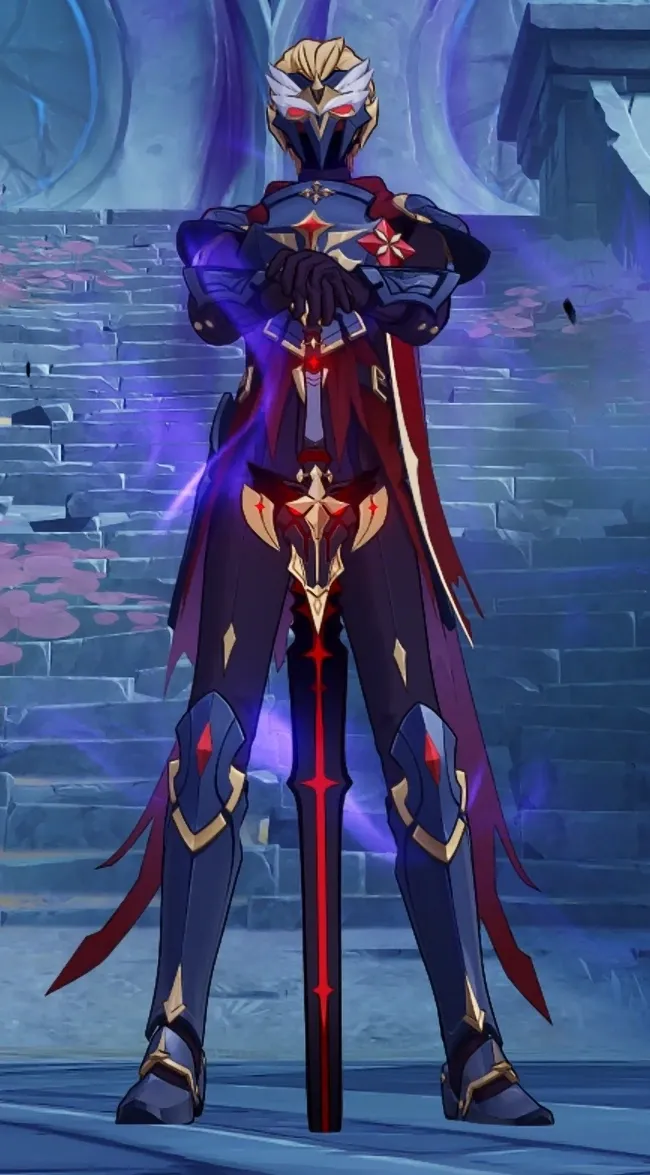
Pre-Cataclysm noble-born Knight of Favonius under Captain Arundolyn 500 years ago and a student of Wolf Pup Rostam; the White Knight to the Knights of Favonius, and the Bloodstained Knight after his descent. Wielder of the Black Sword and namesake of the Bloodstained Chivalry artifact set. After the Cataclysm he wandered westward and used Boreas's lingering power to create a domain of eternal peace for his fallen knights at Kipumaki Cliff. He pledged himself to the Abyss at an 'ancient fallen kingdom' in protest at the 'ultimate injustice' of the curse twisting that kingdom's people into beasts, and is presumed dead; the Abyss in turn learned everything from him. He killed the Viridescent Venerer on the continuing westward journey, and his story is the second incident in which the Boreas lineage was nearly extinguished. An imitation of Roland, fashioned by the Abyss, later led the Wild Hunt in Nod-Krai and Mondstadt after Rerir's expulsion, infested Andrius's remains, dueled Varka during Lupus Majoris Chapter Act I (Luna V / patch 6.4 / 25 February 2026), and expired during that same chapter, leaving the Wild Hunt leaderless with only a primal urge to destroy
Overview
A deceased Mondstadt knight, once the White Knight, later the Bloodstained Knight.
A noble-born Knight of Favonius who served under Captain Arundolyn 500 years ago.
Lost himself in slaughter, then pledged himself to the Abyss at a fallen kingdom.
Namesake of the Bloodstained Chivalry artifact set and wielder of the Black Sword.
An Abyss-made imitation of him later led the Wild Hunt, until Varka's Story Quest.
Roland, also known as the Bloodstained Knight and previously as the White Knight, was a noble-born member of the Knights of Favonius who served under Captain Arundolyn 500 years ago, in pre-CataclysmMondstadt, when Boreas still recognised the title of Knight of Boreas and Wolf Pup Rostam, Master of the Knights, was mentoring the order's brightest. Roland was Rostam's brightest student. He is the knight of the Maiden Beloved white-flower scene who held that chivalry was its own reward, the wielder of the Black Sword, and the owner of the artifacts the Bloodstained Chivalry set still preserves. He was also the knight who lost himself in slaughter, traveled westward after the Cataclysm, sealed his fallen comrades at Kipumaki Cliff with Boreas's lingering power, and pledged himself to the Abyss at an ancient fallen kingdom in protest at what he called "the ultimate injustice." His fate was lost, but he presumably died, and "because he had willingly given up everything to the Abyss, it in turn learned everything from him."[1][3]
A note on what Roland is not. Roland is a noble-born Mondstadt Knight of Favonius who pledged himself to the Abyss after the Cataclysm. He is not one of the Five Sinners of Khaenri'ah (that roster is closed at five: Rhinedottir, Vedrfolnir, Surtalogi, Hroptatyr, and Rerir), not an Archon, not one of the Four Shades, not a Sovereign, and not one of the Four Winds of Mondstadt. An older version of the Wild Hunt and Nod-Krai pages cast Roland as a folkloric figure from the Frostmoon Scions' oral history who stepped into the vacuum after Rerir's banishment; primary text released since Luna V supersedes that. Roland is a Mondstadt knight, and what led the Wild Hunt after Rerir's expulsion was an Abyss-made imitation of Roland, not Roland himself; that imitation's form expired during Varka's Story Quest .
1.
Roland - Genshin Impact Wiki (Fandom) · external ↗
2.
Wild Hunt - Genshin Impact Wiki (Fandom) · external ↗
3.
Bloodstained Chivalry - Genshin Impact Wiki (Fandom) · external ↗
4.
The Black Sword - Genshin Impact Wiki (Fandom) · external ↗
5.
Defender's Will - Genshin Impact Wiki (Fandom) · external ↗
6.
Deepwood Memories - Genshin Impact Wiki (Fandom) · external ↗
7.
Hunter's Path - Genshin Impact Wiki (Fandom) · external ↗
He goes by three names. Roland is the personal name. It was first revealed in the description of the 5★ Bow Elegy for the End, expanded across the Bloodstained Chivalry artifact set, and confirmed against the Bloodstained Knight title in the Lost Notes interactables on Wavechaser Plain in Nod-Krai; Roland himself was released as an NPC in Version Luna V (patch 6.4) in Varka's Story Quest Lupus Majoris Chapter: Act I - To Those Who Embark on the Expedition. The White Knight is Roland's Knights of Favonius title from his service under Arundolyn, before his fall, attested in Lupus Majoris Chapter Act I Part 1 Triumphant Warrior. The Bloodstained Knight is the name the artifact set bears, from after his fall; per Note 1, "while he was never granted the title before his descension to madness, his knighthood was already acknowledged by Boreas," so Boreas's recognition predates his turn to bloodstained chivalry and outlasts it. [1][10][3]
Mondstadt knight under Arundolyn and Rostam
The Bloodstained_Knight Story records that "Roland... was a noble-born member of the Knights of Favonius that served under Arundolyn 500 years ago. He was mentored by the Master of the Knights, Wolf Pup Rostam, who taught him chivalry, justice and swordsmanship, and as a result, became a powerful knight obsessed with justice." The date of 500 years ago places his service in pre-Cataclysm Mondstadt. The Cataclysm itself was 500 years ago; his service under Arundolyn came before it, even though the westward journey that follows falls in the same broad period. Boreas was still recognising the title of Knight of Boreas (Note 1: "his knighthood was already acknowledged by Boreas"), and Rostam himself held that title during the Cataclysm, per the Andrius page. Roland is the brightest of Rostam's students, said to have had the potential to be the mightiest Knight of Boreas. [1][5][12]
The defining scene from before his fall is the Maiden Beloved set: "Roland would often jump at the opportunity to correct any injustice he witnessed, and on one such occasion he saved the maiden in Maiden Beloved who fell in love with him. She tried to give him various rewards, but he insisted chivalry was its own reward and only accepted a white flower from her." Per the Trivia, the white flower is the Bloodstained Flower of Iron, a name that foreshadows what the same knight will become. Roland also had a blind brother who "traveled different nations to follow his sibling's footsteps but ultimately died in Sumeru"; the brother's story is carried by the Deepwood Memories artifact set. [1][11][6]
The descent into slaughter
Per the Fandom Bloodstained_Knight Story and the Black Sword weapon description, "Sometime during his many expeditions, Roland began to lose himself in the cutting down of his foes. He convinced himself that the feeling he was getting was satisfaction in justice being served and continued towards his goal of purging the world of evil. Another person tried to counsel him by telling him that slaughter in the sake of justice is still slaughter, but he didn't take their advice and continued on his path." The descent comes from a twisted altruism rather than outside corruption. Roland convinced himself the feeling was satisfaction in justice, and he rejected the counsel he was offered. Before Luna V, the Black Sword and Bloodstained Chivalry were the richest sources for this. [1][4][3]
Post-Cataclysm westward journey and Kipumaki Cliff
"Following the Cataclysm, Roland and those loyal to him traveled westward." That one terse line carries the chapter's geography. Roland leaves Mondstadt after the Cataclysm and heads west, and the "those loyal to him" line sets up the small band whose story ends at Kipumaki Cliff. "As Roland continued towards his goal, he became increasingly stained by blood from all the monsters he fought, changing the appearance of his sword, armor and accessories as they all became stained black. The people that he saved from monsters understandably fled in fear from him, seeing him as another monster." The line about people fleeing in fear foreshadows the "no different from monsters" line on which the Viridescent Venerer encounter turns. "Some of the Knights and a single Pale-Furred Wolf continued to follow him; aware of this, he asked them to cease, as his path was his to walk alone. The group, who revered him, explained their motives and Roland allowed them to continue, seeing as he had no right in denying them."[1]
The Kipumaki Cliff episode is the basis of the Nameless Bloodstained Monument World Quest in Nod-Krai. "Eventually, the knights fell in battle against a group of monsters near Kipumaki Cliff. Mourning the deaths of his comrades, Roland created a special space with Boreas' lingering power to grant them eternal peace and spared from the world's injustice, preventing anyone not deemed worthy by Boreas from disturbing them. The wolf, who survived the battle, would remain guard outside their resting place and eventually mutated into a powerful Radiant Glacial Wolf known as 'The Homesick Lone Wolf.'" The Boreas' lingering power draws on the same continuation of Boreas's spirit-form that the Andrius page describes, namely the Wolvendom spirit on the Mondstadt side together with the fragment on the Nod-Krai side. The Homesick Lone Wolf is a Local Legend at Ashveil Peak in Nod-Krai, revealed by The Wolves' Call Hidden Exploration Objective. [1][8][12]
The Abyss pledge at the ancient fallen kingdom
"He eventually came to the realization that there was no place left for him and went to an ancient fallen kingdom, intending to die in battle against the monsters there. However, he instead learned that the monsters were in fact the people of the fallen kingdom under a curse. He decides that this was the 'ultimate injustice,' and pledges himself to the Abyss. His fate was lost, but he presumably died; because he had willingly given up everything to the Abyss, it in turn learned everything from him."[1]
The "ancient fallen kingdom" is left unnamed on purpose; the Story section does not say which kingdom. By inference, reading the Bloodstained Chivalry artifact set against the Khaenri'ah curse of the wilderness (per the Khaenri'ah page), the fallen kingdom is Khaenri'ah. Its people under a curse match the curse of the wilderness, disclosed in Caribert, that twisted Khaenri'ahn humans into beasts (the Hilichurls). The source itself keeps the hedge, which is right for a page that leans on inference from artifact lore rather than a direct statement. The "ultimate injustice" is Roland's own phrase. It marks the moment, after his fall, that turns into the final pledge, and the pledge leads to the outcome in which the Abyss learned everything from him. [1][3]
The Viridescent Venerer encounter
Per the Bloodstained_Knight Story, the Deepwood Memories artifact set, and the Hunter's Path weapon: "At an unknown point in time after he had learned about 'the crime of twisting man into a beast's form,' Roland encountered the Viridescent Venerer, who had been tainted by relentless slaughter of Abyssal beasts. Seeing her as no different from monsters, the knight killed her before continuing his westward journey to settle the previously mentioned crime." The phrase "unknown point in time after he had learned about 'the crime of twisting man into a beast's form'" places the encounter after his pledge to the Abyss (the cursed people of Khaenri'ah are the crime Roland now turns toward). The no different from monsters line mirrors the post-Cataclysm Mondstadt people who fled in fear from him, seeing him as another monster, and the mirror is intentional. The Viridescent Venerer is the Anemo-themed predecessor whose artifact set, bearing her name, has been the Anemo damage-amplifier 4-piece set players have farmed since launch; the Roland encounter is how she dies in-universe. [1][6][7]
The Boreas-lineage second extinction
"Roland's story would be known as the second incident in which the Boreas lineage was nearly extinguished. The story was lost to many people, including those in the Knights, leading to only the most highest-ranking members and a select few knowing the truth." The word second matters. The first incident is Andrius's own near-extinction (per the Andrius page: the split of the Wolf of the North's soul, the second arrival at Mondstadt, and the death in which he passed into the Ley Lines). Roland's story is the second such near-extinction, after which the Boreas lineage remains under strain across the succession of Knights of Boreas after the Cataclysm (Rostam, then a pause when Roland departed, then Varka's eventual accession as Grand Master and Knight of Boreas). That the story was lost to many explains why the Knights after the Cataclysm keep no shared memory of Roland. Only the highest-ranking members and a select few guard the truth. [1][12]
The Wild Hunt imitation - post-Rerir-expulsion command
Per the Bloodstained_Knight Story and the Wild Hunt page: "Following Rerir's expulsion as the leader of the Wild Hunt, the Abyss created an imitation of Roland to lead them in his stead. This imitation also infested Andrius' remains, twisting his thoughts and leaving the wolf god unable to find peace."[1][2]
The succession is precise. The figure that led the Wild Hunt after Rerir's Welkin Moon Act IV banishment is an Abyss-made imitation of Roland, not the historical Roland (who died after the Cataclysm, centuries before Rerir's banishment in Act IV, per the reading of his pledge to the Abyss). What made the imitation possible was everything the Abyss learned from Roland when he pledged himself to it. Per the Wild Hunt page: "The Lightkeepers classify the Abyssal phenomena at Kipumaki Cliff and elsewhere in northern Nod-Krai as part of the Wild Hunt, although they noted that it was different than the normal Wild Hunt. Rather than being controlled by Rerir, the Wild Hunt in northern Nod-Krai was caused by Rotwang and his disciples." The two run at the same time and are distinct. The Roland imitation is the main thread of the Wild Hunt in Nod-Krai and Mondstadt after Rerir's banishment, while Rotwang and his disciples run the variant in northern Nod-Krai. Both belong to the Wild Hunt; neither subsumes the other. [2][15][16]
The infestation of Andrius's remains links this page to the Andrius page's reading of the Welkin Moon arc. Per the Andrius page, Andrius's Nod-Krai fragment became warped by the Abyss, which manifested a form of Roland, the same White Knight whose turn to bloodstained chivalry had paused the line of the Knights of Boreas during the Cataclysm. The corruption works on the Nod-Krai side of Boreas's split soul (the fragment on the Mondstadt side is the Wolvendom spirit that adopted Razor), and the Roland imitation's command of the Wild Hunt across Nod-Krai and Mondstadt is bound up with the corrupted Boreas fragment it occupies. [1][12]
Varka's Lupus Majoris Chapter Act I - duel and the form's expiry
Per the Bloodstained_Knight Story: "Roland would lead the Wild Hunt in Nod-Krai and Mondstadt, confronting and seemingly killing Varka during their duel, unaware that the Knight of Boreas had done so in order to get to the wolf's heart. When he learned what he planned to do, Roland lamented his inability to bring him salvation, but after Varka revealed his plan, Roland unleashed all the souls he had killed in an attempt to prevent him from escaping. Varka escaped from the domain and ran into Roland's sword on the way back, telling the sword that while he did not meet the real Roland, he hoped that Roland knew that Rostam and Arundolyn had cared for him." The duel takes place in Lupus Majoris Chapter Act I - To Those Who Embark on the Expedition, released in Version Luna V (patch 6.4). Its parts include Part 1 Triumphant Warrior (where the White Knight is disclosed) and Part 3 Lonely Warrior (where Varka speaks to Roland's sword about Rostam and Arundolyn). [1][9]
Per the Wild Hunt page: "After Roland's form expired during the events of Varka's Story Quest, Lupus Majoris Chapter: Act I - To Those Who Embark on the Expedition, the Wild Hunt is left leaderless, with a simple, primal urge to destroy." The wording form expired sets it apart. The Roland imitation is not killed the way Rerir was banished; its expiry is a deeper collapse of the imitation the Abyss made. As a result the Wild Hunt is left leaderless, with a simple, primal urge to destroy. That tests whether it can keep running on its own as a Moon Gate phenomenon, and it passes the test by continuing without a central leader. The Andrius page describes the resolution of Lupus Majoris Chapter Act I as doing two things at once, defeating the imitation and transferring Andrius's Nod-Krai fragment back to the Ley Lines, and this is what lies behind the leaderless aftermath. [2][12]
The bloodstained sword in Ashveil Peak
Per the closing lines of the Bloodstained_Knight Story: "Varka escaped from the domain and ran into Roland's sword on the way back, telling the sword that while he did not meet the real Roland, he hoped that Roland knew that Rostam and Arundolyn had cared for him." The sword is left in a stone at Ashveil Peak in Nod-Krai, the same place the Homesick Lone Wolf Local Legend occupies, surfaced by The Wolves' Call Hidden Exploration Objective. Primary text leaves open whether the narrating voice of the sword in the Wavechaser Plain Lost Notes and the Ashveil Peak interactables is Roland's ghost, or an imprint in a sentient sword that is independent of the consciousness of a man presumed dead. [1]
What primary text leaves unstated
The following remain uncertain.
The exact moment and circumstances of Roland's death. The wording "His fate was lost, but he presumably died" is the primary text's own; whether he died inside the ancient fallen kingdom, on the continuing westward journey after the Viridescent Venerer encounter, or at some later point is unstated. The presumably is a deliberate hedge. [1]
Whether the "ancient fallen kingdom" is Khaenri'ah explicitly. The Story section keeps the hedge; the lore of the Bloodstained Chivalry artifact set gives the most support for the Khaenri'ah reading, but the Story section does not name it. Keep the hedge unless future primary text closes the inference. [3]
What exactly killed the blind brother in Sumeru. It is unstated whether he died seeking Roland directly, was caught up in Abyssal corruption that followed from Roland's path, or died for unrelated reasons. The lore of the Deepwood Memories artifact set is the richest source for this. [6]
Whether the Bloodstained Sword's sentient narrator at Ashveil Peak is Roland's ghost, a sentient-sword imprint independent of his consciousness, or a fragment of the Abyss-made imitation that expired during Lupus Majoris Chapter Act I. The line in the HEO about waiting for someone to wake from its slumber leaves this open. [1]
The full list of sub-quest parts in Lupus Majoris Chapter Act I. References on the Roland page confirm Part 1 Triumphant Warrior and Part 3 Lonely Warrior; whether a separately titled Part 2 exists, and what its title is, has not come out. The Varka page's suggestion, from before Luna V, that "Triumphant Warrior" might be a separately titled Varka SQ chapter is rejected (Triumphant Warrior and Lonely Warrior are parts of Lupus Majoris Chapter Act I; that earlier suggestion worked from pre-release uncertainty). [9][13]
Whether future imitations made by the Abyss can reverse the Wild Hunt's leaderless state after the Roland imitation expired in Lupus Majoris Chapter Act I. The line with a simple, primal urge to destroy keeps the Hunt running on its own as an autonomous Moon Gate phenomenon; it is held open whether future primary text introduces a new commander or keeps the Hunt leaderless. [2]
Etymology and trivia
Per the Etymology section of the Roland page: "Roland is a primary character in the Matter of France and Western European legends, he is one of the twelve paladins who serves Charlemagne. Roland statues, knights with a drawn sword, protecting the city hall or market square, were often found in medieval German cities. Even today, many such statues still exist. One particularly famous example is the Roland of Bremen. He is part of a UNESCO World Heritage Site." The Roland statues in medieval German cities fit the Germanic naming of Genshin's pre-Cataclysm Mondstadt (the same pattern from Germanic mythology behind Rerir, Dainsleif, Surtalogi, Hroptatyr, Vedrfolnir, and the broader Khaenri'ahn and Mondstadt names). The Roland of Bremen, a UNESCO World Heritage Site, is the closest real-world reference for the Genshin figure. [1]
The literary namesake is also picked up on the La Chanson d'Erinnyes book page. Per that book's Trivia, the Fontaine V4.2 Book Collection La Chanson d'Erinnyes is "named after the Song of Roland (French: La Chanson de Roland)," the 11th-century Old French chanson de geste whose roster of Matter of France paladins the book borrows wholesale. Every named knight is taken from the Roland cycle (Otkerus of Rhenanie, Blancandrin, Marsile, Guillaume of Gellone with the sword Narbonnais, Naimes, Tulpin, Fierabras, and the inversion that reassigns Hauteclaire from Olivier). The Lochknight roster draws its names from the same literary source. Per the Trivia on the Roland page, the Maiden Beloved artifact set details a certain woman's unrequited love for Roland, and the flower she gives him is the Bloodstained Flower of Iron. [17][11]
Roland's order is the Knights of Favonius, and his mentor Wolf Pup Rostam and Captain Arundolyn are currently covered on the Andrius page rather than on pages of their own. The successor Knight of Boreas who duelled his Abyss-fashioned imitation is Varka, and the Boreas spirit whose remains that imitation infested is, again, Andrius. His thread in the Wild Hunt runs alongside Rerir, whose expulsion it followed, and Rotwang, who led the variant in northern Nod-Krai; the Wild Hunt page gives the overall picture. The wider background is the Cataclysm and the ancient fallen kingdom he pledged himself to, read by inference as Khaenri'ah; his literary namesake sits on the La Chanson d'Erinnyes book page.