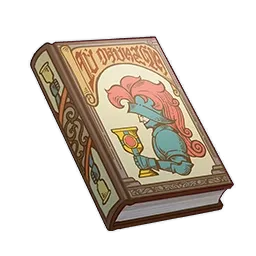
La Chanson d'Erinnyes (French "The Song of Erinnyes," CN 伊黎耶之歌 Yīlíyé Zhī Gē) is a 3-volume Fontaine Book Collection released in Version 4.2, the same patch that introduced The Fall of the Faded Castle and Tales of a Snow-Winged Goose, a three-book V4.2 release block all set in the Remurian past. The book is named after the Song of Roland (French: La Chanson de Roland), the 11th-century Old French chanson de geste, and it borrows that cycle's paladin roster from the Matter of France wholesale: every named knight in the volumes is lifted from the Roland-cycle index. The arc the three volumes stage is the pre-Egeria Fontainan resistance against the Remurian conquest, led by the Lochknight Erinnyes, and the book is the main source for the Lochknight roster. [1] [2]
Vol. 1 - the emissary at Aremori Castle
Vol. 1 opens with the standing description "How the emissary of King Remus came to Erinnyes, asking her for a gift of Aremori Castle's water and earth, and for her to submit to the Sumphonia Capitolii (which means 'the eternal harmony')." Erinnyes has just defeated the princes of "Bellouacoi, Atrebatis, and Uiromanduoi" (Gaulish tribal names lifted from real-world Bellovaci/Atrebates/Viromandui), and "the residents of those lands knew of the kindness of the Mistress of Many Waters, submitting to her rule with sincerity. To celebrate that fealty and wisdom, eight days of feasting were ordered in Aremori Castle, with all to be treated as honored guests." On that day a musician arrives, "an emissary dispatched by King Remus of Capitolii, claiming to have a message to deliver," bearing "a golden-tipped fasces as a symbol of his status," the Roman magistrate's emblem and a marker of Remurian office. [1]
The emissary's demand is the old-world tribute formula of submission: "King Remus asks of you two gifts, as legitimate tribute. The first is water, for the purest of waters can wash away all sins. The second is earth, for dense earth can resist the erosion that looms." Under threat ("Should you dare resist, death shall be sure to follow"), Sir Guillaume of Gellone draws "the sacred blade Narbonnais from its scabbard" in rage; "more of the brave knights drew their swords, including Knight Blancandrin and his compatriot Knight Marsile." But Erinnyes restrains them ("the emissary from Capitoliani was not to be harmed") and returns her reply: "in this whole world, there is only one to whom we bend the knee ... the beneficent Mistress of Many Waters, our mistress, who bears for us our sins, the greatest and most honorable ruler." The emissary closes the volume with King Remus's defense of harmony through conquest: "Those who once fought against each other have been brought to peace under a single ruler, and this is wisdom ... King Remus's orders are well-meant and born of pity. He does not wish to see a single person fall into the waters. He would see all saved." [1]
Vol. 2 - the knights pledge their swords, and the Capitoliani are denounced
Vol. 2's standing description ("How the Knights of every region united to lend their strength to Erinnyes, in opposition to the designs of the Capitoliani to invade") turns the volume into a roll-call of the Lochknights. Knight Drest, Prince of Lyonnais, "the fine bowman," is first to speak: "The harmony and prosperity that Vivarium's heir has promised us are naught but lies, his promise but trickery ... Knight Erinnyes of the Lakelight, none so wise and noble as you should be taken in by such pretense ... It may be dazzling to watch, but the pain it brings shall be all the greater." His fair companion Adsiltia, "the lady of the azure sail, whose name meant 'daughter of ice,'" sharpens the indictment to a name: "Vivarium's heir is the least trustworthy of traitors. That he would have such harmonious congress with Boethius is completely bewildering." The book names the Harmost Boethius directly. The "Vivarium's heir" epithet reads safely as shorthand for a second figure inside the Capitoliani court: Vivarium is the real-world monastery of Cassiodorus, whose name-twin is the Harmost Cassiodor, though the book does not equate the two on-page. [1] [5]
Adsiltia closes her speech with the volume's central oath: "Let the evil disappear like dew in the sun. Oathbreakers and the unjust will be driven from this world. And in this way, songs will be sung of your wisdom, for those who seek to exact the debt of bloodshed will be remembered by those in misery." The roster swells: "Sir Naimes, Sir Tulpin, and all the other noble knights lent their swords to the fight." Erinnyes addresses the emissary one last time: "The Mistress of Many Waters has granted us all equal honor. There are none greater who shall trample me, none lesser who must envy me. And I am to lead her blessed army to destroy the white dragon and the grand city, and to cleanse their bodies in their own blood." The emissary is then dispatched back to Carubdis Castle, the seat of the Capitoliani court (Carubdis being the Latin form of the Greek sea-monster Charybdis), with "wondrous gifts" prepared by Sir Fierabras, escorted as the volume's coda. [1]
Vol. 3 - Hauteclaire returned three times to the lake
Vol. 3 leaves the war frame entirely. Its standing description ("How Erinnyes bid farewell to the Mistress of Many Waters, and how she threw her sword into the lake three times") opens onto a confessional scene at a lake-shore, with the "Queen of Many Waters" granting Erinnyes's request to be remembered and to have her surviving knights forgiven. "O Queen of Many Waters," Erinnyes prays, "I confess to you my sins and do not hide my evil, for they are too grave to be forgiven ... There are no angels or divine edicts. In your kind and loving land, only sin may determine sin, and only people may judge people." Then "the knight with sea-colored eyes" draws her sacred sword: "Oh fair Hauteclaire, Sword of Light! How you shine under the blazing sun's beams!" The sword has a "golden hilt inlaid with jewels." [1]
The three-throw sequence is spelled out. On the first throw Erinnyes invokes her own bloodguilt ("Countless sins stain my coat, for I bear the guilt of bloodshed. I have taken lives, even that of the righteous, yet still you shine ... Beautiful and holy Lakelight, I return you now to the lake!"), and the sword "did not sink and drifted back to her feet." On the second she invokes Hauteclaire's provenance: "Daeira, that maiden by the lake, that noble lady of pure waters, gifted you to the chief of knights so she could perform countless deeds. She once used you to conquer Peiregord; she once used you to defeat Aisias. Even the fae of the distant south could not seize you." Again the sword drifts back. On the third she prophesies a future bearer ("By your blade were so many conflicts settled in peace, and the ravages of war laid to rest in these lands. One day there shall be one nobler than I, seven times more so, who will lift you again, and they shall do deeds seven times greater"), and the sword finally "sank without a trace." Erinnyes departs with "the spirit who had been by her side from the start, never again to be seen by any in this world." [1]
The Lochknight roster
Across the wiki, the book's main job is to anchor the Lochknight roster. The Lochknights were "a group of knights who were charged with the duty of protecting Oceanids ... one of the rebel groups led by the Lochknight Erinnyes to resist Remus' rule over Remuria," who "swore by armor of stone" and "pledge[d] faith in Egeria." Their full member list reads: Erinnyes (leader), Agricane, Blancandrin, Drest, Guillaume of Gellone, Kudenin of Dunnaer, Marsile, Naimes, Otkerus of Rhenanie, and Tulpin. Nine of the ten names trace to citations of La Chanson d'Erinnyes itself; only Kudenin of Dunnaer is named outside this book, in NPC dialogue from Tolfin. The Vol. 1 mention of "Otkerus of Rhenanie, a righteous and noble knight, and his valiant battle against a venom-breathing dragon," invoked in the narrator's transition into the main scene, counts too, even though the dragon-battle itself is skipped to reach the Erinnyes thread. [2] [1]
The Lochknight story continues past this book's frame. "Not long after Remuria collapsed, they shed their armor," and "the concept of Lochknights completely died out a few decades after Remuria's fall," but their descendants "join[ed] the Marechaussee Hunters, a group of heroes gathered by the Golden Hunter to wipe out the monsters threatening the peace of Fontaine." The Golden Hunter is Cassiodor, the surviving Harmost who took the name Ouranides of Ouranopolis after the fall. Cassiodor and Erinnyes were of the same Fontainan tribe, which makes the Hunters' founding a reunion of the two halves of the anti-Remurian resistance under one banner after Remuria's fall. [2] [6]
Sumphonia Capitolii, Vivarium's heir, and the canon-safe Egeria reading
The book records a small set of Remurian terms the wider wiki treats as settled. "The Sumphonia Capitolii (which means 'the eternal harmony')" is the in-poem name for the Grand Symphony Phobos, the Remurian fate-symphony described on the Remuria page and in the V4.6 Canticles of Harmony chain, though the book itself does not name Phobos; the match is one of translation and function, not a name on the page. The Vol. 2 "Vivarium's heir" epithet is handled with the same caution: Vivarium is the real-world monastery of Cassiodorus, whose name-twin Harmost is Cassiodor, but in the poem Adsiltia distinguishes "Vivarium's heir" from Boethius ("That he would have such harmonious congress with Boethius is completely bewildering"), so the book does not equate the heir with either Harmost on-page. [1] [7] [5]
The "Mistress of Many Waters" and "Queen of Many Waters" epithets that Erinnyes prays to in Vols. 1 and 3, and the "Daeira, that maiden by the lake, that noble lady of pure waters" attribution that gifts Hauteclaire to "the chief of knights" in Vol. 3, can safely be read as pointing to Egeria. The cross-reference supports it: the Lochknights "pledge[d] faith in Egeria," and "there is an ancient legend that claims that Egeria gave a Lakelight Lily to the last Lochknight as a farewell gift," which places the Mistress close to Egeria. But the book itself never names Egeria, so the page keeps the equation ambiguous rather than asserting it. Both readings (Mistress = Egeria; Mistress = a distinct pre-Egeria Oceanid lady-of-the-lake in the same lineage) sit consistently with the cross-reference. [2] [1]
The Song of Roland behind it
The book's title parallels La Chanson de Roland, the 11th-century Old French chanson de geste foundational to the paladin cycle of the Matter of France. The Vol. 1 opener uses a Roland-cycle convention directly: "Of the glorious deeds of Otkerus of Rhenanie, a righteous and noble knight, and his valiant battle against a venom-breathing dragon, Much has already been said earlier that we shall draw to a close here," the same "of this matter, we have spoken enough" transition the Chanson de Roland uses to skip between incidents. The in-game book never names these real-world parallels; the connection lives in the title and the roster. The Matter of France names that appear in the book (Otkerus of Rhenanie, or Otger the Dane; Blancandrin; Marsile; Guillaume of Gellone; Naimes; Tulpin, or Turpin; Agricane; Fierabras; and the sword Hauteclaire, which is Olivier's sword in the source-text Roland cycle, re-assigned here to Erinnyes, with Narbonnais as Guillaume's blade) together form a near-complete Roland-cycle paladin index transposed into Fontainan Lochknight roles. The Vol. 3 Hauteclaire-to-the-lake three-throw scene parallels the Arthurian episode of Bedivere returning Excalibur to the Lake, where Bedivere throws twice and lies and the sword sinks only on the third throw. That extends the borrowing from the Matter of France into the Arthurian Matter of Britain, though again the book names neither. [1]
Where the volumes are shelved in-game
Vol. 2 is stocked at Hubel's newsstand in the Court of Fontaine, the same newsstand that carries The Fall of the Faded Castle Vols. 2-3, Time Trekker Vols. 1-3, Perinheri Vols. 1-2, Fables de Fontaine Vol. 1, Robben versus Chesterton Vols. 2-3, The History of the Decline and Fall of Remuria Vols. 1+3, Tales of a Snow-Winged Goose Vols. 1-3, and Two Musketeers Vols. 2-3. Vols. 1 and 3 are obtained elsewhere in the world; the stock list names only Vol. 2 for this Book Collection. [4]
What the book establishes, and what it leaves open
What holds up here: the 3-volume Fontaine V4.2 structure inside the V4.2 release block with The Fall of the Faded Castle and Tales of a Snow-Winged Goose; the "named after the Song of Roland" parallel; the book's role as the source for 9 of the 10 named Lochknights; the "Sumphonia Capitolii = the eternal harmony" translation, which matches the Grand Symphony Phobos in function; the water-and-earth tribute formula as Remurian conquest practice; the Aremori Castle (Erinnyes's seat in Lakelight) and Carubdis Castle (the seat of the Capitoliani court) location pair; and the three-throw Hauteclaire-to-the-lake scene with its Bedivere-Excalibur echo and its "one nobler than I, seven times more so" future-bearer prophecy. [1] [2] [3]
What does not hold up on-page, and is kept ambiguous, is any on-page identification of Egeria with the "Mistress of Many Waters" / "Queen of Many Waters" / "Daeira" epithets. The book never writes the name Egeria, even though the cross-reference to the Lochknights' "pledge[d] faith in Egeria" and the "Egeria gave a Lakelight Lily to the last Lochknight" legend makes the equation a safe reading. Also unanchored on-page: the identification of "Vivarium's heir" with any specific Harmost (Adsiltia distinguishes the heir from Boethius); the identification of the white dragon and the grand city Erinnyes vows to destroy with Capitolium or any specific Remurian construct, which the book leaves un-equated to Domus Aurea or Phobos; and the identification of the spirit who had been by Erinnyes's side from the start, who departs with her in Vol. 3, with any named entity. The Vol. 3 prophecy "one nobler than I, seven times more so, who will lift you again" is left open. The book does not name Furina, Neuvillette, Clorinde, or anyone else as the prophesied bearer of Hauteclaire, and the page keeps the prophecy as an open, forward-looking ambiguity. The book is not a historical chronicle in the manner of The History of the Decline and Fall of Remuria; it is a chanson, a heroic-cycle poem whose borrowing from the Matter of France signals literary style rather than documentation. [1] [10] [9]