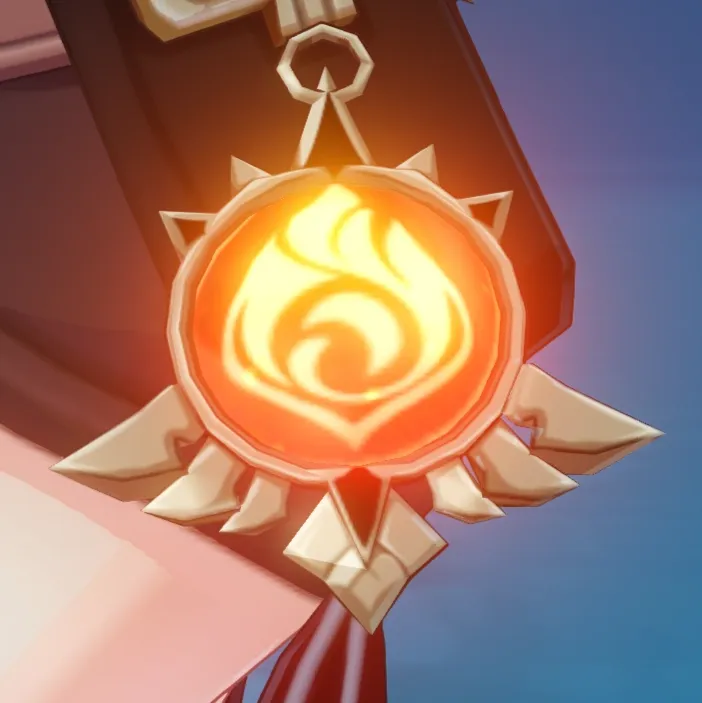
An Allogene is the in-world name for a Vision-bearer. The term turns up most prominently in Sumeru, used by the Akademiya and in the Archon Quest dialogue Nahida shares with the Outlander, and it is uncomfortable in a way the everyday "Vision-holder" is not. It makes the Vision system's character visible. An Allogene is not "someone Heaven blessed" but "someone Heaven noticed and tagged." The Chinese form, 原神 Yuánshén ("Primordial God" or "Original God"), is identical to the game's title, per a translation note, which also acknowledges the Gnostic root: in Gnosticism, "Allogenes" is the half-human, half-divine figure who in some stories becomes fully divine. [1]
The Akademiya reportedly tried to suppress the term, because its plain reading makes the Vision system too legible. That system is a channel through which Celestia recruits and monitors people. It binds an exceptional person's elemental potential into a fragment of an Archon's Authority, maps it to a constellation, and, by the Narzissenkreuz Ordo's reading, sells it "to the 'fate' of this world, to Heimarmene." [9] That is the mechanism the in-game text spells out, and the warmer "gift" framing quietly contradicts it.
What we know
- Distribution. Fandom's Allogene page describes Visions as "bestowed by Celestia and the Seven Archons to allogenes, people of Teyvat with particularly powerful desires who have the potential to ascend to Celestia and become gods themselves." That last clause is the common belief, which Chapter VII Act VI overturns (see below). For the Archons, the process is automatic. The Seven Archons distribute Visions as part of their duty without choosing the recipient or knowing the recipient's desire, and issuance triggers when a "powerful desire stepped into the threshold of the sacred." [1]
- After the War of Funerary Flame. The system was established "as part of a 'new order' over the world, alongside the rise of The Seven [...] created to suppress the world's original order in place of the Heavenly Principles's absolute authority, which it could no longer maintain after being gravely injured during the War of Funerary Flame." Allogenes are who that new order was aimed at. [1]
- Authority, not strictly the Archon. Per Neuvillette's Vision Character Story, Visions come from whoever holds the elemental Authority. When the Hydro Sovereign Neuvillette regained his full Authority at the close of AQ IV Act V, he willingly set aside a portion for humans to claim. Allogene eligibility follows whoever holds the Authority, not the Archon title as such. [2]
- Revocation. The Vision Hunt Decree in Inazuma is the on-screen worked example. The Raiden Shogun's puppet confiscated Visions from Inazuman Allogenes; those confiscated lost their elemental power entirely, and several (Tejima, Kurosawa Kyounosuke, Domon) lost the defining ambition or memory that had produced the Vision. Allogenes are bound to the Vision in a way that Adepti and Archons, who keep their elemental ability after surrendering a Gnosis, are not. [3]
- Non-human Allogenes. The adepti Xiao, Yae Miko, Kirara, and Xianyun, and the melusine Sigewinne, all receive Visions. Per Xiao's Vision Character Story and HoYoLab Developer Insight #4, adepti can manipulate the elements without an external Vision but wear them "to comply with the expected norm." The game asks whether their Visions are the same as humans' and does not answer. [10]
- Artificial Allogenes. Albedo (a Khaenri'ahn-alchemy homunculus, Geo Vision), the Wanderer (a Khaenri'ahn puppet, his Electro Vision forged by Akademiya sages using captured Nahida-authority, functional but qualitatively different by Nahida's reading), and Ineffa (a Nod-Krai robot, Moon Wheel) all receive Visions despite not being natural humans. What makes an Allogene is not biology; it is desire. [6] [7]
Allogenes are not Descenders
Allogenes and Descenders are different categories, and the difference matters for how the Traveler is understood. Allogenes live inside the Vision system; Descenders stand where the system cannot reach. (Immunity to Vision distribution is the first of the traits that set the Outlander apart, laid out on the Traveler page.) The worked example is the Outlander: per the Traveler's Vision Character Story, the Traveler cannot receive a Vision, since they are an outsider to Teyvat. Yae Miko hedges this in AQ Chapter II Act III Omnipresence Over Mortals ("ambition should be something that transcends the world below and the starry sky above. Something that shines in unison with fate itself"), but the primary text still treats a Vision as impossible for the Traveler. [5]
Allogenes take part in Teyvat's Vision system. Not every outlander is a Descender; Rene says the title belongs only to wills capable of rivaling an entire world. Released text identifies the Heavenly Principles, Nibelung, and the player-character Traveler in numbered positions, with Saarelainen only the strongly implied Third candidate. Skirk is an explicit outlander who denies being a Descender. The Traveler is a Descender, not an Allogene.
Can Khaenri'ahns hold Visions?
Khaenri'ah was godless. As Dainsleif frames it in Travail, it was a civilization built "purely by humans without involvement from any god". The Vision system runs on fragments of Archon Authority under the Seven Archons; Khaenri'ah operated outside that, recruiting "humans who did not follow the gods" as Eide discloses in AQ Chapter III Act VI Caribert. The natural inference, that Khaenri'ahns can't get Visions, is the folk reading the wiki has long noted. [4]
The reading is uncertain. The primary text does not assert "Khaenri'ahns are barred from Visions" as a rule. The inference rests on three observations: the godless-civilization framing leaves out the Archon Authority the system runs on; no pre-Cataclysm Khaenri'ahn with a Vision is on record; and Caribert, the half-Khaenri'ahn, half-Mondstadter child hit by the worst of the Cataclysm degeneration per Eide's disclosure, received the curse of the wilderness (a hilichurl form), not a Vision; the primary text never raises the Vision question for him at all.
But Kaeya breaks an absolute version of the rule. Current quest material identifies him as a pure-blooded Khaenri'ahn of the Alberich Clan, yet he holds a Mondstadt Cryo Vision and ages normally. His four-pointed-star pupils support strong Khaenri'ahn heritage but do not, by themselves, establish descent from the Eclipse Dynasty. The folk reading cannot account for his Vision or his apparent exemption from the immortality curse; the two unexplained facts may be related, but the game has not said that they share a mechanism. [4]
What ascension is for: Chapter VII Act VI
The end of the path comes into view at the close of Act VI, inside Celestia's Divine Throne. Nukvah, the voice that meets the nations' representatives there, uses the two words as one: "each of you is to select a single Vision bearer — or 'allogene,' as they are also known — whom you deem to be most worthy of preservation. They shall ascend to Celestia as the final record of this civilization." It explains what they become. "As 'Vectors of Fate,' they shall guide the next cycle of civilization toward a better future. This is the definition of transcending and attaining immortality." That, it says, "is also the highest calling of the allogenes, and their greatest value to Teyvat." [17] [18]
Venti asks the question legend never answered: "Where are the allogenes who ascended to Celestia in the past? Where is Vennessa right now, for instance?" Nukvah shows a flashing light that marks the "Disembodied Divine Consciousness, Essential Self, and Mind Storage Core," then puts it more simply: "where Vennessa is stored." The in-game text glosses the three parts as soul, personality and memory. To Paimon's outrage it answers that "The form life takes is insignificant. An allogene's foremost duty is to guide fate." Asked by Ningguang whether they are "fodder," it allows, "In extreme cases, that is correct. Although 'fuel' would be a more accurate descriptor." [17] [19] [20]
Why let allogenes guide anything at all? Nahida asks, and the reply is "the optimal result arrived at through immensely complex and extremely lengthy calculations": "Only humans created according to these rules can most closely model humanity as recorded in the database." The game's Guiding Notes now say the same thing in their entry on allogenes: "The truth behind this is their conversion into Vectors of Fate, which will guide all life in Teyvat toward a better future." [17] [21]
The old belief does not survive the audience. "All this time, Paimon thought being an allogene was a good thing," Paimon says. "You know, ascend to Celestia, become a god... It's everyone's dream." Venti: "That's what everyone thought until now." Mavuika finally understands a verse the Hallowing released from the Sacred Flame, "If the intention yet remains, achieved the allogene's truth he has," and sums it up: "Allogenes are turned to fuel that drives the world in a better direction..." Venti's answer is a refusal: "Allogenes should get to define themselves in their own terms." [17]
Only Vennessa is shown. Nukvah locates no other ascended allogene, and nothing in the act says whether all of them are stored the same way.
What canon has not surfaced
- Whether all Allogenes are Vision-bearers. Per the Vision lore: "While all Vision wielders are allogenes, whether all allogenes are Vision wielders has not been addressed." Nukvah's "a single Vision bearer — or 'allogene,' as they are also known" treats the words as synonyms without settling the question. Vennessa is the one ascended Allogene the story has located (in the legends of Mondstadt's founding, the Venti manga, and Chapter VII Act VI), and she is never shown with a Vision. [8] [17]
- What Celestia receives back. The game confirms "the gods supposedly gain something when Vision-bearers successfully fulfill their goals." Act VI gives Nukvah's side of it: the chosen guide fate as "Vectors of Fate," serve in extreme cases as "fuel," and "Progress is possible only by feeding the evolution of civilization back into the system." How that works, and what a stored allogene experiences, is not shown. Before Act VI, the Narzissenkreuz Ordo's reading of Heimarmene framed it as binding people to fate, and the Fatui Harbingers' "skies are fake / stars are a lie" framings read it as a harvest under a false sky. [9] [17]
- Whether a forged Vision counts. The Electro Vision the Akademiya forged for the Wanderer works, but by Nahida's account it is qualitatively different. Whether that makes him an Allogene, or only something close to one, stays open. [7]
An Allogene is "someone Heaven noticed," the Teyvat word for a Vision-bearer. The Sumeru Akademiya tried to suppress the word because it makes plain that the system is a Celestial channel for recruitment and monitoring rather than a reward. Chapter VII Act VI shows where that channel led for Vennessa. Whether Khaenri'ahn-descended people can hold Visions is uncertain, and Kaeya is the case the folk reading can't resolve. Descenders are a different category, and Allogene and Descender are not interchangeable words.