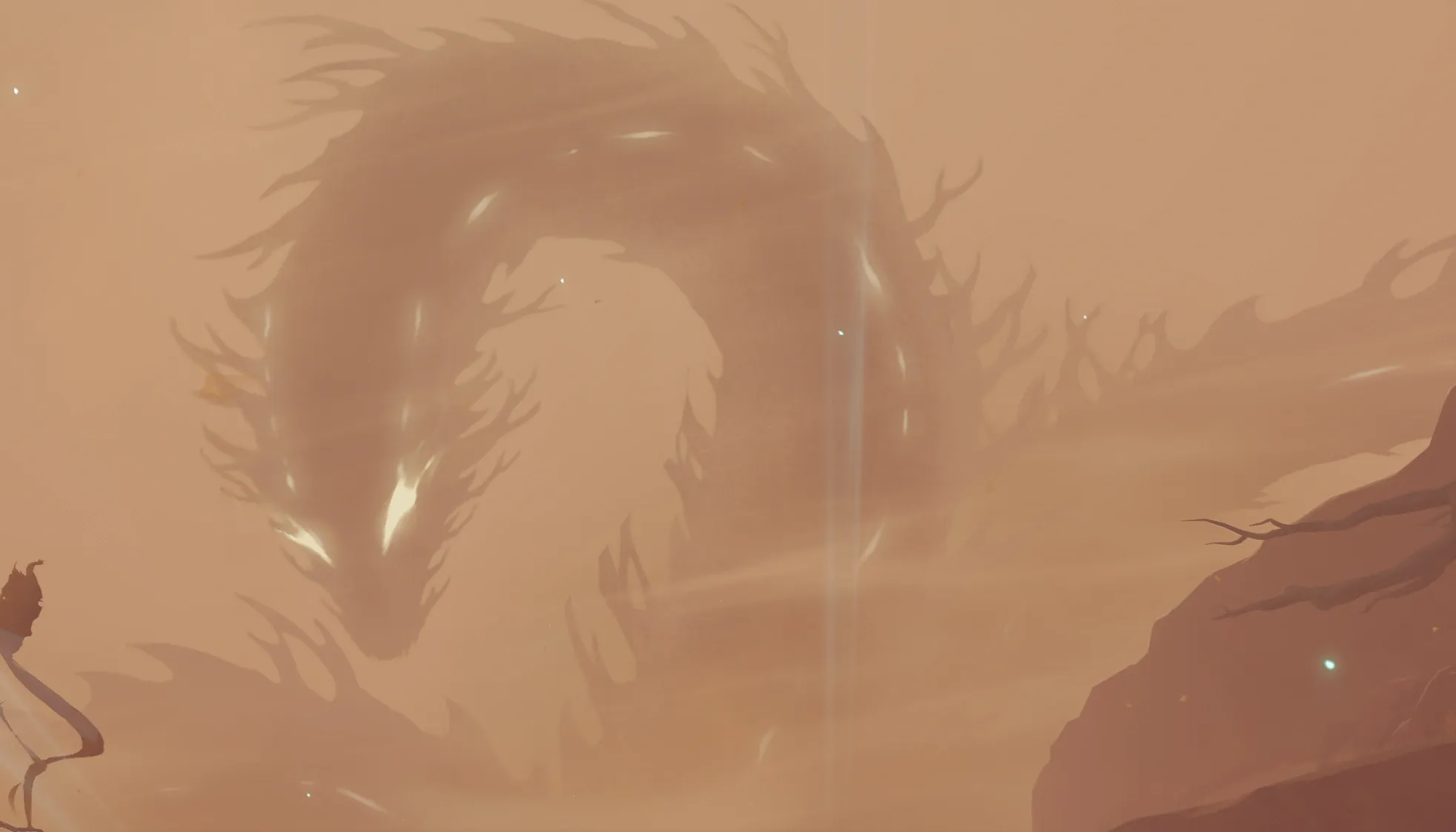
Apep is the Dendro Sovereign and the seventh Pillar of King Deshret. The two roles sit at different levels of the world. As Sovereign she belongs to the old order that predates the Archon system the Heavenly Principles installed; as the seventh Pillar she sits inside King Deshret's pre-Cataclysm desert order. Primary text treats her as holding both at once, and Welkin Moon Act IX As All Falls to Emptiness (Luna VII, Version 6.6) is the act that brings the second one fully into view for the first time. [1] [2]
Her case is sometimes set beside Egeria's on the Hydro side, but the two differ. Egeria was Fontaine's first Hydro Archon and never a Sovereign; Apep is both the Dendro Sovereign and the seventh Pillar, a Sovereign who never simply collapsed into an Archon role. The Dendro version is below. [9] [6]
What we know
- Apep is the Dendro Sovereign and fought alongside Nibelung, the Dragon King whom Fandom counts as the Second Descender, in his war against the Heavenly Principles. [2] [7] [6] Fandom's Apep and Seven Sovereigns pages make her his ally in that war, not his descendant. [5] [6] Fandom ties her to the first Celestial Nail only through Sumeru's desertification, which it says was aimed at the forbidden knowledge she had gathered; neither its Apep page nor its Celestial Nail page says the Nail wounded her or that she was sealed under the desert. [4] [5]
- Apep is the seventh Pillar of King Deshret, counted as in agreement in the Mausoleum scene of Welkin Moon Act IX Ancient Shadows Re-Emerge because she was helping Nahida at the Heart of Oasis during the same act. [1] [3]
- King Deshret is a separate god, not a Sovereign. Apep is the only Sovereign among the Seven Pillars; the other six (Thoth; Heryshaf and Sobek, whom Thoth calls Goatie and Croco; Shesepankh; Bennu; and Hermanubis, through his representative) are King Deshret's subordinates rather than Sovereigns. [15] [3] [11]
- Pre-Cataclysm Sumeru was run by three rulers, King Deshret, Greater Lord Rukkhadevata, and Nabu Malikata, with Apep operating alongside them as the older authority of the dragons. The table of transitions from Sovereign to Archon calls Sumeru the peaceful sharing exception: three governing anchors plus one Sovereign, with no handover through the Archon War. [8]
Apep as Sovereign
The Sovereign role is the older of the two. The Sovereigns are creatures of the Light Realm, the pre-human world where the elements existed in raw, primordial form, and each held one of seven primordial elemental Authorities before the Heavenly Principles arrived and reorganised Teyvat. Apep is the Dendro Sovereign of that earlier arrangement, in which Nibelung, the original Dragon King and Fandom's Second Descender, led the world with the Seven Sovereigns. The Sovereigns stand at the top of a line of dragon-kin that runs from surface vishaps through their elementally pure relatives. [7]
Apep's Authority as Dendro Sovereign sits beneath the system of Archons that the Heavenly Principles laid over it, and the Welkin Moon Act IX scene is where her memory of that older arrangement finally surfaces on-screen. The path that produced Neuvillette as a fallback, a Hydro Sovereign in human form, through the Cryo and Electro impurity of the Bathysmal Vishaps, has no Dendro equivalent on screen; Apep still operates from her seal, and no rebirth of the Dendro Sovereign after the Cataclysm has been disclosed. She is the first fellow Sovereign whom primary text shows recognising the restoration of Neuvillette's power in AQ IV Act V as the same kind of event as her own aims. [1] [7] [14]
Apep as the seventh Pillar
The Pillar role sits one step down. The Pillars are the pre-Cataclysm desert order King Deshret raised: six named subordinates anchored at the Mausoleum of King Deshret, plus Apep as the seventh, whose membership works as an alliance rather than a place in a chain of command. King Deshret brought in a Sovereign's support alongside his named subordinates, and that seventh seat is the odd one out the group has to resolve. [3]
In Ancient Shadows Re-Emerge, Nefer answers Thoth's riddle with "time," Thoth, Goatie, and Croco are released from the Mausoleum, Cyno fills the three Pillars in on the situation, they agree to accept the risks of helping the Akademiya, and Heryshaf calls Shesepankh and Bennu. When Shesepankh objects that "the last of the Seven Pillars, the Dendro Dragon Apep, will never communicate with us," Sobek answers that "Apep is, in fact, healing the Dendro Archon as we speak," and Heryshaf counts her in: "Hermanubis's representative and the Dendro Dragon Apep made their choice ahead of time." With all seven in agreement, the path to Aaru opens. [1] [15]
Apep is counted as the seventh Pillar in agreement even though she is not at the Mausoleum, because she is performing her own act of help during the same act, restoring Nahida at the Heart of Oasis in repayment of a favour: "to receive aid without repaying it would likewise tarnish a dragon's dignity." The set completes because of that parallel, not in spite of it. [2] [15]
The other six Pillars are members of King Deshret's order, none of them a Sovereign. Apep alone is a Sovereign, and her seventh seat is the bridge between King Deshret's order and the older authority of the Light Realm that she carries. King Deshret himself is a separate god, close in rank to an Archon, and is not a Sovereign. [3] [11]
Sumeru's three pre-Cataclysm rulers
The Pillars sat beneath a ruling trio. Pre-Cataclysm Sumeru was held by three: King Deshret (the desert god, anchored at the Mausoleum), Greater Lord Rukkhadevata (the rainforest god and Dendro Archon, steward of Irminsul), and Nabu Malikata (the Goddess of Flowers). The Sumeru story calls the arrangement peaceful sharing; after Nabu Malikata and King Deshret died thousands of years ago, Rukkhadevata "presumably ascended as the Dendro Archon," in Fandom's words. [11] [8] [17]
Apep operates alongside this trio from a fourth position, as the older authority of the dragons rather than in one of the three governing seats. So the group reads as three rulers plus one Sovereign, not four figures of equal kind. Two of the three rulers have fragments carried on by someone after the Cataclysm: Nahida inherits Rukkhadevata's position through a fragment of her consciousness, and Collei carried "a very small fragment" of Nabu Malikata's remains, which the Fatui had injected into her as a child. Nicole Reeyn reveals it at a secluded spot in Welkin Moon Act IX Ancient Shadows Re-Emerge ("Those were the remains of Nabu Malikata... the Goddess of Flowers."), and in Act X Liloupar takes the remains from Collei. King Deshret's order survives through the Seven Pillars themselves rather than through someone bearing a fragment, and Apep remains, in her own right, the surviving fourth corner, the Sovereign. [10] [15] [16] [3]
Heart of Oasis: the reclamation arc opens
Welkin Moon Act IX A Divergence Leading to Oneself moves Apep's Sovereign side from off-screen exposition, in the Nahida Story Quest Homecoming and the WQ The Dirge of Bilqis, to on-screen acknowledgment of the arc of reclamation after the Cataclysm. The Outlander takes the comatose Nahida to the Heart of Oasis. Apep had expected them, agrees to help ("to receive aid without repaying it would likewise tarnish a dragon's dignity"), and restores Nahida's life force. [1] [2]
What makes the scene matter is the disclosure that follows. "That tree was not planted by the Heavenly Principles. Irminsul existed before they ever arrived in Teyvat," Apep says. In those days "The Ley Lines flowed with an abundance of a familiar, primitive form of elemental energy... You may know it as the power of the Light Realm," and then "The Heavenly Principles usurped and refashioned Irminsul, made it serve humanity, and used it to anchor the fate of the world." She goes on: "But there will come a day when we reclaim this world for ourselves." And of Neuvillette: "I can already sense that far away from here, the Hydro Dragon has wrested his authority from the hands of the usurpers. Though we have yet to meet, I know that we are both preparing for our revenge day and night." [15] The older arrangement is something Apep remembers as a prior world; the Heavenly Principles inherited and reorganised it rather than building it. [1] [13]
This is where the dragons' arc of reclaiming Teyvat opens on-screen. Neuvillette is the first reclaimer that primary text confirms through one Sovereign recognising another; Apep is the first to follow that openly; and "there will come a day when we reclaim this world for ourselves" lands as something she states as inevitable rather than as a wish. The Tsaritsa's project with the seven Gnoses runs in the same direction as Apep's prediction, though Apep has not (yet) named her as an ally. [7]
The comparison with Fontaine is about offices, not about one figure holding both. Focalors held the office of Hydro Archon until she destroyed its Throne; Neuvillette is the Iudex and the Hydro Sovereign in human form, and was never Hydro Archon. What Apep discloses at the Heart of Oasis opens the wider arc of the Sovereigns' reclamation without her own Authority returning. [9]
Apep in present-day Sumeru
Present-day Sumeru inherits the old ruling trio through the Akademiya and Nahida. The Akademiya, as an institution, carries on Rukkhadevata's position, and its Six Darshans complete their named set at Welkin Moon Act IX alongside the Seven Pillars. Nahida, as Lesser Lord Kusanali and Buer, inherits the Dendro Archon seat through her fragment of Rukkhadevata's consciousness; she does not inherit Apep's Sovereign authority, which stays with Apep herself. [12] [10]
In A Divergence Leading to Oneself, Apep promises, "Buer is safe with me. Once she has recovered, I shall return her to your side." The briefing before that visit had raised her power for Nahida's recovery, not for the Akasha: "as long as Apep is willing, she should be able to convert her own power into a form that the Archon can use," Tighnari says, and Alhaitham adds, "The only problem is convincing her to help." The Akasha's renovation is to run on Aaru instead. [15] Her practical cooperation with present-day Sumeru runs across the Welkin Moon arc, despite her earlier hostility toward humans in general. [1] [12]
Related
Apep's biographical page, with the scene at the Heart of Oasis, is Apep. The Pillars page, with the full roster and the clarification that King Deshret was not a Sovereign, is The Seven Pillars of King Deshret, and the table by region, with Sumeru's peaceful sharing row for Dendro, is The Sovereign-to-Archon transition. The matching essay on the Hydro side is Egeria and the true origin of Fontaine. For the Seven Thrones, the arc of reclamation, and the species' origin in the Light Realm, see Seven Sovereigns. Nahida is the one Apep restores, and Sumeru carries the pre-Cataclysm history.
Open questions
- Whether Apep's Authority will return the way the Hydro Authority returned to Neuvillette. Primary text keeps her still sealed, still fading, and still expecting her own death; "there will come a day when we reclaim this world for ourselves" does not say whether she lives to see it, returns through a successor (none shown), or only witnesses the reclamation without recovering her own Authority.
- What Apep's own revenge would involve. Her line includes herself ("I know that we are both preparing for our revenge day and night"), but the act shows no plan of hers, and what Neuvillette intends is only her reading of him.
- Whether the other six Pillars stay active after the coordinated Welkin Moon Act IX agreement, or whether opening the path to Aaru discharges their role. The state after Aaru is open.
- Whether the Tsaritsa's project with the seven Gnoses lines up with Apep's prediction of a day "when we reclaim this world for ourselves" as a deliberate restoration program, a coincidental parallel, or a hijack of the dragons' inheritance. Primary text does not say; the open readings are kept on the Seven Sovereigns page.