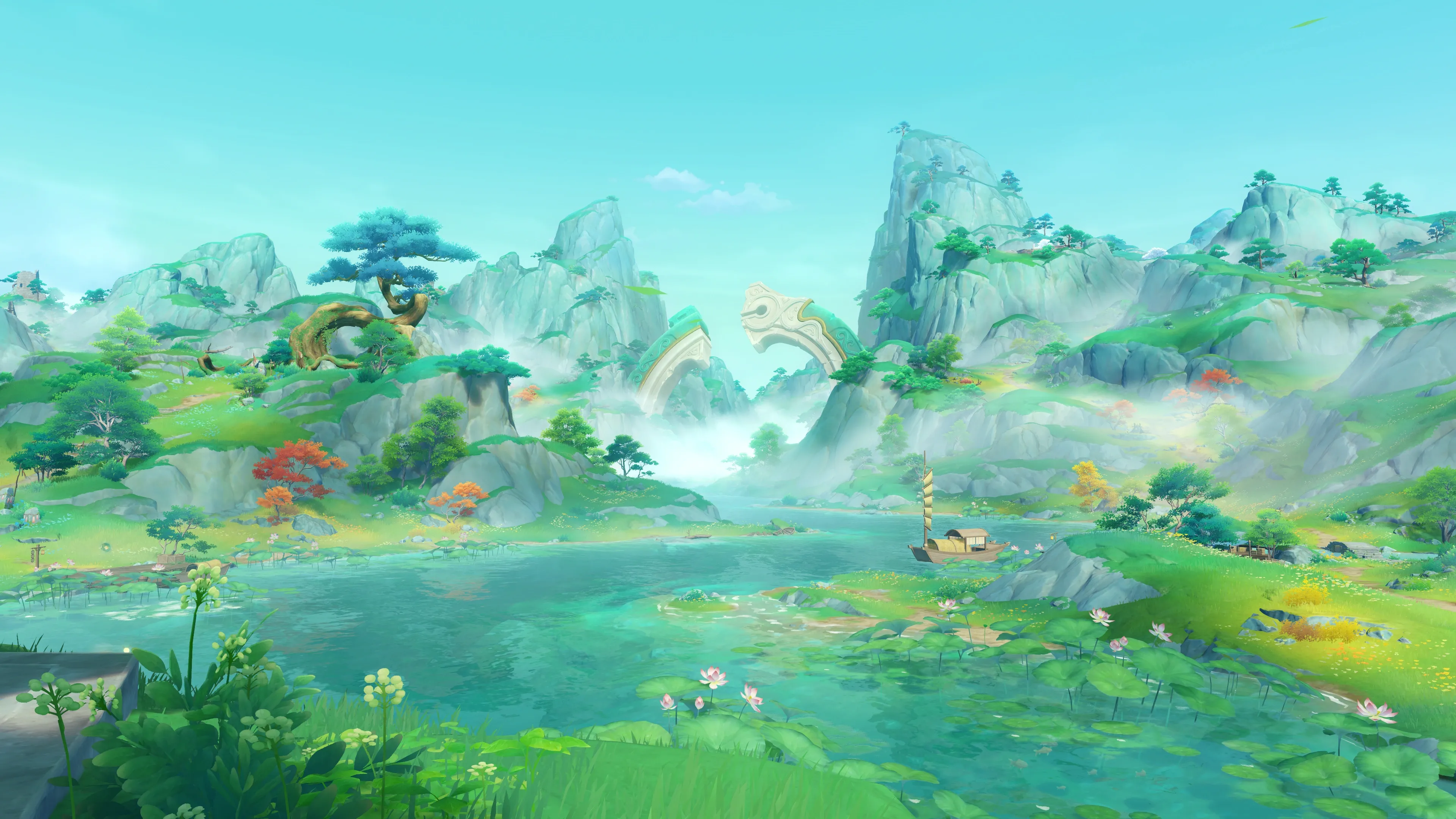
A northwest-Liyue subregion built around the sacred Mt. Yaojun and the Bishui River, which flows down through Qiaoying Village to Yilong Wharf. In distant times the vale was ruled by an unnamed lesser goddess and her three Adepti; near the end of the Archon War she flooded the Bishui to defeat Morax, and the Adepti rebelled to save the vale and its people. Today it is a tea-producing region whose present-day quest chain resolves the aftermath of that ancient rebellion.
Overview
Chenyu Vale (沉玉谷 Chényù-gǔ, "Sunken Jade Valley") is the northwest-Liyue subregion released in Version 4.4, first referenced back in V2.6 via the Echoes of an Offering artifact set, wedged between the rest of Liyue and the Fontaine border. It is built around the sacred mountain Mt. Yaojun and the Bishui River that flows from it, with mist-shrouded peaks, tea-terraced hillsides, and the Golden Carp's Leap traversal mechanism that lets the Traveler shift form into a golden carp.[1]
In distant times the vale was presided over by an unnamed mistress, a lesser goddess of "wild mountain nature," and her three Adepti: Herblord, Fujin, and Lingyuan. The region's tea industry, its jade-ornament tradition, and the Rainjade Rite all descend from a single rebellion of those three Adepti against the mistress at the close of the Archon War. The mistress is a lesser Liyue deity, not one of the Seven Sovereigns, and her flood happened during the Archon War rather than the much later Cataclysm.[1] [10]
Geography
Chenyu Vale has two top-level Areas, Chenyu Vale: Southern Mountain and Chenyu Vale: Upper Vale, plus a third area, Mt. Laixin, that is initially story-locked and opens only once the WQ chain Chenyu's Blessings of Sunken Jade is completed.[1] [7]
- Chenyu Vale: Southern Mountain. The most populated sector. It holds Qiaoying Village (a Huizhou-architecture-inspired tea-producing settlement, anchor for Grandpa Lu's tea-quality crisis) and Yilong Wharf (a bustling port whose artisans still make jade ornaments "to this day" per Symbol of Felicitation), along with Adeptus's Repose, Chizhang Wall, Lingshu Courtyard (Herblord's abode), Mt. Xuanlian, Teatree Slope (named after Fujin's first tea-tree, still growing), and Yaodie Valley.[1] [5] [3]
- Chenyu Vale: Upper Vale. The upland sector, containing Mt. Lingmeng (the peak Fujin climbed to hurl the Votive Rainjade into the Bishui). Lingyuan is findable around Mt. Lingmeng and west of Chizhang Wall in the post-WQ rotation.[4] [6]
- Mt. Laixin (来歆山 Láixīn-shān). The story-locked western subregion that opens during An Ancient Sacrifice of Sacred Brocade. It has two sub-locations: Carp's Rest (Fujin's abode, unlocked via the follow-up WQ The Cloud-Padded Path to the Chiwang Repose and anchor of the Rainjade Oblation / Spirit Carp offering system) and Chiwang Terrace (the underground cavern sector). The Chinese Láixīn shares its compound with the Echoes of an Offering artifact-set title (来歆余响 Láixīn Yúxiǎng), which places Mt. Laixin as the terrain that artifact-set lore is set on.[7] [3]
The Bishui River flows from Chenyu Vale's mountains through to Bishui Plain in core Liyue, making the vale the Bishui's headwaters. That is the cosmological reason the mistress's "flood the Bishui to defeat Morax" gambit was both her most dangerous move and the one most certain to drown her own people.[1]
History
The mistress of Chenyu Vale and the Adepti trio
In "distant times," before either wave of human settlement, Chenyu Vale was ruled by an unnamed mistress. Canon never names her in primary text, referencing her only descriptively as "the mistress of Chenyu Vale" or "the unnamed mistress." Per the in-game Mt. Lingmeng Gossip (Vol. 3), she "presided over all animals and spirits of wild mountain nature, mediated between mortals and the wilderness, and controlled the ebb and flow of the Bishui River." She was attended by "wild spirits and many Adepti," of whom three are named:[1]
- Herblord (药君 Yào Jūn), a giant white snake spirit who took on a human form, used her knowledge to create medicines, and dwelt at Lingshu Courtyard in Yaodie Valley near Teatree Slope. She is the same entity as Baizhu's familiar Changsheng, confirmed in-game when Fujin, told of the Traveler's adventures in Liyue Harbor, recognises that "Changsheng and the Herblord are one and the same."[5]
- Fujin (浮锦 Fújǐn), a giant golden carp spirit who lived in the Bishui and was "fond of humans." In human form she conducted the Rainjade Rite that "changed the water veins and soil of Chenyu Vale and made them more palatable to humans," and planted the first tea tree of Chenyu Vale in Herblord's territory, the tree that gave Teatree Slope its name and the origin-point of the vale's tea industry.[4] [3]
- Lingyuan (灵渊 Língyuān), a suanni who "never became close to humanity, preferring to live as a wild beast in the mountains." Her in-game appearance is a darker-blue variant of the Solitary Suanni class, and her WQ alias is Bluey (Little Mao's nickname).[6]
Two human-settlement waves
Canon distinguishes two separate waves of human migration, roughly 5,500 years apart. The first came "some 6000 years ago" per the Jadefall's Splendor weapon-text: "When The Chasm was created some 6000 years ago, the surviving tribes evacuated and moved to Chenyu Vale, founding the first human settlements in this area." This was the first wave of settlers, whom Fujin guided, teaching rituals (jade offerings among them) and modifying the environment for habitability. The second is Cataclysm-era, roughly 500 years ago, per the Springtime Charms event: "Many present-day inhabitants of Chenyu Vale are the descendants of refugees who fled the Chasm during the events of the cataclysm. Yelan and Lan Yan's ancestors are among them." The two waves answer to different events at the Chasm (its creation 6,000y ago versus its collapse in the Cataclysm 500y ago), and the two must stay distinct; the Yelan and Lan Yan lineage belongs to the second wave, not the first.[1] [12]
The Archon War flood and the Adepti rebellion
The vale's central historical event is the rebellion of the three Adepti near the close of Liyue's Archon War, some 2,000 years ago or more, not the Cataclysm 500 years ago. The mistress was at war with Morax, Herblord and Fujin served under her, and the people of Chenyu Vale did not participate, so Fujin and Herblord built sanctuaries to shelter them from the mistress's other followers. "Near the end of the war, in a final attempt to defeat Morax, the goddess unleashed a tremendous flood coursing the Bishui River, which would have also destroyed the vale and its people." The trio rebelled. Herblord fought the mistress directly and had her body "ripped apart," left in a "small form that could barely survive on her own" and stripped of her human-form ability, the surviving white-snake that would later become Baizhu's Changsheng. Fujin climbed Mt. Lingmeng and hurled the Votive Rainjade into the Bishui, "creating the Jademouth in the process," the massive jade ring visible from Yilong Wharf's watchtower that pinned the flood; she "sank into the sea" and was trapped at Carp's Rest for thousands of years. Lingyuan "herded the people of Chenyu Vale to safety." The mistress, for her part, was "sealed deep underneath Chenyu Vale, slumbering by the ruins of the lunar chariot, for eternity," a phrase whose lunar-chariot referent stays unexpanded in present primary text.[1] [4] [5] [6]
The Jade-Sinking legend and the Echoes of an Offering lore
The vale's name, Chenyu, "Sunken Jade," comes from the legend of "a slab of jade located on a sacred mountain, which was capable of summoning sweet rains and became coveted by demons, after which it was thrown into the river and sank underwater." Variants preserved across the Echoes of an Offering artifact set have Herblord splitting the jade into ornaments hidden underwater, in mountains, and in shrines, "believed to carry the blessings from a pact with a deity," while Flowing Rings has the jade carved by "Rex Lapis himself." The Yilong Wharf jade-ornament tradition is the present-day continuation. The tea industry is the other inheritance: Fujin's original tea-tree was "grafted to the other side of the river by the mortals who dwelled in the mountains," and its leaves are "famous in Liyue Harbor and other areas."[1] [3]
Present-day: the Lingyuan-tampering arc
In the present (V4.4, Chenyu's Blessings of Sunken Jade WQ chain), Lingyuan, yearning to restore Fujin's strength and the natural conditions that produced the original tea, began tampering with the vale's spirit lines, intentionally causing soil and water to "return to nature." Qiaoying Village's tea was the on-screen casualty, and miasma erupted across several sites as an unintended consequence. Fujin in her diminished carp-form recruits the Traveler, who across the three-quest chain identifies Lingyuan, defeats her in a short fight, and brings her back to her senses. Fujin then expends more power to undo the damage, unable to revert the remaining miasma, and reverts permanently to her carp form. After the WQ, collecting Spirit Carp through the Rainjade Oblation at Carp's Rest is how Fujin builds up enough adeptal energy to resume her human form.[1] [2] [4] [6] [7]
Version 7.2: where the beams converge
The last quest of Chapter VII Act VI, A Yesterday Sent From Beyond, begins in Chenyu Vale. Once the Trials of Usurpation are passed, the description of that quest, Knocking at the Door to the Final Act, reads: "The beams of light cast by the Nail of Retribution converge at a corner in the Chenyu Vale, as if they were extending an invitation." [13] The nations' representatives meet there before a door that Venti calls "an invitation from the heavens," and Mavuika, who has flown Furina in, says she had "heard of Chenyu Vale's stunning scenery before, but seeing it for myself... it's even more beautiful than I imagined." Through the door, Paimon realizes, is Celestia. [14] No line names the exact spot. Fandom's summary of the act places the gathering at Mt. Mingyuan, which Fandom's location page puts in Chenyu Vale's Upper Vale and says "lies directly beneath Celestia." [15] [16]
Where the mistress ranks
The mistress belongs to Liyue's lesser gods, listed on the Gods page alongside Guizhong, Havria, Marchosius, Chi, Tao Dou, Zibai, and Osial. The parent Liyue page names her in its gods listing as the "demon-lord former master of Fujin and Herblord." Her flood happened during the Archon War, some 2,000 years ago or more, not during the Cataclysm 500 years ago. She is not one of the Seven Sovereigns, whose named members include Apep (Dendro) and Azhdaha (Geo, sealed); she is a lesser deity, not a Sovereign.[9] [8] [10]
The parallel to Watatsumi Island is close. In both cases a regional deity (the mistress here, Orobashi there) goes to war with the prevailing Archon (Morax, or Ei acting for Makoto), loses near the close of an Archon-War conflict, and leaves behind surviving attendants: Fujin, Lingyuan, and the Herblord line through Changsheng on one side; the Sangonomiya clan through the Watatsumi Omikami inheritance on the other. Both figures rank the same way, as lesser deities rather than Sovereigns, and both carry the same risk of misreading, since outside sources sometimes loosely call them "ancient gods" in language that could be taken to mean a Sovereign.[10] [9]
Connected pages
The parent region Liyue carries the broader Liyue lore and its lesser deities. On the character side, Baizhu is the central link: Changsheng is the Herblord, and Baizhu's contract is a later iteration of the Way of the Dragon-Dragging Jade Snake contract she first offered a plague-stricken doctor centuries ago, anchored on-screen in the Lagenaria Chapter SQ Act I. Yelan carries the lineage of refugees from the Chasm in the second, Cataclysm-era wave (with Lan Yan's family).
The closest sister-region is Watatsumi Island, which mirrors the same pattern: a regional deity at war with an Archon, surviving attendants, and the same care not to mistake a lesser god for a Sovereign. The Chasm matters here too: its creation ~6,000 years ago drove the first wave of settlement in Chenyu Vale, and its Cataclysm-era collapse ~500 years ago drove the second. On the question of rank, Seven Sovereigns confirms the mistress is not a Sovereign, Gods places her among Liyue's lesser deities, and The Cataclysm frames the second migration wave.
Open questions
The mistress has no name in primary text, only the descriptive "the mistress of Chenyu Vale" or "the unnamed goddess." Whether that is a deliberate omission or simply unrevealed as of Version 7.2 is open, and "uncertain" is the safest way to put it.[1] The Mt. Lingmeng Gossip book seals her "by the ruins of the lunar chariot," and no primary-text source has expanded what the lunar chariot is, where it crashed, or how it relates to broader Teyvat moon-cosmology, and the phrase stays preserved as written.[1]
Her Archon-War-era position relative to Morax is also thin. Canon establishes she was "at war with Morax," placing her among his opponents during the Liyue Archon War, but whether she was a regional rival, an ally-turned-rival, or a separate jurisdiction Morax annexed by force is unsurfaced.[1] One more object-level ambiguity remains: the Symbol of Felicitation lore says Herblord split the sacred jade slab into "many parts" hidden in many places, while the Jademouth is Fujin's act using the Votive Rainjade. Whether these are the same artifact, related, or unrelated is unclarified.[1] [3]