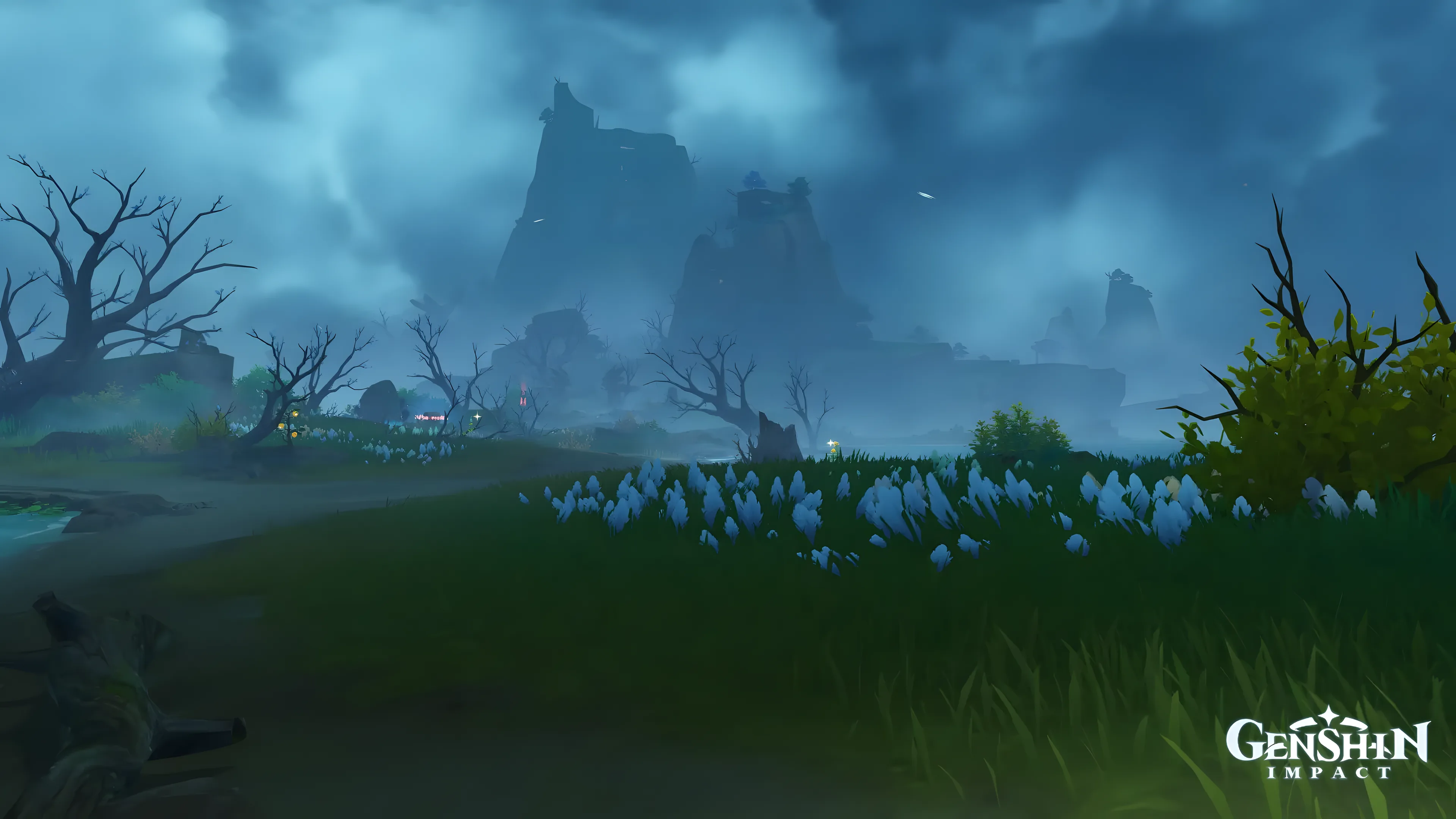
An Inazuma sub-region in the southeastern archipelago, released in patch 2.2, perpetually fogged when the Traveler arrives. The fog is a curse left by the Great Thunderbird Kanna Kapatcir after her worshippers ritually sacrificed the boy Ruu she had befriended, and the island holds the layered remains of two civilisations that died here: a Pre-Thunderbird people who worshipped Celestia, and a later tribe who worshipped Kapatcir. The Through the Mists World Quest series lifts the curse.
Overview
Tsurumi Island is the southeastern, perennially fog-shrouded sub-region of Inazuma, introduced through NPC dialogue in version 2.0 and physically released in patch 2.2. Before the Traveler arrives, the island reads as empty: a dense, navigation-resistant mist teleports unguided travellers back to the Statue of the Seven, and the surface population is just hilichurls, riftwolves, and automatons. The Through the Mists World Quest series then reveals what the fog conceals, the layered residue of two pre-Inazuma civilisations, both annihilated long before the Raiden Shogun ever consolidated authority over the archipelago. [1] [12]
The first was the Pre-Thunderbird Civilization, an underground people described as worshipping Celestia "much like Sal Vindagnyr" and as having "questioned heaven's authority" per the Prayers for Wisdom artifact-set lore. They were destroyed when a sky-fallen object, implied across primary text to be a Celestial Nail, struck the island and produced the perpetual mist. [5] [10] The second was the Thunderbird Civilization, an Ainu-coded surface tribe that arrived "over 1500 years ago," possibly fleeing the Archon War, and built its religious life around the giant violet-feathered eagle the boy Ruu would eventually name Kanna Kapatcir ("Great Eagle of the Storm"). They too were wiped out, not by Celestia but by Kapatcir's own grief-curse after their misread human sacrifice of Ruu. The curse held the surface population in an illusory three-day loop until the Traveler closed The Sun-Wheel and Mt. Kanna and let Ruu sing his promised song. [4] [3] [6]
Geography
Tsurumi has seven subareas, plus one point of interest: [1]
- Autake Plains, the foggy uplands above Oina Beach where Ruu would slip away from the village to practise his singing, and where Kapatcir first descended to listen. Most of the Plains stay fog-bound after A Particularly Particular Author closes; only The Sun-Wheel and Mt. Kanna's closure dispels the residue.
- Chirai Shrine, a fog-bound shrine in the island's northern lobe whose underside contains one of the two entrances into the Tsurumi Underground Ruins.
- Moshiri Ceremonial Site, the site of Ruu's death. The Thunderbird tribe's main ceremonial scaffolding sits here, and the Outlander returns to it repeatedly across the chain.
- Mt. Kanna, the Thunderbird's old roost, considered sacred ground by the tribe and the site of the Sun-Wheel and Mt. Kanna finale. The Mt. Kanna Thunder Manifestation is born from Kapatcir's rage when the Traveler reaches the altar.
- Oina Beach, the landing-shore where Kama's boat from Ritou arrives. The Octave of the Maushiro sub-quest stages the "Kama" illusion-arc here, where the Outlander discovers that the boatman is a spectral inhabitant of the Thunderbird Civilization rather than a living NPC.
- Shirikoro Peak, the inland peak in the island's southern lobe whose underside is the second entrance into the Tsurumi Underground Ruins and the staging area in primary text for the Sea of Fog and the Rite of the Trees sub-quest.
- Wakukau Shoal, the small offshore islet on Tsurumi's eastern flank. Wakukau is the name of the Shoal itself, not of any tribe. [1]
The island also holds one point of interest outside the seven subareas: [7]
- Tsurumi Underground Ruins, the subterranean ruin connecting Shirikoro Peak and Chirai Shrine. Per the point-of-interest page, it holds "remnants of both the Thunderbird Civilization and an even earlier civilization," with the murals attributed to "the unified human civilization which spanned the whole world." This is the primary-text locus for the Pre-Thunderbird Civilization, and the Peculiar Pinion gadget acquired in Octave of the Maushiro is the token that unlocks the Ruins Torch puzzles guarding the deeper chambers.
Until the Through the Mists chain begins, the surface of Tsurumi is empty of human residents; the fog teleports unguided travellers back to the Statue of the Seven, and the only living things the Outlander encounters are hilichurls, riftwolves, and automatons. [1]
History
Pre-Thunderbird Civilization (deep antiquity)
The earliest Tsurumi inhabitants were an underground people known as the Pre-Thunderbird Civilization. Per the Pre-Thunderbird Civilization page, they worshipped Celestia "much like Sal Vindagnyr," and per the Prayers for Wisdom 5★ artifact-set lore they "questioned heaven's authority" and "coveted divine power," the same offence that marks the Sal Vindagnyr / Skyfrost Nail event. [5] [10]
Their end belongs to the same class of event as the other Heavenly Nail strikes catalogued on the Heavenly Nail page. Kapatcir's own primary-text memory anchors the sky-strike: "Once, strange objects fell from the heavens, one of which landed upon this island… Afterward, the fog started to emerge." Per the Inazuma / History timeline, the sequence runs "~6000 years ago, the Thunderbird spots Tsurumi Island and decides to make her home there. At some point, objects fall from the heavens - possibly the Celestial Nail - one of which lands on Tsurumi Island, annihilating the first civilization and shrouding the island in perpetual mist." Their successors in the Thunderbird Civilization sealed the Pre-Thunderbird murals behind statues of Kapatcir, and the Pre-Thunderbird people may have migrated above ground to become the Thunderbird Civilization itself, though that continuity is suggested but not confirmed and remains one of the island's open questions. [5] [9]
Thunderbird Civilization (~1500+ years ago)
The Thunderbird Civilization arrived on Tsurumi "over 1500 years ago," possibly fleeing the Archon War on the mainland. They built a strict, hierarchical religious society with priests at the top, wrote in the Ishine Script, and forged the Maushiro, a feather-instrument that let them navigate the fog. The Maushiro was originally made from Kapatcir's own feathers, with a wooden imitation substituted later. Their culture held that those who left the island became "lost in the sea of darkness," and they practiced human sacrifice in the belief that it pleased their deity. [4]
The deity itself was more monster than god. Per the Thundering Fury 4★ artifact-set lore, "the Thunderbird was still a monster that cared not for the worship of mankind. They knew it not, and regarded the unpredictable actions of the Thunderbird as divine revelations." The civilization's name for her came only at the very end of its history, from a single child, the boy Ruu, son of the last priest Mata. Ruu "managed to befriend Kapatcir through a song that pierced the clouds," and in return she gave him her name in two forms: Kanna (her self-given honorific, "the radiant" or "the shining") and Kapatcir (an Ainu-language gloss approximating "Great Eagle of the Storm"). She promised to return to hear him sing again. [11] [3] [2]
Ruu's sacrifice and the curse-loop
The trigger event is narrow. As Ruu's friends began to leave the island for the mainland, Ruu, convinced his sacrifice would "bring everything back to normal," voluntarily allowed the priests of his own civilization to ritually kill him at the Moshiri Ceremonial Site, his blood collected in a sacrificial cup at Mt. Kanna. When Kapatcir returned to hear his promised song, she found the cup and his body. "While Ruu had believed that his sacrifice was for the good of the tribe, Kapatcir saw it as the murder of an innocent and breaking of a promise. Driven mad by rage and sorrow, Kapatcir destroyed the tribe to avenge the boy, before placing a curse that would repeat the events indefinitely until she could hear his song once more." [4] [3]
The curse held. The civilization's last days looped without its inhabitants knowing; Ruu himself, revived by the looping, was aware of the changes and the passage of time but not of the cause. The sole living descendant is Kama. The Boatman the Outlander meets at Oina Beach during Octave of the Maushiro turns out to be a spectral inheritor of that role rather than the living Kama, but the bloodline itself persists in one person. [4]
Kapatcir's slaying and the Asase-Shrine seal
Some considerable time after the curse settled, "centuries later" per the Kapatcir page, the Thunderbird was "hunted down and killed by Ei for being an obstacle to progress," and her residue was sealed at the Asase Shrine on Seirai Island. The Lore section on the Asase Shrine frames it as "After Kanna Kapatcir was felled over Seirai Island, the Asase Shrine was established to manage the wards and suppress its lingering hatred." The actor was Ei specifically, not the Raiden Shogun puppet, which did not yet exist; the Gods page sharpens this with the pattern that "the duty of slaying such foes during the Archon War fell upon Ei, rather than the Electro Archon." The event pre-dates the Cataclysm ~500 years ago: the Seirai Rebellion in which Asase Hibiki later un-sealed the wards came "several years after the Cataclysm drew to a close," so the wards stood at least from Kapatcir's slaying through the Cataclysm. [2]
Ei confirms a killing of this kind in her own words in Version 7.2. "Long ago, in the distant past, I once slew a great Thunderbird on the island of Seirai which posed a threat to Inazuma's safety," she says in Act VI of Chapter VII, though the act never uses the name Kanna Kapatcir. She frees that Thunderbird's power on Seirai before the trial described below. [22]
Present-day: Through the Mists (2.2)
The fog persisted into the present day. Per Through the Mists, a Sumida writing commission frames the narrative entry. Sumida (based in Inazuma City, not on Tsurumi or Seirai) commissions the Outlander to investigate the Maushiro instrument, Kama transports the Outlander across to Oina Beach, and the chain advances through A Particularly Particular Author (initial fog-clearing at Autake Plains), Octave of the Maushiro (acquiring the Peculiar Pinion gadget, and the reveal that Kama is a spirit), and The Sea of Fog and the Rite of the Trees (the Shirikoro Peak / Underground Ruins arc), closing at The Sun-Wheel and Mt. Kanna. That finale stages Ruu meeting Kapatcir at the Mt. Kanna altar and triggers the Mt. Kanna Thunder Manifestation, which emanates from Kapatcir's lingering rage. [6] [8]
The resolution runs through the parallel Seirai chain. The Peculiar Pinion the Outlander recovered in Seirai Stormchasers is one of Kapatcir's feathers, per Ruu's disclosure late in the chain. The Outlander brings Ruu to Seirai, where Kapatcir was slain, Ruu sings to her remains at Asase Shrine, and the curse lifts. With the fog gone, the spectral inhabitants of the civilisation appear on the island alongside the Boatman "tasked with bringing these spirits to a golden land," and the Outlander helps individual spirits to closure and to board. [4] [13]
The Hallowing and Inazuma's trial (Version 7.2)
In Chapter VII the Holy Soil phenomenon reaches Tsurumi before any other Inazuman island. "When the Hallowing spread to Tsurumi Island," Thoma says in Act VI, "we thought it wouldn't spread any further, at least for now," until it turned up on Seirai's shores as well. Tsurumi holds Inazuma's Nail of Retribution. Once she has freed the Thunderbird's power on Seirai, Ei goes there for the nation's Trial of Usurpation: "I will go to Tsurumi Island alone." The trial is a cinematic that the dialogue record does not transcribe. Afterwards Ei explains that she "felt that there was no need for me to say anything to the Heavenly Principles," that she struck "with the force of my own power combined with primordial Electro energy," and that "the rune sensed this, and that is why it disappeared." [22] [24]
Two civilisations, two endings
Tsurumi is a single sub-region carrying residue from two distinct catastrophes at two different cosmological orders. The Pre-Thunderbird layer belongs to the Heavenly Nail framework, a Heavenly Nail target alongside Sal Vindagnyr / Dragonspine, The Chasm, Mt. Damavand / Desert of Hadramaveth / Eternal Oasis, and the Night Kingdom over Natlan; it is the Inazuma entry in that roster of 6 Nails. Chapter VII bears that out: in Act V Pierro counts "six Nails of Retribution in Teyvat," and in Act VI Inazuma's trial is taken at the one on Tsurumi. [21] [22] Seirai is not a Nail target; its hazard is the residue of Kapatcir herself, a slain divine being, rather than a sky-strike.
For the Thunderbird layer, the Gods page lists Kapatcir among Inazuma's lesser deities, with her godhood marked uncertain. The difference from Orobashi, the Watatsumi Omikami of Watatsumi / Yashiori, is one of era. Orobashi was slain by Ei during the Inazuma Archon War ~2000 years ago, whereas Kapatcir was slain some considerable time after Ruu's death (~1500 years ago) but still before the Cataclysm. The two deaths therefore fall on opposite sides of the boundary between the Archon War and the later pre-Cataclysm period, and neither is the Cataclysm itself. [20] [19] [18]
No line in the game calls Kapatcir a Sovereign, and no released line names an Electro Sovereign. Version 7.2 reopens the question: in Act VI Ei introduces the Thunderbird she slew on Seirai under "the concept of 'elemental dragons'," and Paimon and the Traveler call it the Electro Dragon, but the act neither names it nor calls it a Sovereign. [22] Fandom's Seven Sovereigns table now lists Kapatcir among the current Sovereigns as the "Original Electro Dragon," alive as of Act VI with its essence held in the Shogun. [23] Tsurumi and Seirai are tied together through her. The Mt. Kanna Thunder Manifestation on Tsurumi (born from Kapatcir's rage at the Sun-Wheel finale) and the Amakumo Peak Thunder Manifestation on Seirai (released from the Asase Shrine seal by Hibiki in the Rebellion) are sister residues of the same divine entity, and the Outlander's arc across the two chains pacifies both again. [8] [17]
Connected pages
The parent region Inazuma covers the Tri-Commission, the institutions behind the Raiden Shogun, and the broader Inazuman religious tradition that Tsurumi's cohabitation cycle entirely pre-dates. Its closest parallel is Seirai Island, where Kapatcir was slain and where Asase Shrine keeps her seal. There the Outlander's Peculiar Pinion bridges the two chains, and Ruu's disclosure on Day 4 of Through the Mists that the Pinion is one of Kapatcir's feathers is the payoff. Watatsumi Island, where the Sangonomiya keep the cult of Orobashi, the Watatsumi Omikami, is the counterpart with a different aftermath: an active living cult rather than an extinct civilisation plus spectral residue.
The main primary text is Through the Mists, the 2.2 chain of four sub-quests (A Particularly Particular Author → Octave of the Maushiro → The Sea of Fog and the Rite of the Trees → The Sun-Wheel and Mt. Kanna) that lifts the fog and discloses Kapatcir's cosmology, with Seirai Stormchasers as prerequisite. On the framework side, Heavenly Nail places the Pre-Thunderbird sky-strike in the roster of 6 Nails, Gods lists Kapatcir among Inazuma's lesser deities, her godhood uncertain, and Humans ties both populations to Teyvat's default human lineage (the Underground Ruins murals reference "the unified human civilization which spanned the whole world," placing the Pre-Thunderbird people inside that deep-time human lineage). A related containment story is Orobashi's Legacy. Its line of Tatarigami caretakers on Yashiori Island, through Kaji, parallels the continuity of spirit NPCs on Tsurumi and the line of Hibiki and Neko at Seirai's Asase Shrine, and together the three make up the framework of pre-Cataclysm containment zones on Inazuma's islands.
Open questions
Did the Pre-Thunderbird people become the Thunderbird people? The Pre-Thunderbird Civilization page suggests, without confirming, that the underground Celestia-worshippers may have migrated above ground after the sky-strike to become the surface worshippers of the Thunderbird, their original drawings sealed behind statues of Kapatcir. Whether the continuity is biological descent or merely an overlap of sites is unresolved. [5]
The sky-strike object's identity is also open. Kapatcir's primary-text memory describes "strange objects [falling] from the heavens, one of which landed upon this island," and the Inazuma / History timeline frames this as "possibly the Celestial Nail." Whether the object that struck Tsurumi is a Celestial Nail, a strike of some other class issued by the Heavenly Principles, or a punitive instrument from within Celestia is unconfirmed; the "questioned heaven's authority" lore of the Prayers for Wisdom artifact set supplies a motive but does not identify the instrument. [9] [10] Version 7.2 places Inazuma's Nail of Retribution on Tsurumi, where Ei takes the nation's trial, but no line says that this Nail is the object Kapatcir remembers falling. [22]
The Boatman's destination is unspecified too. He is tasked with bringing the spectral inhabitants "to a golden land," but the identity, location, and cosmological status of that destination go unstated, and may or may not relate to the broader post-mortem cosmology Inazuman primary text touches elsewhere (the Realm Within / Tokoyokoku / Enkanomiyan post-mortem registers, for instance). [4]
One naming point: Wakukau names only the Shoal subarea. [1]
World Quests
- Through the Mists · Patch 2.2