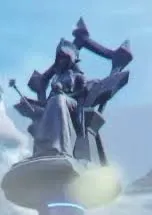
For most of the story, the Tsaritsa's plan reached the reader secondhand. Version 7.0 brought her on screen without a line of dialogue and left Pierro to explain. Version 7.1 changes that. In Chapter VII Act III she gives the Traveler her own account of why she collects the Gnoses, and in Act IV she shows what they can already do. Version 7.2 takes that account to the other nations. In Act V she answers for the Gnosis collection before their leaders, and in Act VI she passes Snezhnaya's trial and hears Celestia's verdict. [22] [23] The aim here is to keep three things apart: what she says, what her servants attribute to her, and what readers infer. [1] [15]
What Pierro said first
In Mistilteinn, Pierro gave the clearest account then available. Project Stuzha consolidates Snezhnaya's energy and material resources for Project Mistilteinn, whose Armory Palace researchers reverse-engineered Stellar Linchpins to produce anti-Celestia energy. Of the Tsaritsa's aim he said: "If she can seize their authority, she will reconstruct the entire world... and when that time comes, humanity will be completely liberated from curses and lies." The Gnoses "will undoubtedly serve as a key bargaining chip when she confronts the Heavenly Principles. Beyond that... you had best ask the Tsaritsa herself." [8] [7]
Those remain Pierro's words. She has not repeated the promise of a rebuilt world in her own voice.
What the Tsaritsa says
Act III is, in effect, the Traveler taking Pierro's advice. Asked why she sends the Fatui after the Gnoses, she answers directly: "The Gnoses possess a powerful elemental affinity, and are capable of amplifying their bearers' power. They do not originate from within the system of Teyvat, but from the Third Descender." Fully exploited, they open "many new possibilities... including the power to transcend the limits of one's authority." Gathering them is "a necessary step towards facing the Heavenly Principles," because "the power of The Seven can create a storm, but it cannot shake the foundations of the world." [11] [13]
She frames the reason as survival. "In many fields," she says of Snezhnaya, "we reached the boundary of what is permitted by the Heavenly Principles long ago. And ever since, Snezhnaya has lived under the threat of annihilation by a Nail of Retribution at any moment." The Traveler draws the conclusion aloud: "So this isn't an ideological battle. It's a fight to survive." [11]
There is a second purpose. She shows the Traveler a seal the Third Descender left: "Whatever the Third Descender sought to protect at the very end, it must be of vital importance. But even all these centuries on, every attempt to open it has failed. The only thing that seems to respond to it is a Gnosis." When Paimon sums up two reasons for the collection, to amplify her power against the Heavenly Principles and to break the seal, the Tsaritsa answers, "Correct." [11]
Asked for her domain of authority, she says "love," and disowns it at once: "I do not identify with this authority, nor do I intend to use it." The love gods hold for humanity, she says, "is the result of a curse by the Heavenly Principles." Rather than yield to it, "I choose instead to be my true self, and to fulfill my duties as the Tsaritsa." [11] [15]
The plan in motion
Act IV shows the method without the whole design. Pierro says the plan against Ronova "is broken down into stages, each with its own objective," and that even he is not "privy to its full scope," because the Fatui assume Ronova is always listening. He adds: "Though she has yet to gather all seven Gnoses, I believe the Tsaritsa has already amassed enough power to strike at the rules of Teyvat." [12]
The tea with Rhinedottir was one of those stages. With Cryo amplified by the Gnoses and, in her words, "my own insights gained over the past thousand years," the Tsaritsa slowed time in the hall where they sat. The window in which Rhinedottir was meant to revive Ronova's victims passed unnoticed, and Celestia reclaimed Ronova's Authority of Death. Rhinedottir describes the feat as "using Cryo to influence time and space, rewriting the rules of the world on a small scale." [12] [14] [16]
The Gnosis count needs care. Rhinedottir says "you have six Gnoses in your possession," which fits the Tsaritsa's own Cryo Gnosis plus the five collected from the Anemo, Geo, Electro, Dendro, and Hydro Archons. The Pyro Gnosis is not among them. In Act III the Tsaritsa calls it "the only one of the seven Gnoses whose whereabouts are unknown." The Traveler tells her it was reduced to ashes when Irminsul burned and, according to Mavuika, returned to the Ley Lines. She replies that Gnoses "should not be able to coexist with the Ley Lines for long," so it "will one day be excised," and adds, "We will locate it eventually." That expectation is hers; where the Pyro Gnosis is now is unconfirmed. [11] [12] [2]
Before the other nations
Act V brings the method into the open. With the Nails of Retribution set off and the Hallowing spreading, the Tsaritsa invites the leaders of every nation to Zapolyarny Palace and opens the meeting by recalling that "The last gathering of The Seven was in Khaenri'ah, during the cataclysm." Pierro then offers a conclusion from research done "Before the destruction of Khaenri'ah": "for the Heavenly Principles, it is far better for the nations to operate in isolation than in unity," because "the Gnoses are the only things with the potential to disrupt the order of the world, and each is in the hands of a different archon." Nahida warns against "crossing the line into the conspiratorial." [20] [22]
Ningguang asks to hear the Tsaritsa's own account, since most of Snezhnaya's replies to Liyue "were signed by Mr. Pulcinella." The Tsaritsa gives it. When the Fatui planned "the retrieval of the Gnoses," a peaceful option was tabled: persuade the other archons at a meeting. "But it was not realistic." The gods disagree about defying the Heavenly Principles, and "they are all cursed with a love for humanity that would impair their decision-making." Then: "Even with those who wished to support us, we had no choice but to stage a performance so as to minimize the risk of failure." Venti's only comment is "Hehe..." She ends with an apology that keeps the plan intact: "I apologize to all who have been negatively impacted by our plan, but I do not regret starting down this path." [20]
The admission concerns method. By her account some archons wished to support the project, and the Fatui staged a performance even with them. She does not say which archons she means or which handovers were staged, and Venti's laugh invites a reading that nobody spells out. Ningguang accepts the apology "In the short term only, of course," because "A nation's will has to reflect the will of its people, not our personal preferences or emotional whims." [20]
The same meeting shows what her plan still lacks. Pierro tells the leaders, "Due to roadblocks in our research, we have yet to locate the Pyro Gnosis. Without it, we have no immediate means of challenging the Heavenly Principles directly." Earlier, at the council in Snezhnograd, Pantalone notes that with Ronova gone "Project Mistilteinn can now resume," and Mitya needs "another two months minimum." By Act VI he is still at work on what Paimon calls "the Tsaritsa's weapon," and he admits, "Our research isn't progressing fast enough. Passing the trials is still looking like our best bet at this stage." [20] [21]
The trials themselves she takes on as her own. When she reports that "to stop the Hallowing, six so-called 'Trials of Usurpation' must be completed," she claims Snezhnaya's: "This started in Snezhnaya, thus is it my responsibility to bear. Besides, I made a contract with the 'late' Rex Lapis. I am obliged, both by conscience and principle, to do this myself." The act does not say what that contract was. Once Xianyun reports that each trial asks for proof that a civilization follows the Heavenly Principles' "divine plan," the Tsaritsa answers in the language of Act III: "A 'plan' in name alone — in truth, they are curses placed on our civilizations by the Heavenly Principles." In Act VI Venti passes the idea on as hers: "I'm sure you've heard from the Tsaritsa that all the rules of this world are curses." [20] [21]
Testimony about love
Before Version 7.1, the case for her benevolence rested on her Harbingers. Tartaglia calls her "a gentle soul. Too gentle, in fact, and that's why she had to harden herself," and says "she declared war against the whole world only because she dreams of peace." Arlecchino calls her "a person of true sincerity and compassion," though she doubts that compassion alone "is enough to melt the ice and snow that permeates her land." [17] [18]
Act III complicates that testimony, because the Tsaritsa herself denies that the love she holds is real. Her people push back. Danica asks why the Tsaritsa would have let her follow her own wishes "if Her Majesty were truly as she claims," and Vesna's voice-over answers the "curse" with small kindnesses she takes as genuine love. [11] [19]
Act VI puts the refusal to the test. A plague spreads among the Fatui and Druzhna soldiers who fought the Hallowing, and the fae lord Noy traces it to the fury of fae who died in the war before the Belyi Tsar unified Snezhnaya, frozen beneath the ice until the Hallowing released it. The Tsaritsa names it "a curse, formed by the death of the fae, left to afflict other forms of life," and decides that "My authority exists precisely for this purpose." Pierro explains to Noy: "Love. That is Her Majesty's power — the power to undo most of the curses that afflict the world." Noy doubts it still answers her: "You have rejected this form of 'love'... Can you wield its power even so?" She calls that "the most ridiculous aspect of all of this" and goes ahead anyway: "If the heavens see fit that I make a gesture of 'love,' then so be it." Pierro has seen her use the power "only once" before, and says she "has simply been... unwilling to use it until now." By Vodyanitsa's report, golden snow then falls all over Snezhnaya and the plague disappears "just as quickly as it came." [21] [23]
Her Trial of Usurpation turns on the same word. Esoptron, the terminal that speaks inside the Nails during the trials, sets the subject "Love," and she answers with the limits placed on her: "By your design, Love is a force that dispels curses afflicting the world and maintains Teyvat's stability." "I can only remove such curses as you did not beget. I must turn a blind eye to those you impose." "Love itself is one such curse. You force me to forget its true nature. Instead, I may love only those whom you require." Esoptron rules that "The above answer bears no relevance to the trial," so she examines the trial instead: "You have inflicted the Holy Soil phenomenon upon Teyvat, releasing the wrath of the ancient fae." The test, as she reads it, was whether she would then dispel that wrath. "Clearly, even you do not know what love is, Phanes." She calls the test "a desecration of love." [21]
The two scenes keep her Act III position and add a limit to it. She still speaks of love as something imposed on her, and now as a power that can lift only the curses its maker did not cause. What is new is that she uses it. Phanes is the name she gives the trial's author, the one whose "design" made love her authority; the act does not explain the name, and Celestia, the Heavenly Principles, and the Divine Thrones sets out what the line does and does not establish.
The Khaenri'ah question
The Fatui's upper ranks have long been threaded with Khaenri'ah. Pierro, the Fatui's unnumbered Director, was a royal mage in Khaenri'ah's court, not its First Sage. The First numbered rank belongs to Commander Thrain (Capitano), whose position the Tsaritsa kept as-is even though he can no longer take part after Natlan. [5] [6] An older reading took her war as answered grievance: a divine order that destroyed a godless nation in the Cataclysm, called to account. [10]
Act IV makes the tie literal and, at the same time, loosens that reading. Rhinedottir greets her as "Mother of Khaenri'ah" and says all Khaenri'ahns descend from "a bloodline that began with you and the Third Descender." The Tsaritsa answers that she has no memory of it: "I've just never known how to face you all." Whether those erased events are true matters less to her than the fight at hand: "As long as the Heavenly Principles are allowed to exist and have their way with this world, I choose to live in the present." After hearing how the Third Descender gave his remains to have her restored, she repeats it: "Like I said, I choose to live in the present." Rhinedottir draws her own conclusion, that the Tsaritsa's hostility "doesn't necessarily stem from past grievances. It's more about Snezhnaya's ideals and future." [12]
The comparison with the Abyss Order still holds as a frame. Both answer the same wound, but the Abyss Order works to tear the world's order down through the Abyss, while the Tsaritsa wages an organized, state-backed war from inside Teyvat. Whether the two campaigns collide is unrevealed. [9]
Celestia's answer
Act VI ends in Celestia. Before setting out for the place where the Nails' beams converge, she expects little: "It will likely be a procedural announcement. The Heavenly Principles still slumbers — direct communication would be impossible." In Celestia the voice that receives the nations' representatives is Nukvah, at what it calls "the 'Divine Throne,' Celestia's integrated computational array." Passing the trials has bought a suspension of the Holy Soil phenomenon and nothing more. Nukvah insists that "a civilization that has proven its value must still be destroyed," offers to preserve one allogene chosen by each representative, and sets a date: "Only 42 days remain. After that, true annihilation shall descend." [21] [23]
The Tsaritsa's question to it concerns her own course: "With so many samples of civilization to draw on, have you never considered that rebellion may be inevitable?" Nukvah allows that "You have the freedom to imagine what you will and act as you choose." Outside, she draws the conclusion the other representatives then echo. "Following the will of heaven can only lead us to a dead end. In Celestia's eyes, we are but fuel... samples... test subjects in a sandbox." And: "Our sole remaining option is to fight until our last breath." [21]
None of this shows how the fight would be waged. The act names no weapon ready in time, and Paimon's last worry is the gap Pierro admitted in Act V: "But we still don't know where the Pyro Gnosis is..." [21]
What remains withheld
- What the seal holds. She calls it "a secret that has yet to be revealed," and suggests it may open only "once the remains of the Third Descender are no longer scattered across the world." [11]
- How the confrontation itself would work. Amplification lets a god "transcend the limits of one's authority," and Pierro attributes a rebuilt world to her, but neither explains the sequence, its limits, or the order that would follow. In Version 7.2 Pierro says that without the Pyro Gnosis the Fatui have "no immediate means of challenging the Heavenly Principles directly," and the Tsaritsa's call to fight comes without a stated plan. [11] [8] [20] [21]
- Which handovers were staged. She says the Fatui had to "stage a performance" even with archons who wished to support them, and names none. [20]
- Why the Heavenly Principles sleep. After hearing Rhinedottir's story, the Tsaritsa reasons that the Cataclysm "must have triggered the Third Descender's curse... That's why the Heavenly Principles are asleep." That is her inference, and Rhinedottir insists she was only telling "a story." In Act VI she says only that "The Heavenly Principles still slumbers." [12] [21]
- The moral verdict. Her Harbingers testify to her care, she disowns love, and the Fatui's methods stand on the record. In Version 7.2 she apologizes for those methods without regretting the plan, and uses her authority of love to end a plague. Canon asserts each without reconciling them. [1] [20] [21]
After Version 7.2, the canon-safe statement runs as follows. The Tsaritsa wants the Gnoses for two reasons she states herself: to amplify her power past the limits of an Archon's authority, and to open the Third Descender's seal. She frames the fight as Snezhnaya's survival under the Heavenly Principles. She holds six Gnoses counting her own, and the Pyro Gnosis is not one of them; at the end of Act VI nobody knows where it is. Before the other nations' leaders she has said that the Fatui staged a performance even with archons who wished to support them, and has apologized without regretting the plan. In Act VI she uses her authority of love to end a plague, and after Celestia gives Teyvat 42 days she calls for a fight to the last breath. Pierro's rebuilt world remains his attribution. [11] [12] [20] [21] [4] [3]