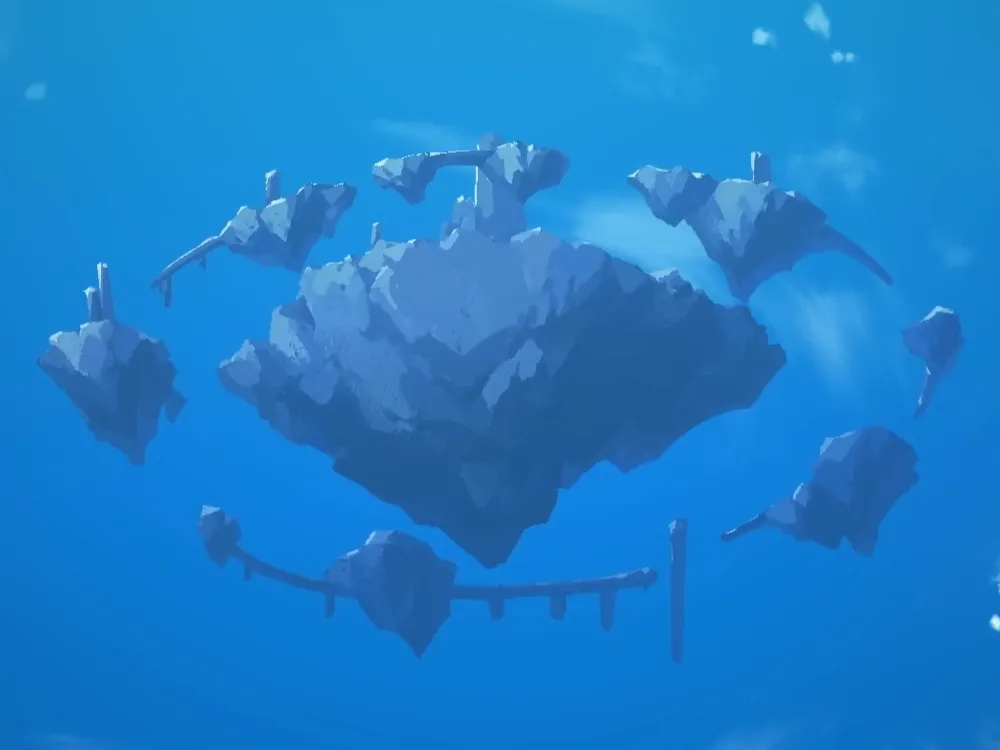
Celestia is the floating cluster of islands above Teyvat: the citadel of the Heavenly Principles (HP), the source from which Visions and Gnoses descend, and the home of their enforcers, the Four Shades. The HP go by several names, and only some of the links between them are stated in-game. Columbina names the "first Descender" as the Heavenly Principles. The Primordial One comes from the book Before Sun and Moon, whose author adds that it "may have been Phanes" and never uses the words Heavenly Principles. Taking all four names as one being is Fandom's reading, and for the Primordial One and Phanes it rests on a reading rather than a line. [1] [2]
Version 7.2 puts the name Phanes in a character's mouth. Until then it appeared in the game's English text only in that book. Answering her Trial of Usurpation in Chapter VII Act VI, the Tsaritsa tells Esoptron, the terminal that sets the trial, "Clearly, even you do not know what love is, Phanes." The "you" she addresses is the one whose "design," she says, made love "a force that dispels curses afflicting the world and maintains Teyvat's stability," and who has "inflicted the Holy Soil phenomenon upon Teyvat." Other lines give the same works to the Heavenly Principles. In Act III the Tsaritsa called "the love held by gods for humanity" "the result of a curse by the Heavenly Principles." In Act V Pierro calls the Hallowing "the Heavenly Principles' final recourse," Nahida asks whether the trials are "the Heavenly Principles' way of testing us," and the Tsaritsa calls their terms "curses placed on our civilizations by the Heavenly Principles." So the line shows the Tsaritsa using Phanes as a name for the being these lines call the Heavenly Principles. It stops short of saying the two names mean one being, and it says nothing of the Primordial One or of Descenders. [19] [10] [18] [20]
How the Heavenly Principles' system is run
The Primordial One arrived from the sea of stars during the era "When the Doves Held Branches," created the Four Shades to assist, fought a forty-year war against the Seven Sovereigns, seized the elemental Authorities, and reshaped Teyvat from the dragons' older Light Realm into the Human Realm under a false sky. [5] The Heavenly Principles have been dormant since the Cataclysm five hundred years ago: present, still seated in Celestia, but no longer answering in person. [1] When the nations' representatives reach Celestia at the end of Chapter VII Act VI, the voice that receives them is that of Nukvah, and nothing it says mentions the Heavenly Principles; the Tsaritsa had expected only "a procedural announcement," because "The Heavenly Principles still slumbers." [19]
Even dormant, the system runs through delegated layers, and two of them are made of persons. The Four Shades embody the world's eternal laws and act for the Heavenly Principles: Naberius (Life, currently fused with Rhinedottir), Ronova (Death), Istaroth (Time), and Asmoday (Space). Asmoday is the Sustainer of Heavenly Principles, the role she holds rather than a separate rank. She is absent from the Shades, and in Version 7.2 Alice calls her simply "missing"; that she defected is Fandom's reading. The other three still gather in Celestia from time to time. [2] [18] [25] The Seven Archons are the political layer, installed through the Archon War, won by tournament rather than made from scratch, but operating under the same umbrella of the Heavenly Principles. [3]
Chapter VII shows that machinery working without its master. In an Act III memory, Ronova says that "during this period of slumber, Celestia only monitors our actions periodically," so a death and resurrection completed between two monitoring periods incurs no sin. In Act IV the Tsaritsa slows time so that the agreed window for reviving Ronova's victims passes; Rhinedottir reports that "Celestia has detected this incident, and thus, a directive has been provided," and Ronova's Authority of Death is reclaimed. [10] [11] [13]
Version 7.2 adds a third layer, made of machines. At the Temple of Space, Alice introduces the Esoptron: "a Variable-Response Query Terminal. Built by the Heavenly Principles, it is capable of acting on its master's behalf within certain parameters." "Each of the Four Shades has the right to perform queries using the terminal," she adds, which makes the Shades its users. Esoptron also speaks inside the Nails of Retribution during the Trials of Usurpation, setting each trial's subject. In Celestia, Nukvah welcomes the representatives "to the 'Divine Throne,' Celestia's integrated computational array" and announces that "The default program requires Teyvat to be reset." The game's Guiding Notes call the Esoptron "A small data processing terminal created by the Heavenly Principles that can receive data from Celestia," and Nukvah "A large data processing terminal, positioned at the Divine Throne," whose "purpose is to control the course of fate." [18] [19] [22] [21]
Both terminals fall back on defaults when nothing answers above them. The Esoptron cannot reach Celestia ("Could not connect. Activating default module."), and inside Sumeru's Nail it finds the "Core database not responding..." before loading a "default protocol." Nukvah's central database gives "No response," so it runs in "default mode." Fandom's Esoptron page presumes the two terminals are one entity; the quests do not say so, and Nukvah's own note names no maker. No line makes Nukvah the Heavenly Principles or one of the Four Shades. The layer is plain to see, but whose will it carries out while its master sleeps is not stated. [18] [19] [24]
Divine Thrones crafted from Sovereign powers
How an Archon's authority over an element comes from the Heavenly Principles redistributing Sovereign power is set out at length in the Sovereign-to-Archon transition deep dive. The Archon War began when Celestia created the Gnoses out of the Third Descender's remains and crafted the Divine Thrones from pieces of the Dragon Sovereigns' powers; the gods of Teyvat were then driven to war over the seven divine seats, and the war ended around 2,000 years ago once the final seat was claimed. [5]
Two threads meet in the Throne. The War of Funerary Flame ended with the Heavenly Principles killing Nibelung and suffering severe damage. Afterward, but before the Archon War, they and "one who came after" fashioned the seven Gnoses from the Third Descender's remains. Hymns of the Far North separately says Saarelainen was carved into seven pieces, so he is strongly implied to be that figure, though never explicitly named as such. [5]
Chapter VII Act IV adds Rhinedottir's account of how those remains reached Celestia. The Third Descender "ascended to Celestia to negotiate with the Heavenly Principles" and "consented to have his remains be split into seven pieces to consolidate the system of rule established by the Heavenly Principles," in exchange for the Tsaritsa's resurrection and the safety of his descendants, the Khaenri'ahns. The Heavenly Principles then "used Irminsul to erase all traces of the Third Descender's existence from the world." She calls the account "just a story," and she does not name him. [11] [13]
The split between the two matters. The Throne is the power-source; the Gnosis is made from the Third Descender's remains and is the link to Celestia. In Act III the Tsaritsa adds that the Gnoses "do not originate from within the system of Teyvat" and amplify their bearers' power. Identifying those remains as Saarelainen is an inference from combining the sources. [5] [10]
The seven seats at the end of the Welkin Moon arc
The current state of the seven Archon seats is: [3]
Nation | Element | Archon (current) | Throne state |
|---|---|---|---|
Anemo | Barbatos (Venti) | Intact; one of two original Archons remaining | |
Geo | Morax (Zhongli) | Intact; one of two original Archons remaining; retired post-AQ I | |
Electro | Ei (Beelzebul) | Intact; succeeded Makoto (Baal) after Cataclysm | |
Sumeru | Dendro | Buer (Nahida) | Intact; succeeded Greater Lord Rukkhadevata via post-Cataclysm samsara + AQ III V Irminsul-edit |
Hydro |
| Destroyed at AQ IV V | |
Pyro | Mavuika (Haborym) | Intact; mortal-Pyro-Archon Pilgrimage lineage; second ascension post-Cataclysm | |
Cryo | Tsaritsa (Anastasya) | Intact; current holder. Checked primary sources do not establish the preceding Belyi figure as Monomakh or a Cryo Archon. |
Of the original seven from roughly 2,000 years ago, only Barbatos and Morax remain in place. Several seats turned over around the Cataclysm. The Cryo predecessor calls for caution: the Version 7.0 World Quest does not identify its Belyi Tsar as Monomakh or a Cryo Archon. The Tsaritsa's agents hold five other Archons' Gnoses; the Pyro Gnosis disappeared after the operation that burned Irminsul. [3] [9] In Chapter VII Act III the Traveler tells the Tsaritsa it was reduced to ashes along with Irminsul and relays Mavuika's word that it "has returned to the Ley Lines." The Tsaritsa, calling it "the only one of the seven Gnoses whose whereabouts are unknown," expects that "it will one day be excised." No holder is confirmed. [10] [12] In Version 7.2 Pierro tells the other nations' leaders that the Fatui "have yet to locate" it, Mavuika says she "can no longer sense it," and Act VI ends with nobody knowing where it is. [18] [19]
The one Throne that was destroyed
The only Throne destroyed on-screen is the Hydro Throne, at AQ Chapter IV Act V Masquerade of the Guilty. Focalors's dissolution completed the five-hundred-year project of breaking the Hydro Prophecy; the Throne itself was destroyed in the process; and the Hydro Authority Egeria had handed to Focalors as an Archon-level stand-in returned to Neuvillette as the reborn Hydro Sovereign, in keeping with the Enkanomiyan prophecy that the next Dragon of Water would "definitely descend in the form of a human." [5] [3]
The Hydro Authority now sits with Neuvillette, and Arlecchino's proposal to withdraw from Fontaine was accepted by Neuvillette at Palais Mermonia in the Ignis Purgatorius Chapter Story Quest (Version 4.6). The Hydro Gnosis was collected separately by Arlecchino on the Tsaritsa's behalf. Throne and Gnosis come apart, and the Hydro case is the only on-screen example of either move. It is the clearest sign that a Throne can be reversed seat by seat when the conditions hold. [3]
Six Divine Thrones remain. The Pyro Sovereign Xiuhcoatl was killed by Xbalanque about 2,000 years ago, in a fight that legend places at the Great Volcano of Tollan, a separate matter from the missing Pyro Gnosis. [14] No other Throne is destroyed, and no other Authority returned, on-screen. [5]
The other Divine Throne
Version 7.2 gives the English name a second use. When the nations' representatives go through the door where the Nails' beams converge, Nukvah welcomes them "to the 'Divine Throne,' Celestia's integrated computational array," and Paimon realizes, "Celestia... We actually made it to Celestia..." The game's Guiding Notes describe this Divine Throne as "The central hub from which Celestia controls fate and stores allogenes." [19] [22] [20]
The text gives no reason to count it among the seven. Those are, in this essay's sources, Archon seats made from pieces of the Sovereigns' powers; this one is a place in Celestia that Nukvah calls a computational array. No line in the act connects the two, and the game's Chinese text names them differently. Nukvah's Divine Throne is 神之座, while the Archons' thrones, such as the Hydro Archon's throne that Focalors destroyed or the throne whose power Mavuika used for her Night War, are 神座. No line explains why the English text gives both the same name. [19] [23]
The world before and after the Heavenly Principles
The reframing of where the Heavenly Principles' authority came from lands at Welkin Moon Act IX A Divergence Leading to Oneself. Apep, restoring Nahida's life force at the Heart of Oasis after the coma Nahida fell into while investigating Irminsul, discloses a set of claims that fill in the older world beneath the present one: [7]
- Irminsul existed before the Heavenly Principles arrived on Teyvat: "That tree was not planted by the Heavenly Principles." Its "appearance and function then differed greatly from today." The Heavenly Principles did not build it; they reorganised it.
- In that age, Apep says, "The Ley Lines flowed with an abundance of a familiar, primitive form of elemental energy... You may know it as the power of the Light Realm." [15]
- The Heavenly Principles "usurped and refashioned Irminsul, made it serve humanity, and used it to anchor the fate of the world." [15] That anchoring of fate is a later retrofit onto the older tree. Fandom's example of it is the Prophecy of Fontaine, which Nahida says "was carved into Irminsul long ago." [16] [17] That the curse of Khaenri'ah and Vision distribution also run on it is this essay's own reading and is unconfirmed.
- One day, the dragons will reclaim control of Teyvat. Apep states this as fact, not as a wish. [4]
This adds to the picture rather than overturning it. The Heavenly Principles still run Teyvat through their managing system. What changes is the reading of where their authority came from: they arrived from the sea of stars, defeated the Sovereigns, inherited the older world (Irminsul and the Ley Lines), and repurposed it for the present human-Teyvat order of fate and elements. The older world was a Sovereign-era one; the present one is a reorganisation of the same foundations under a foreign creator-god. [1]
The Cataclysm was the last known large direct intervention by this power: six of the Seven Archons summoned to Khaenri'ah, Egeria slain at Tunigi Hollow, Ronova's curse of immortality on full-blooded Khaenri'ahns, and the curse of the wilderness that turned people whose ancestry belonged to gods' domains into monsters. Caribert is the direct named hilichurl case; the source does not map Abyss Mages or other enemy classes to that group. The Heavenly Principles have been dormant for the five hundred years since. [6] In Chapter VII Act IV the Tsaritsa offers a cause: the Cataclysm in Khaenri'ah "must have triggered the Third Descender's curse... That's why the Heavenly Principles are asleep." Rhinedottir does not confirm it. [11]
Why this isn't the Loom of Fate
A speculative reading in fan analysis treats the Heavenly Principles' managed Teyvat as Teyvat's "operating system" and equates it with the Loom of Fate. That equation is out of scope, and the "operating system" reading itself is theory rather than primary text. [8] Nukvah does not change that. It speaks from what it calls "Celestia's integrated computational array," and its Guiding Notes entry gives it the purpose "to control the course of fate," which is the nearest primary text has come to the reading's vocabulary, but no line calls it, or anything else in Celestia, the Loom of Fate. [19] [22]
The name "Loom of Fate" points at three separate things: the device the Abyss Order built and the Sibling's project around it; the pre-Cataclysm Khaenri'ahn concept of a cosmological engineer (the Loom-flavoured references in pre-Cataclysm book fragments, which flow from Surtalogi's stolen Abyssal authority); and the speculative "operating system" reading of the Heavenly Principles' system. The three are not the same. The Outlander's recognition of traces of the Sibling is not the Sibling's operation of the Abyss Order's Loom device; the "operating system" reading is not that device either; and the pre-Cataclysm Khaenri'ahn references are neither. [8]
The Heavenly Principles' managing system is a concrete, visible one, working at the level of Phanes / First Descender, Vision distribution, the minting of Gnoses, and the installing of Archons. Any reading that re-skins it as an "operating system" and then equates it with one of the other two Looms is theory, and should be marked as such.
Related
The main page on HP cosmology, covering what the HP inherited from the world before them and the Four Shades, is Heavenly Principles; the current state of Celestia, with the path of ascension and its links to the gods and Angels, is Celestia. The Sovereigns whose Authority the Thrones carry are covered at Seven Sovereigns, and the Archons who occupy them, with a full profile of each and a tally of the Gnoses collected, at Seven Archons. The full mechanism deep dive is The Sovereign-to-Archon transition, the context of the HP's retaliation in the Cataclysm is What caused the Cataclysm, and the essay that keeps the three senses of the Loom of Fate apart is The three things called the Loom of Fate. The terminal at Celestia's Divine Throne has its own page, Nukvah.