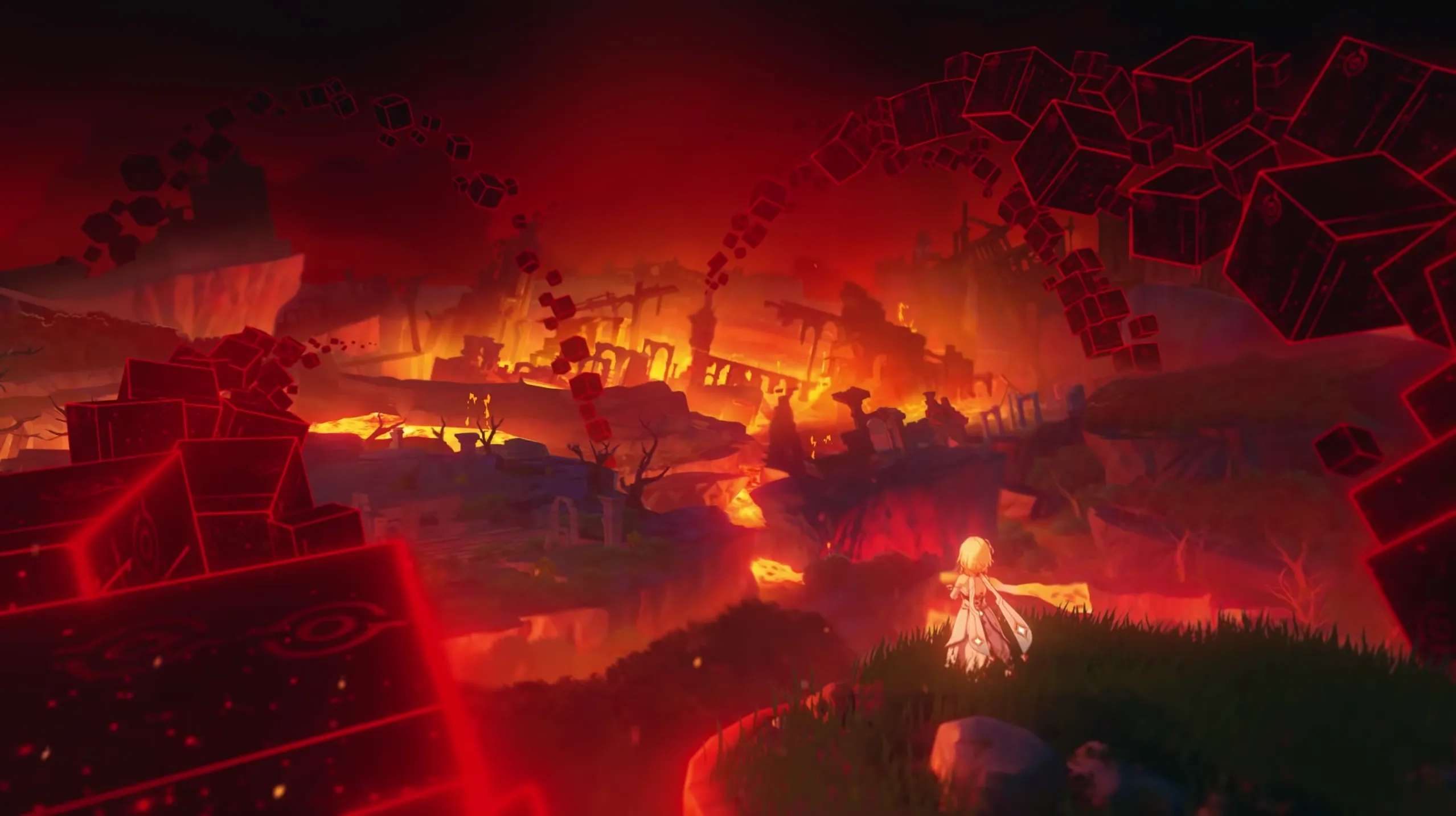
The Cataclysm was the world-scale disaster five hundred years ago: Khaenri'ah's destruction, an Abyssal monster eruption across Teyvat, the Heavenly Principles' and the Archons' assault on the godless underground nation, and the curse that still marks every Khaenri'ahn survivor line. Canon keeps the exact order of events deliberately unclear. What stays steady is the shape: Khaenri'ah had become deeply involved with the Abyss, monsters poured out of the kingdom, the gods and the Heavenly Principles destroyed it, and the survivors were cursed. [1]
Three causes drove it. The full Cataclysm page covers a wider set; these three are the ones that actually pulled the trigger. The Crimson Moon Dynasty layer and the engineered Ruin-Machine diaspora that came after belong to their own pages. [2]
Cause 1: Khaenri'ah against the Heavenly Principles' order
The first cause lies in what Khaenri'ah was. It was the godless nation, not one whose god had died or left but one that never had a god at all. In Dainsleif's Travail telling, it was "the pride of humankind," a subterranean nation built purely by humans, a flourishing of civilization with no divine sponsor. By the late Eclipse Dynasty under King Irmin, that project had turned hard toward mechanical engineering and forbidden-knowledge research, chasing "secrets from beyond the skies" to push Khaenri'ahn machinery past the laws of Teyvat. [2]
The deeper aim shows in the doctrine of mimesis the Chaos Bolt material text records. The Khaenri'ahns were "obsessed with the idea of mimesis," especially biomimesis; they built their machines on the belief that any natural form could be copied in a way that surpassed the original, making superior beings that could "replace the continuously decaying and shattering order." That phrase names what the doctrine wanted to replace: the order the Heavenly Principles had imposed on Teyvat, the one the godless project lived under. [2]
This put Khaenri'ah at odds with the Heavenly Principles, the Phanes / First Descender power that manages Teyvat. The prohibitions Heaven enforces weakened over time. That managing system should not be confused with the Abyss Order's Loom of Fate device; the name "Loom of Fate" points at three separate things (the device-and-Sibling project the Abyss Order built, the pre-Cataclysm Khaenri'ahn concept of a cosmological engineer, and the speculative reading of it as Teyvat's operating system), and they must not be merged. The conflict here is with the managing system itself: Khaenri'ah's mimesis program set out to replace the very order the Heavenly Principles existed to enforce. [5]
That conflict alone did not trigger the Cataclysm. Khaenri'ah had lasted through both the Crimson Moon and Eclipse Dynasty eras without intervention, and its godless status was tolerated all that time. The clash was the long-term cause, but the immediate trigger came from elsewhere.
Cause 2: the Five Sinners steal the Sibling's Abyssal power
The second cause is the immediate trigger. Per Welkin Moon Act IV "An Elegy for Faded Moonlight" (Luna II), King Irmin had induced the Traveler's Sibling, by then already an arrival from beyond Teyvat, to absorb world-shattering Abyssal power in the deepest depths of Khaenri'ah. The Sibling was the vessel into which Irmin's ritual concentrated the power Nibelung had brought back from the Sea of Stars. [4]
Dainsleif organised a five-person raid to free his older brother Vedrfolnir, a prophet Irmin had imprisoned for warning that Khaenri'ah would fall, from the royal palace. The raid succeeded, but in breaching the palace the five raiders also reached the vessel and each took a one-sixth share of the Abyssal power for themselves rather than restoring it. They became the Five Sinners of Khaenri'ah: Rhinedottir ("Gold"), Vedrfolnir, Surtalogi ("The Foul"), Hroptatyr ("The Wise"), and Rerir ("Rächer of Solnari"). The remaining one-sixth share stayed with the Sibling as vessel; one note describes it as "trapped within the moon's reflection, unable to return." [3]
Dainsleif organised the raid but declined a share of the power. He is the one organiser who is not a Sinner: the sixth person present at the founding event, who took nothing. His five-hundred-year investigation as Bough Keeper rests on having organised a rescue whose ultimate result was that his kingdom's strongest fighters abandoned it. [3]
Per Capitano in AQ V Act V "When All Becomes a Monument," the Sinners' use of stolen Abyssal power preceded Ronova's immortality curse on full-blooded Khaenri'ahns. The Sinners themselves became what they were by taking Abyssal power, not through curses Heaven passed on each of them. Rerir had been an ordinary Eclipse intelligence officer. The original Cryo Sovereign is separately established as unnamed and dead, with no current successor known. [3]
Cause 3: the Heavenly Principles strike back
The third cause is the response. The Sinners' act crossed a line, and Heaven's answer was direct and on a vast scale. Six of the Seven Archons (all but Rukkhadevata, who was tasked with protecting Irminsul) were summoned to Khaenri'ah; Egeria was slain at Tunigi Hollow trying to suppress the defilement seeping from the kingdom; Mavuika scorched the battlefield to the level of Musoujin Gorge, per Ei's "About Haborym" voiceover. The skies turned red and filled with crimson cubes, and the land was torn apart and flooded with lava. [1] [2]
Chapter VII Act V recalls the same moment. Opening the leaders' meeting in Snezhnaya, the Tsaritsa says, "The last gathering of The Seven was in Khaenri'ah, during the cataclysm," and Mavuika, meeting her in person for the first time, recalls that they "did have the chance to meet five hundred years ago" before she "had no choice but to return to Natlan." Neither says which archons were there. [9]
The curses followed. Ronova cursed pure-blooded Khaenri'ahns with immortality. Separately, per Eide's disclosure in AQ III V "Caribert," people whose ancestry belonged to the domains of other gods were struck with the curse of the wilderness as they fled and became monsters; Caribert is the direct named case who became a hilichurl. The checked primary text does not assign every Abyss Mage, Herald, Lector, Shadowy Husk, or Black Serpent form to people of that ancestry. [2]
The cruel part is the asymmetry: the five who triggered the curse did not suffer it. By then they were transcendent beings carrying stolen Abyssal authority, and none returned to defend Khaenri'ah when the Cataclysm came. Full-blooded Khaenri'ahns such as Dainsleif and Pierro received immortality, while the people separately described as cursed with the wilderness became monsters. [11] [12] Halfdan, the Royal Guard elite whom Dainsleif finds among the cursed Black Serpent Knights, is not a clean example of either: no source names the curse he bore. [13] [14] Keeping those groups distinct avoids treating hilichurls or Abyss Mages as examples of the immortality curse on full-blooded Khaenri'ahns. The Cataclysm is the last known large direct intervention by the Heavenly Principles, who have been dormant for the five hundred years since. [3]
After the strike: the Tsaritsa's account of the sleep
Chapter VII Act IV offers an explanation for that dormancy, though not for the strike itself. Rhinedottir tells the Tsaritsa that the Third Descender once bargained with the Heavenly Principles: his remains would be "split into seven pieces to consolidate the system of rule established by the Heavenly Principles" if they resurrected her and "promised to never lay a hand on his descendants," the people later known as Khaenri'ahns. He held them to it with "a curse, profound and complex, one that would only take effect if the promise was ever broken." [8] [10]
The conclusion is the Tsaritsa's own: "So, when the Cataclysm occurred in Khaenri'ah, it must have triggered the Third Descender's curse... That's why the Heavenly Principles are asleep." Rhinedottir will not confirm it, calling what she told "just a story" and saying she "certainly wasn't answering any particular question." The reading implies that the strike on Khaenri'ah broke the promise, but neither speaker says so outright, and the account remains unconfirmed. It leaves the three causes above as they were. [8]
What canon has not surfaced
Four threads are held back or pushed to other pages. The Crimson Moon Dynasty, the older Khaenri'ahn ruling line whose Three-Moon cosmology and Art of Khemia predate the Eclipse-era turn, has its own page. The engineered Ruin-Machine diaspora that came after, the Field-Tiller line that wandered Teyvat for centuries, is the mechanical counterpart to the curse-modified hilichurls and lives on its own race page. The Sustainer's role during the Cataclysm window is also held back; the Sustainer is Asmoday (Ruler of Space among the Four Shades, whose absence Fandom reads as a defection), the role she holds rather than a separate rank. [15] And the unnamed source of the shared voice that recruited each Sinner is still unresolved. [6]
Related
The full event page, with regional impacts and the four post-Cataclysm survivor lines, is The Cataclysm. The civilization itself is Khaenri'ah, the Sinner group is Five Sinners of Khaenri'ah, and the Abyssal side is The Abyss. The long-form narrative essay is Khaenri'ah, the Cataclysm, and 500 years after. [7]