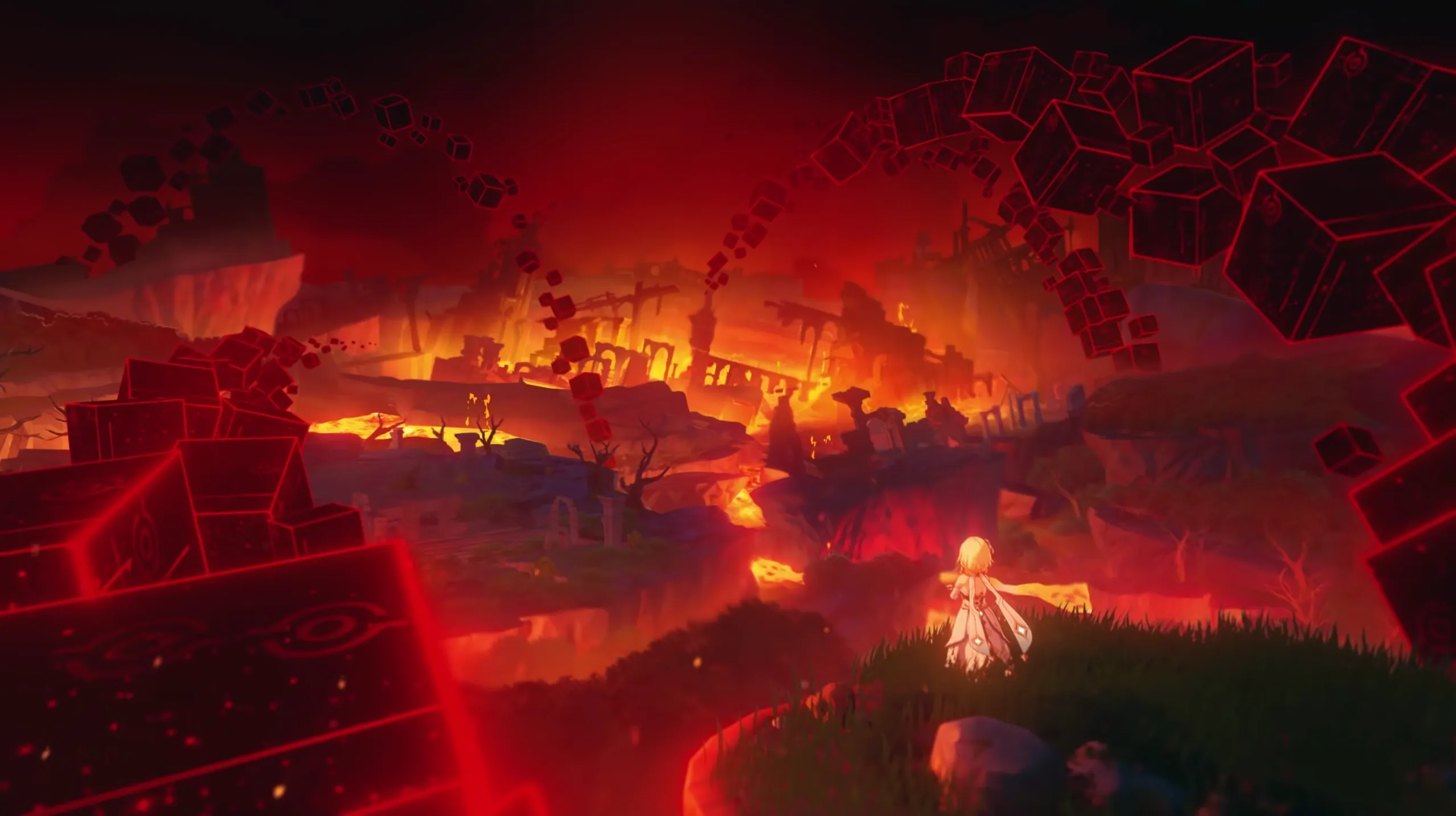
Five hundred years ago an underground civilization in the centre of Teyvat refused to acknowledge the gods, was destroyed for it, and the survivors were cursed into states of being they have still not recovered from. Almost every faction the present-day story treats as antagonistic (the Fatui, the Abyss Order, the Five Sinners, the cursed individuals like Dainsleif and Kaeya) traces back to that event. So does the Tsaritsa's plan, which is the spine of the Archon Quest.
The official Version 7.0 Special Program adds one direct relationship: "all Khaenri'ahns are descendants of the Tsaritsa." The developer statement establishes the lineage but supplies no biological, dynastic, ritual, or supernatural mechanism, so this essay does not infer one. [26]
Chapter VII Act IV (Version 7.1) supplies an in-game account, though still no genealogy. Rhinedottir greets the Tsaritsa as "Mother of Khaenri'ah" and tells her that "all Khaenri'ahns are descendants of a bloodline that began with you and the Third Descender." The Tsaritsa answers that she is aware of it, "although I have no memory of it." The account does not relate that bloodline to Khaenri'ah's two dynasties. [28] [30]
The history below runs roughly chronologically: what the kingdom was, how the Cataclysm unfolded, what the four post-Cataclysm lineages have done for five centuries, and what remains ambiguous after released Chapter VII Acts I-VI. The essay no longer treats Snezhnaya as the place where these threads will be resolved later.
What Khaenri'ah was
Khaenri'ah was a large underground human civilization, several million people at peak, with its capital somewhere beneath central Teyvat, probably under the Chasm in southern Liyue and possibly extending toward Dragonspine and the Sea of Bygone Eras. It was founded thousands of years before the present and outlived several of the surface nations' early forms. By the time of the Cataclysm it was the only civilization in Teyvat that had achieved a high technological level without divine sponsorship[1].
Three features made it distinct.
The first was political. Khaenri'ah was ruled by the Eclipse Dynasty, a hereditary monarchy whose last Vinster King, Irmin, reigned until his death 500 years ago; Fandom ties his use of Abyssal power to the Cataclysm and the emergence of the Five Sinners. [2] The dynasty's named survivors are retainers such as Dainsleif rather than a confirmed royal heir[1]. (Caribert, sometimes taken for an Eclipse heir, in fact belongs to the Alberich clan, the noble line that founded the Abyss Order; canon does not equate the Alberich line with the Eclipse royal house[3].)
The second was technological. The Ruin Guards, Ruin Hunters, Ruin Graders, and Ruin Drakes found across modern Teyvat are all Khaenri'ahn machines, biomimetic war machines whose Khaenri'ahn codename was Field Tillers, after the anti-agricultural Khaenri'ahn motto "The land is not to be tilled with farming tools, but rather to be fought for with steel and blood." "Field Tiller" is the original Khaenri'ahn name for what modern Teyvat calls Ruin Guards, not a separate farming machine. The line is war-machine engineering meant to replace the natural order under the Khaenri'ahn doctrine of biomimesis (per the Chaos Bolt material text, the Khaenri'ahns were "obsessed with the idea of mimesis," particularly biomimesis, and built their machines to "replace the continuously decaying and shattering order"), not a mix of combat and agriculture. They still function five centuries after their builders died. The Chasm's deep ruins, the Sumeru desert's deep ruins, and several Mondstadt-area ruins all date to Khaenri'ahn occupation. The melusines of Fontaine are not Khaenri'ahn; those are Neuvillette's[6], though the broader pattern of synthetic humanoids has Khaenri'ahn parallels. For the full race page on the ruin machines (the Field Tiller prototype at Stormterror's Lair, Sandrone's Marionette regiment, Ley-Line reactivation per Afratu's Dilemma), see the Ruin Machines page.[16]
The third was alchemical. Rhinedottir, called "Gold," created the original Durin, a Pyro/Abyssal dragon who attacked Mondstadt during the Cataclysm and was slain by Dvalin, the Anemo dragon. Durin's corpse became part of Dragonspine. She also created Albedo, the Kreideprinz homunculus. [8]
The single defining feature of the culture, though, was not technology. It was the explicit, codified rejection of Celestial gods. Khaenri'ah had no religion: not "had several" or "was syncretic," but had none. The kingdom held, as a matter of state philosophy, that human achievement did not require divine sponsorship. The Heavenly Principles' issued Visions were absent from Khaenri'ah by design. The Seven Archons' authority did not run there. This was the official reason the Heavenly Principles eventually destroyed the kingdom, and it is the reason every present-day Khaenri'ah-aligned faction frames the destruction not as a war's outcome but as a deliberate Heavenly judgement.
The Cataclysm - what we know happened
The Cataclysm is a cluster of events approximately five hundred years before the present, centred on the destruction of Khaenri'ah and the deaths or transformations of multiple Archons. The events are not a single battle. They span several years and several regions.
The Cataclysm chain includes the Five Sinners stealing Abyssal power and Rhinedottir's creations attacking Khaenri'ah and the Seven Nations. Released primary text does not supply the invented project label previously used here.
The known Heavenly Nail strikes belong to an older period of cleansing after the War of Vengeance, millennia before the Cataclysm. Dragonspine and the desert Nail sites must not be presented as Heaven's opening response to Khaenri'ah five hundred years ago. [10] [9]
The Cataclysm-era Khaenri'ahn curses are separate from those ancient Nail strikes. Primary text securely establishes two ancestry-based punishments:
- Pure-blooded Khaenri'ahns received the curse of immortality. Dainsleif is the best-known example, and the "Bough Keeper: Dainsleif" World Quest establishes that he has wandered Teyvat investigating the Cataclysm for the full five hundred years since[1].
- People whose ancestry belonged to the domains of other gods received the curse of the wilderness and were turned into monsters. Caribert is the named primary-text case who became a hilichurl[3].
Those statements do not securely assign every Abyss Mage, Herald, Lector, Shadowy Husk, or Black Serpent form to either blood cohort, nor do they establish that pure-bloods exclusively became the Order's leadership.
Chapter VII Act VI adds a general word about hilichurls. On Dragonspine, when the Traveler asks whether the hilichurls are answering old voices "Because of... Khaenri'ah?", Venti says: "Exactly. It was a different era, a different civilization, but the fact remains... They were once human, too." Hearing the cries of a destroyed people, "they probably thought the cataclysm was coming all over again." He does not say which curse made them, or whether every hilichurl shares that past. [35]
The curse was deliberate. Canon is consistent across sources: this was not a side-effect of the Nails but a separate Heavenly act.
The Cataclysm also took or transformed several Archon lines. Raiden Makoto died[1], and Greater Lord Rukkhadevata sacrificed herself against Forbidden Knowledge[5]. Egeria died during the Cataclysm; Focalors later held the Hydro Archon office and partitioned herself, leaving Furina as the public human role. Neuvillette remained the Iudex and Hydro Sovereign in human form, never a Hydro Archon. [6]
The regional effects ran wide. Dvalin, the Anemo dragon, slew the original Durin, a Pyro/Abyssal creation, over Mondstadt; Durin's corpse became part of Dragonspine[9]. The Abyss Order later coalesced in its modern political form.
Version 7.2 adds a detail from the gods' side. Opening the meeting of the nations' leaders in Chapter VII Act V, the Tsaritsa says, "The last gathering of The Seven was in Khaenri'ah, during the cataclysm. Five hundred years on, many familiar faces are no longer with us." Mavuika, meeting her in person for the first time, recalls: "Although we did have the chance to meet five hundred years ago, all sorts of things ended up getting in the way. For my part, I had no choice but to return to Natlan." Neither says why the Seven gathered there or what they did. [34] [36]
This is the period the present-day game refers to as "the Cataclysm." Within Khaenri'ah it is the destruction of the kingdom. Within the wider cosmology it is the moment the Heavenly Principles took their last large direct action and went dormant. Both framings are accurate. Neither is the whole story.
The cosmological reason
Khaenri'ah was not destroyed for being too prosperous, too technologically advanced, or too aggressive. The more specific cosmological logic is that Khaenri'ah's prosperity without divine sponsorship was the problem. A thriving godless civilization proves that the Heavenly Principles' system of Visions and Gnoses is not necessary. If humans can flourish at scale outside the Visions framework, Celestia's whole administration becomes one possible arrangement rather than a necessity. Khaenri'ah was a refutation of the cosmology[7].
In Version 7.2 Pierro offers a related conclusion to the other nations' leaders: "Before the destruction of Khaenri'ah, we conducted research on this point. Our conclusion was that, for the Heavenly Principles, it is far better for the nations to operate in isolation than in unity." The reason he gives is that "the Gnoses are the only things with the potential to disrupt the order of the world, and each is in the hands of a different archon." He does not say who "we" were, and Nahida warns that "we must speculate with care, or we risk crossing the line into the conspiratorial." [34]
The curses targeted people: pure-blooded Khaenri'ahns with immortality, and people whose ancestry belonged to gods' domains with monstrous transformation. Caribert's hilichurl form shows one result of the latter without making it the only result. The ancient Nail sites belong to a separate chronology and cannot be read as strikes on infrastructure during the Cataclysm.
There is a secondary cosmological layer. Skirk says the Gnoses were made from the Third Descender's remains; Hymns of the Far North separately says Saarelainen was carved into seven pieces. The parallel makes Saarelainen the strongly implied candidate, but no primary line explicitly identifies him as the Third. The Gnoses and the Archon system belong after the War of Funerary Flame and before the Archon War, not to the Cataclysm.
Chapter VII Act IV adds Rhinedottir's account of how those remains were given up, still without naming the Third Descender. In her telling, the Belyi Tsar incited the Tsaritsa, then "a mere herald of the court," to "open the gate to the Abyss alongside the Third Descender," and the Heavenly Principles "immediately erased your existence as punishment." The Third Descender "ascended to Celestia to negotiate," agreeing to have his remains "split into seven pieces to consolidate the system of rule established by the Heavenly Principles" if they resurrected her and "promised to never lay a hand on his descendants," the people later known as Khaenri'ahns. He bound the promise with a curse that would take effect only if it were broken. The Tsaritsa concludes that the Cataclysm "must have triggered the Third Descender's curse," which is why the Heavenly Principles sleep; Rhinedottir answers that it was "just a story." [28]
If the Saarelainen identification is correct, the Tsaritsa's collection reassembles something Heaven partitioned. The identity remains a theory, but her motive no longer rests on inference. In Act III she says the Gnoses can amplify their bearer enough to "transcend the limits of one's authority," and of a seal the Third Descender left she says: "The only thing that seems to respond to it is a Gnosis. Once the remains of the Third Descender are no longer scattered across the world... Perhaps only then, we may behold the legacy he sealed away." [27] [29]
The 500 years since - four lineages
In the five centuries since the Cataclysm, four distinct Khaenri'ah-descended lineages have formed. They are not allied. They overlap personally (Pierro knows Dainsleif, the Five Sinners include figures the Abyss Order venerates, Kaeya and Albedo move between Mondstadt and Khaenri'ahn-aligned circles), but their goals are not the same.
The Fatui are the most visible as an organisation. After the Cataclysm, Pierro, formerly a royal mage in Khaenri'ah's court, survived and sought sanctuary. Mocking Mask says his learning did not compare with the sages and that he failed to stop them; no source makes him their First Sage or superior. He found an ally in the Tsaritsa, and the Fatui was established under his leadership. Pierro became its unnumbered Director. Commander Thrain, the Khaenri'ahn commander known as Capitano, retains the First numbered Harbinger rank even though his Natlan sacrifice left him unable to participate. Pierro also became the architect of the recruitment pattern that defines the rest: find people the world broke (orphans, exiles, the cursed) and train them. Almost every Harbinger fits the template. Of the order's members, Pierro, Thrain, and Arlecchino are Khaenri'ah-blooded directly, while others such as Columbina and Wanderer carry different cosmological grievances. The Special Program's statement that all Khaenri'ahns descend from the Tsaritsa gives this alliance a direct lineage context. Rhinedottir's Act IV account traces the line to the Tsaritsa and the Third Descender but still gives no genealogy, and even Dainsleif, who stands outside the Fatui, calls her "the Mother of Khaenri'ah." [28] [23] [24] [22] [25] [4] [26]
The Fatui's institutional memory is the most significant single thing they inherited from Khaenri'ah. Pierro carries Khaenri'ah's grievance into an organisation aimed at the Heavenly Principles' order. Asmoday is the Sustainer and is absent from the Shades (in Chapter VII Act V Alice says, "She's missing, after all"), but released canon does not say she currently fills the throne. [34]
The Abyss Order is the political-military mirror. Chlothar Alberich, a pure-blooded Khaenri'ahn cursed with immortality, encountered Vedrfolnir among Sumeru's ruined sites; the meeting and Caribert's fate drove the Order's founding. The Order is rooted in Khaenri'ah and fields Abyss Mages, Heralds, Lectors, hilichurls, and other Abyssal beings, but primary text does not provide a blood-cohort map for those classes. In particular, it does not establish that Heralds and Lectors were mixed-ancestry aristocrats who consciously chose transformation, that Mages represent the same lineage at a lower rank, or that pure-bloods exclusively form the leadership.
The Order's leadership question is unresolved in canon. The Traveler's sibling has been with the Order since shortly after their Cataclysm-era arrival, and is the most publicly visible figure on the Abyss side. The Order's goals are mixed: revenge against Celestia, restoration of Khaenri'ah by a different mechanism, cooperation with the Abyss as a counter-cosmology rather than instrumental use of it, and a parallel desire to help the Traveler find their sibling. The last has produced an unusual pattern in which Abyssal forces consistently don't fight the Traveler with full force.
The Five Sinners of Khaenri'ah are the third lineage: Rhinedottir, Vedrfolnir, Surtalogi, Hroptatyr, and Rerir. They stole shares of world-shattering Abyssal power during the operation to rescue Vedrfolnir. Rerir was an ordinary Eclipse intelligence officer, not an aristocrat; becoming a Sinner was an outcome of taking Abyssal power, not a special curse sentence issued by Heaven. The event does not map the ancestry of Mages, Heralds, or Lectors.
Of the five, Rerir has had the most visible active role: he commanded the Wild Hunt, the centuries-old Abyssal cavalry attack on Nod-Krai, until the Luna I-IV arc, when he was banished back through the Moon Gate at the climax of Welkin Moon Act IV. The Wild Hunt did not dissolve; command passed to Rotwang, the exiled Khaenri'ahn monk of the Eclipse Dynasty's Universitas Magistrorum, "The Professor," and to an imitation of the Mondstadt knight Roland fashioned by the Abyss (per in-game text, not the figures from Frostmoon Scion myth that readings before the Welkin Moon arc assumed). The Five Sinners are aligned with none of the Fatui, the Abyss Order, or the Traveler. They are their own faction with their own goals, and the accepted reading is that they were never a unified group either, since the rescue of Vedrfolnir left them with shares of the same Abyssal power but very different paths afterward: Rerir to command of the Wild Hunt; Surtalogi to exile in the Sea of Stars, training Skirk; Rhinedottir to the Hexenzirkel and alchemical work involving a fusion with Naberius; Vedrfolnir to the contact with Chlothar that founded the Abyss Order; and Hroptatyr, by Pierro's account in Chapter VII Act IV, out of Teyvat altogether. Not long after the Cataclysm he handed Pierro a notebook and left "to venture into the depths of the universe and merge with the Abyss to acquire infinite knowledge." [28]
The cursed individual remnants are the fourth lineage, and they are not an organisation. They are people. Dainsleif is the clearest case: five hundred years of independent investigation, periodic contact with the Traveler, no allegiance to either Fatui or Order[1]. In Chapter VII Act IV he answers Pierro's summons to fight Ronova, though only to "humor him this once." [28] Kaeya Alberich is the Mondstadt-resident half-Khaenri'ahn whose father left him with the Ragnvindrs as a sleeper agent with original instructions he has chosen not to act on; the unresolved loyalty question is the unspoken centre of his arc[15]. Albedo comes from Rhinedottir rather than from Khaenri'ahn blood, but inherits the Khaenri'ahn alchemical lineage directly and is in periodic correspondence with Rhinedottir, who herself disappeared into the deep Abyss after the Cataclysm and may be partly corrupted, partly fine; the letters do not say. [8] Arlecchino (born Peruere), the current Knave and head of the House of the Hearth, carries the Crimson Moon Dynasty bloodline of old Khaenri'ah, a lineage the Jester told her had been thought extinct; her cruel predecessor Crucabena, whom Peruere killed to take the title, is a separate figure whose own Khaenri'ahn descent canon does not establish[4].
These four lineages overlap personally and disagree in their goals. They are the demographic and political consequence of the Cataclysm.
Caribert in detail
Caribert, the sixth act of the Chapter III Archon Quest (Version 3.5), is the densest single disclosure of how the Abyss Order began and what the Khaenri'ahn curse did to ordinary families.[3] Following a lead from the Sibling's "Loom of Fate" operation, the Traveler and Dainsleif reach a hut in Avidya Forest kept by a god-hating Khaenri'ahn calling himself Eide.
Eide is hiding his son, Caribert, a child of mixed Khaenri'ahn and Mondstadt blood whom the Cataclysm's curse turned into a hilichurl. Ordinary remedies fail. What works is the Abyss: in a hidden sanctuary, Eide and the Sibling find the chained Sinner Vedrfolnir, whose Abyssal power briefly restores Caribert's mind. From this Eide draws his doctrine, that only a sinner can save a sinner, and that the Abyss can do what the gods will not.[3]
When Caribert removes the mask he was forbidden to take off, Abyssal power floods out of him and the boy becomes the seed of the Loom of Fate. Eide reveals himself as Chlothar Alberich, recognises the Sibling, and addresses them as his Prince or Princess. He founds the Abyss Order and instates the Sibling at its head, then later goes mad and disappears, his remains eventually found in the same forest. The Sibling, disturbed at first, comes to accept his reading of Teyvat after travelling with Dainsleif.[3]
Three things come out of the Caribert thread. It is the Abyss Order's origin story. It puts a family and a face to the Khaenri'ahn curse, the same curse that produced Teyvat's feral hilichurls. And it is a hinge in the Sibling's turn toward the Abyss, the choice that sets up every later sibling encounter in the main story.
Caribert is often confused with the child tied to Arlecchino's past, but he is not that child. That child is Clervie, daughter of the previous Knave Crucabena, and her death is disclosed in Arlecchino's own Story Quest, "Ignis Purgatorius."[4] The two threads share neither characters nor setting. The separate revelation that the Cataclysm was a deliberate, ordered destruction is carried by the main Sumeru acts and by Nahida, not by the Caribert act.
The convergence
For most of the post-Cataclysm period, the four lineages have operated separately. The Fatui were the most visible as an organisation but acted region by region; the Abyss Order skirmished on the edges; the Five Sinners were rumoured and not named; the cursed individual remnants did their own private investigations. The Archon Quest moved through five regions across the patches before any of these threads sat directly on the same screen.
By released Chapter VII Acts I-VI, those lines are all visible, though not fully converged.
The Fatui's collection program is in its final phase. Five other Archons' Gnoses are confirmed in Fatui possession: Anemo (Venti, taken from Mondstadt), Geo (Zhongli, voluntary handoff in Liyue), Electro, Dendro, and Hydro (Arlecchino's collection from Fontaine). The Electro route is Ei to Yae before Ei's withdrawal, Yae to Scaramouche through the Delusion Factory exchange for the Traveler's safety, Scaramouche into the Sumeru god-creation project, Nahida's recovery after his defeat, and Nahida's transfer to Dottore. Nahida separately transferred her Dendro Gnosis to Dottore. Signora never carried the Electro Gnosis, Yae never delivered it directly to Pierro, and no Gnosis handoff occurred at Tenshukaku. [17] [18] [19] The Pyro Gnosis came through AQ V uncollected. After the war Mavuika says that "since this is the final Gnosis, I doubt the Tsaritsa will let the situation stand." [31] She later gave it to Sumeru at Nahida's request, and Nahida used it in the operation to burn Irminsul. It disappeared without a trace afterward; searching the remnants of Irminsul, Nahida found "not even any trace of it burning to ash." [32] [33] Its location is unknown, and neither Mavuika nor the Fatui/Tsaritsa is confirmed to hold it. In Chapter VII Act III the Tsaritsa calls it "the only one of the seven Gnoses whose whereabouts are unknown." The Traveler tells her that it "was reduced to ashes" along with Irminsul and relays Mavuika's word that it "has returned to the Ley Lines." In Act IV Rhinedottir remarks that the Tsaritsa has "six Gnoses in your possession," a count consistent with her own Cryo Gnosis plus the five collected, while Pierro says she "has yet to gather all seven Gnoses." [20] [27] [28] In Act V Pierro tells the other nations' leaders that the Fatui "have yet to locate the Pyro Gnosis" and are still searching, and Mavuika says she "can no longer sense it"; Act VI ends with nobody knowing where it is. At the same meeting the Tsaritsa gives her own account of the collection: "Even with those who wished to support us, we had no choice but to stage a performance so as to minimize the risk of failure." She does not say which of the handovers above she means. [34] [35]
The Abyss Order is moving into the open. Two of the three sibling encounters in the AQ across Liyue, Sumeru, and Fontaine have placed the sibling explicitly in command of significant Abyssal forces. The Wild Hunt in Nod-Krai is now under Rotwang and Roland after Rerir's banishment. Dainsleif's investigations have moved from the Chasm period (Mondstadt and Liyue) into the Caribert period (Sumeru) and into present-day cooperation with the Traveler (Bough Keeper: Dainsleif, the Version 1.3 World Quest that leads into Chapter I Act IV, We Will Be Reunited). [1] The Order is no longer a background hostility but a faction the player visibly interacts with.
The Five Sinners now appear as a complete group. Their post-Cataclysm paths diverged, and released Chapter VII Acts I-VI do not establish a coordinated Sinner project: Rhinedottir appears as the Ruler of Life alongside Naberius, and Hroptatyr only through his notebook and a prism memory of his younger self. [28] Acts V and VI add only Alice's passing mention of "Rhine," presumably Rhinedottir. [34] Their goals remain distinct from both the Fatui's and the Order's.
The cursed individual remnants are talking to each other. The Khaenri'ahn-blooded characters who had been holding their grievances privately (Dainsleif, Kaeya in Mondstadt's interludes, Albedo in his Princeps Cretaceus chain, Arlecchino across her Fontaine arc) have in the Luna VII period started showing up in proximity to one another. The Traveler is the most consistent node in this network, and the AQ's structure is positioning the Traveler as the figure through whom the Khaenri'ahn lineages converge.
In Chapter VII Act IV two lineages fight side by side: Dainsleif and Pierro, the Fatui's Director, join the Traveler against Ronova, the Shade Dainsleif blames for his curse. [28]
Released Chapter VII Acts I-VI bring the story into Snezhnaya and, at the end of Act VI, into Celestia, but they do not finish the Cataclysm arc or place every lineage in one coordinated operation. [21] [20] [29] [30] [36] [37]
What's still ambiguous
Several of the most-asked questions about Khaenri'ah remain unanswered after released Chapter VII Acts I-VI.
The full Eclipse Dynasty is unmapped. No surviving royal heir is named in canon; the dynasty's named figures are its retainers, such as Dainsleif, rather than confirmed royalty (Caribert belongs to the Alberich clan, not the Eclipse line). Whether any heirs survived, and what their present-day status is, is open.
Durin and Albedo remain documented Rhinedottir creations on their own terms; no additional named project or product should be invented.[8]
Whether the Five Sinners coordinated after the rescue of Vedrfolnir is open. All five are now named, but whether they ever worked together as a group after the founding event, or whether the rescue was their only joint operation, is not established. Hroptatyr's trajectory is now partly told: Pierro's account and the notebook in Chapter VII Act IV take him from leading the Universitas Magistrorum's research into the Crimson Moon to his departure from Teyvat, but what became of him after that is unknown. [28]
The Traveler's sibling's actual alignment is unresolved. The Order frames them as a leader, and their on-screen behaviour has been ambivalent in every encounter. Whether they are dogmatically Abyssal, manipulated, operating toward a goal the Traveler has not yet understood, or some combination, is open. Chapter VII Act IV adds a question rather than an answer: Pierro says that "When I summoned Paimon from Celestia, Hroptatyr summoned someone else at the same time," and that it was the Sibling. [28] Act VI ends on another. Its last spoken line, which Fandom gives to the Sibling and Yatta to the Traveler, is "I have already traveled through this world once. Once you reach the end of your journey as I did, you will see for yourself the true nature of this world." The Traveler then reflects, "(All of a sudden, Teyvat is to me what Khaenri'ah is to her/him...)" That thought is the Traveler's. It says what Khaenri'ah means to the Sibling as the Traveler now understands it, not what the Sibling intends. [35] [38]
Pierro's relationship to the Descender framework is unconfirmed. He is repeatedly described in oblique terms ("the man who has already failed once at the largest possible scale"; "the only Harbinger whose grievance is cosmic"), and some readings place him as a Descender or Descender-adjacent figure. Canon has not confirmed this; the Descenders page treats him as a cursed survivor, not a Descender.
The Heavenly Principles' present status is dormant, and Nahida and the Traveler's sibling both date the silence to the Cataclysm.[39] Neuvillette's Character Story 5 does not mention the sleep; it speaks of fate as the way "the present ruler of this world plays with living beings."[14] Released Chapter VII Acts I-VI do not resolve when they will wake. In Act IV Rhinedottir refuses to tell the Tsaritsa, and the Tsaritsa's own inference that the Cataclysm triggered the Third Descender's curse is met with Rhinedottir's "just a story." [28] Before the nations' representatives enter Celestia in Act VI, the Tsaritsa says only that "The Heavenly Principles still slumbers." [35]
The curse's exact form-selection mechanism stays ambiguous. Eide makes ancestry relevant to which curse was imposed, and Caribert directly demonstrates a hilichurl outcome, but released text does not explain why one monster form rather than another results or map the Abyss enemy classes onto blood cohorts.[3]
Chapter VII Acts I-VI leave these questions open. The essay records that released state rather than projecting a future Snezhnaya resolution.
If you want the cosmological complement, the Descenders page covers the criterion of a will that rivals the world, and where the evidence stops: Saarelainen is a strongly implied candidate for the Third Descender's identity, not one the game confirms by name.