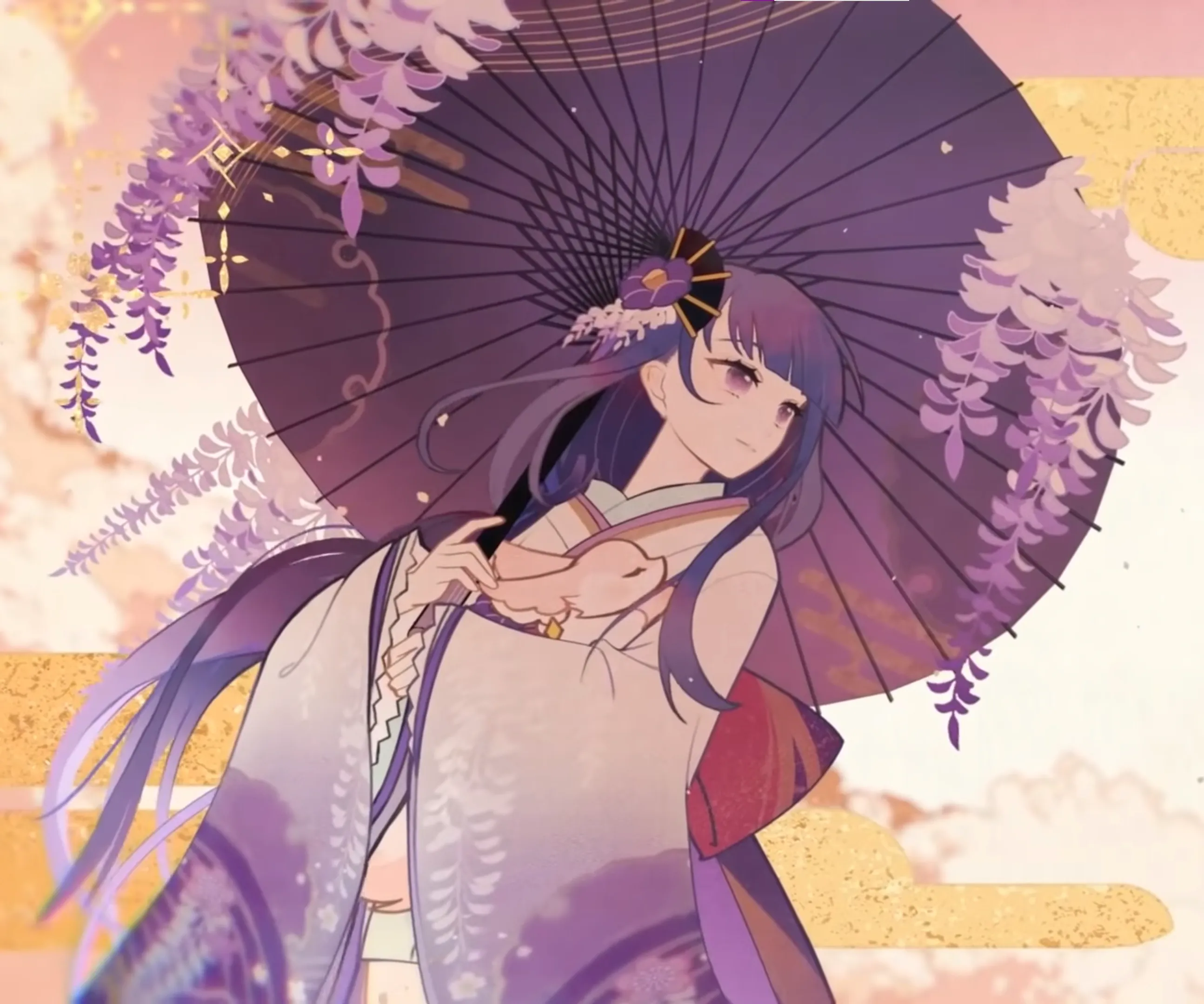
Archon War-era founder of the Inazuma Shogunate; original Electro Archon; Cataclysm casualty ~500 years ago
Overview
Inazuma's original Electro Archon and founder of the Inazuma Shogunate, around 2,000 years ago.
The elder twin of Raiden Ei and the first to hold the Raiden Shogun title (Narukami Gongen).
Died at the Cataclysm roughly 500 years ago after travelling to Khaenri'ah alone.
Her death set off Ei's long withdrawal from the world.
Appears only in flashback; never playable.
The original Electro Archon of Inazuma: the elder twin of Raiden Ei, the first Raiden Shogun (Narukami Gongen), and the public face of the Electro seat from the close of the Archon War until the Cataclysm 500 years ago, where she died responding to events at Khaenri'ah. Her death is the underlying cause of Ei's centuries-long withdrawal.
Spoiler-free overview. You hid spoilers under Settings → Reading; choose Show all there to read the full content.
Raiden Makoto (Japanese 雷電眞, Goetic name Baal, with aliases Narukami Gongen, First Shogun, True Shogun, God of Eternity, Lord of Thunder, and Her Excellency the Almighty Narukami Ogosho) was Inazuma's original Electro Archon, the elder twin of Raiden Ei, and the founder of the Inazuma Shogunate at the close of the Archon War roughly 2,000 years ago. She died at the Cataclysm about 500 years ago, having travelled to Khaenri'ah alone without informing Ei. Her death is the root cause of nearly every piece of Inazuman political history the player meets: Ei's withdrawal into the Plane of Euthymia, the puppet Raiden Shogun Ei built in Makoto's likeness, the Vision Hunt Decree's eventual hardening into autopilot, and the present-day "Eternity" doctrine that Ei, after AQ II, is trying to restore to the warmer form Makoto herself defined. [1]
Two Archons: Shin and Kage
The founding narrative comes from the in-game book Treasured Tales of the Chouken Shinkageuchi (V2.2; sold at the Yae Publishing House), which walks through Inazuma's founding in the Archon War era from the First Shogun's perspective. The book states: "From the day Narukami Gongen, the First Shogun, began her dominion over the land of Inazuma, she was accompanied by her younger twin sister. 'Shin' and 'Kage,' light and dark they were, mediating and holding court, ordering and giving battle." Makoto is Shin (the true blade, the public-facing Archon); Ei is Kage, the shadow-warrior (kagemusha), the sister whose name "if her name were to be written plainly, it would likely be the word for 'shadow.'" The modern Raiden Shogun's shape, two figures behind one Archon, began here with Makoto and Ei's original co-rule, centuries before Ei rebuilt it after the Cataclysm with a puppet body. [5][15]
1.
Makoto - Genshin Impact Wiki (Fandom) · external ↗
2.
Raiden Shogun/Lore - Genshin Impact Wiki (Fandom) · external ↗
Where the Boat of Consciousness Lies - Genshin Impact Wiki (Fandom) · external ↗
19.
Kitsune Saiguu - Genshin Impact Wiki (Fandom) · external ↗
20.
Transient Dreams - local dialogue transcript · open page →
The division between the twins was one of role, not rank: "Makoto presumably handled general affairs, while Ei would handle those that would require force." Ei was "a far more formidable warrior than the peaceful Makoto"; Makoto was the better-suited Archon for "leading humanity," in Ei's own judgement. The public-facing framework was that "as far as the world was aware, there were not two, but one. They complemented each other, and they ruled Inazuma jointly; therefore, there was no need for the public to know the truth. The name 'Baal' and the title of Raiden Shogun were understood to refer to both of them."[1][2]
The Archon-War institutional transfer
What bridged the two-sister partnership and the founding of the Inazuma Shogunate was Ei's bodily sacrifice during the Archon War. Per the Treasured Tales account: only "The Seven emerged from the wrack and ruin of the war that rolled across the mortal world like a crimson storm." Though Ei ("the Shadow Shogun") was "divinely skilled in martial arts and unsurpassed with the blade," she believed herself "little more than a warrior with little understanding of mortal hearts." So "she chose to give up her bodily form, helping her sister to ascend to the 'heavenly citadel' and obtain dominion over Inazuma." Makoto then set up her Shogunate, and "remembering their bond, she recalled 'Ei's' divine will and reforged her body, thus returning her sister to her side once more as her kagemusha."[5]
This is a case of godhood passed by inheritance and succession, one of the four ways canon shows godhood being acquired. The Electro seat among The Seven is Makoto's after the war; she met with the original Seven from time to time in Liyue, handled Inazuma's day-to-day general affairs, and left the matters that required force to Ei. [17][12]
(Raiden Shogun's Voice-Over: More About Ei: III sets the limits of the book's reliability: Treasured Tales is "fairly accurate regarding the events leading up to the war against Orobashi," the founding material from the Archon War era, but "after that point idealizes her motivations and actions." The founding material the book covers is trustworthy; the later material in the same volume, after the war against Orobashi, should be read with that caveat.) [15]
Per Raiden Shogun's Lore page, after the Archon War's close "the two would live in relative peace until the cataclysm 500 years prior to the start of the game." The pre-Cataclysm period under Makoto and Ei is when the Hyakkiyakou era ran, the flourishing of yokai culture organised under the Kitsune Saiguu's Grand Narukami Shrine. [2]
In the Akitsu Kimodameshi 3.3 Test of Courage event, Ei recalls during a beach stroll that "the yokai held festivals called the Mikawa Flower Festival which Ei and Makoto attended together" and that "Makoto enjoyed playing Akitsu Hazura," the hagoita-and-ball yokai game that was the festival's highlight. The Mikawa Flower Festival is dated the same way: "the Mikawa Flower Festival dates back over five hundred years. Historically, many prominent youkai, as well as both Ei and Makoto, attended the festival." This is the primary text showing that Makoto played Akitsu Hazura at the original Mikawa Flower Festival alongside Ei, and it matters for her pre-Cataclysm chronology, since she otherwise appears only in flashback and has no Story Quest of her own. [16]
Makoto's pre-Cataclysm Inazuma ran on the same yokai culture, centred on Mt. Yougou and organised by the Kitsune Saiguu, that Ayato's modern cultural revival through the Yashiro Commission is consciously continuing. That continuity is not coincidental; it is what Makoto's Inazuma was made of. [16]
The Cataclysm: Khaenri'ah, alone
Makoto's death is shown in Imperatrix Umbrosa Chapter Act II "Transient Dreams" (Raiden Shogun SQ Act II, patch 2.5), where rifthound damage to the Sacred Sakura's root system brings Cataclysm-era memories held in the Ley Lines to the surface and Ei walks the Outlander through what happened ~500 years ago. [3][9]
Canon records: "the two would live in relative peace until the cataclysm 500 years prior to the start of the game, when monsters began appearing across Inazuma and leaving mass trails of destruction in their wake. Makoto headed to Khaenri'ah alone without informing Ei, as she was compelled to do so. By the time Ei found Makoto in Khaenri'ah, she had already fallen unconscious in the ensuing battle and was dying."[1]
Act II and the wider record bring out three details of the event:
Inazuma was under attack by monsters at the same time. Kitsune Saiguu (Ei's friend and close ally) led the defence and was killed in the same wave of events; Mikoshi Chiyo / Torachiyo (Ei's oni friend) was corrupted by a beast of sin, and Ei cut off her sword-arm and one horn but spared her; the Mt. Yougou yokai under the Kitsune Saiguu were broken. [19][20] The Cataclysm struck Inazuma at both the Archon level and the yokai level at once. [10]
Makoto did not tell Ei. At the close of Imperatrix Umbrosa Act II, Ei asks Makoto's preserved fragment whether she knew what was about to happen in Khaenri'ah. Makoto answers: "I had some sense of it. That place... was not somewhere that any archon could afford to ignore."[20] That hints at a summons to the seven Archons. AQ III Act V later confirms the summons, though not who sent it: in Rukkhadevata's memory, "The Seven were all summoned to the nation of Khaenri'ah, except for me." [18] Makoto's fragment never says why she went without Ei, and Ei can only guess: "Why did she keep me in the dark about it? Was it to shield me?" [20] The chapter does not name the summoner; the cleanest implication is a summons from the Heavenly Principles themselves, but the act keeps the ambiguity. [3]
Ei reached Makoto only for goodbye. Per the Act II disclosure: "Ei was able to save part of her consciousness and moved it to a torii gate underneath the Grand Narukami Shrine. Before her physical death, Makoto had also imbued part of the Musou Isshin with her consciousness that would only awaken when Ei had used its full power, and also spawned the Sacred Sakura on top of Mt. Yougou." The official cause of death is the Khaenri'ah battle; canon does not specify which entity struck the killing blow. [1]
Makoto is one of the four Archon casualties of the Cataclysm: Makoto (Inazuma), Greater Lord Rukkhadevata (Sumeru; self-erased via Irminsul into Lesser Lord Kusanali / Nahida), Egeria (Fontaine; dissolved into the Primordial Sea), and the pre-modern Pyro Archon, Mavuika's predecessor in the long Natlan line of mortal Pyro Archons. Celestia went silent immediately after; no Archon has spoken with the Heavenly Principles in the five centuries since. [11]
What Makoto left behind
Before her physical death Makoto left four things behind (three preserved fragments of her consciousness and one regional Ley-line entity), all of which still operate in the post-Cataclysm Inazuma the player meets: [1]
The Sacred Sakura on Mt. Yougou. Spawned by Makoto before her physical death, "a fragment of Makoto's authority" that "serves as a national seal." The Sakura purifies filth in the Inazuman Ley Lines: tainted filth evokes hostile rifthound-like creatures, while purified filth evokes memories of named Cataclysm-era figures. The tree holds Cataclysm-era memory fragments suspended in the Ley Lines. Per Ei's post-chapter reading (corroborated in Radiant Sakura Vol. 1), Ei believes Makoto had Istaroth (one of the Four Shades, Ruler of Time) involved in the Sakura's creation. The tree is also a time-loop: the seed Makoto's preserved fragment hands Ei at Imperatrix Umbrosa Act II's close is the seed Ei plants retroactively into Inazuma's past to grow into the Sakura. [3][6][14]
The torii gate underneath the Grand Narukami Shrine, where part of her consciousness rests. This is the pocket realm Ei moved part of Makoto's consciousness into before her physical death, and it is not the Plane of Euthymia. The Plane is the realm Ei built for her own withdrawal after the Cataclysm, following Makoto's death, to seal her consciousness away behind the puppet Shogun's daily operation. Makoto's torii gate is a separate pocket realm of preserved consciousness beneath the Grand Narukami Shrine, revealed at the climax of the final duel in Imperatrix Umbrosa Act II. [1]
The Musou Isshin consciousness imprint. Makoto imbued part of the Musou Isshin sword with her consciousness "that would only awaken when Ei had used its full power." This fragment is the source of Makoto's final farewell at Imperatrix Umbrosa Act II's close: the apology for never persuading Ei away from the doctrine of Eternity as stasis before Khaenri'ah forced the issue, the confirmation that she had a sense of what was about to happen and that the Archons could not ignore it, the handing over of the seed that closes the Sacred Sakura time-loop, and the final goodbye. [1][3]
The puppet Raiden Shogun's likeness. Canon states verbatim that "Ei built the Raiden Shogun body before sealing herself in the Plane of Euthymia, modelling the puppet on her sister Makoto." In modern Inazuma, Makoto's likeness survives in the puppet body Ei walks Inazuma in, not in the Statue of the Omnipresent God (built at the Tenshukaku after the Vision Hunt Decree, and depicting someone still debated, with community readings ranging across the Shogun, Ronova of the Four Shades, and a personification of Eternity). After AQ II the puppet still operates, but under Ei rather than in her place; its resemblance to Makoto is permanent. [8][7]
The Inazuma Shogunate's founder
The Treasured Tales places Makoto's establishment of the Inazuma Shogunate immediately after the close of the Archon War, and immediately after Ei's bodily sacrifice and her restoration as kagemusha: "After becoming the first Electro Archon, Makoto recreated Ei's body and made Ei her kagemusha... They complemented each other, and they ruled Inazuma jointly." Makoto's title of First Shogun carries forward into modern Inazuman vocabulary: the Shogunate is Makoto's founding act, and the Raiden Shogun title refers to both twins (and later to Ei alone, then to Ei's puppet, then back to Ei after AQ II). [5][1]
Canon does not explicitly credit Makoto with founding the three subordinate Commissions: Yashiro (Kamisato Clan), Tenryou (Kujou Clan), and Kanjou (Hiiragi Clan). The Tri-Commission page frames the three arms, equal in authority, as operating under the Raiden Shogun's authority in general, without saying whether Makoto, Ei after the Cataclysm, or the revised Ei after AQ II divided the work among the three Clans. The safest reading is that Makoto founded the Inazuma Shogunate, and the three-Commission structure under it post-dates her death, run by whoever held the Raiden Shogun seat (Ei and her puppet through the Vision Hunt Decree era, the revised Ei working with the Tri-Commission's equal-authority council after AQ II). [13]
Two Eternities: Makoto's doctrine and Ei's return
"Makoto's divine ideal was also 'Eternity,' but rather than Ei's pursuit of solemn stillness, Makoto cherished each moment within time and space." The primary-text source for Makoto's version is the in-game book Radiant Sakura Vol. 1: "Eternity extends time into infinity, dreams illuminate each moment within." Per Yae Miko's verbatim "Wishes" sequence at the close of AQ Chapter II Act III "Omnipresence Over Mortals", Makoto "in each moment cherished the beauty of what was before her."[1][6]
The doctrinal drift across the 500-year withdrawal is Ei's, not Makoto's. Per Ei's post-Imperatrix Umbrosa Voice-Over comment, Makoto's understanding of eternity is "much more profound" than Ei's, and Ei is "no longer pursuing an eternity defined by stasis" in the revised doctrine. The Vision Hunt Decree's reading of eternity as static preservation was the puppet Shogun's interpretation of an Eternity doctrine Ei set centuries earlier in grief over Makoto's death, and since AQ II Ei has been moving back toward Makoto's vibrant version, which respects change. The doctrine the modern Tri-Commission operates under is inherited from Makoto, recovered through the Sacred Sakura and the Imperatrix Umbrosa Act II farewell, after a 500-year detour through Ei's grief-driven distortion. [6][4]
What Makoto is not
Not the figure depicted by the Statue of the Omnipresent God. The Statue was built at the Tenshukaku "as the 'Symbol of Eternity' after the promulgation of the Vision Hunt Decree, with the purpose of embedding all confiscated Visions into it," so it post-dates Makoto by 500 years and was the work of the puppet Shogun's Decree regime. Its depicted identity remains "the subject of much debate": most commonly read as the Shogun (Ei or the puppet), also argued to depict Ronova of the Four Shades (who possesses the same wings, haircut, and hairstyle per The Gods' Limits), and also argued to be a personification of Eternity not modelled on any specific person. Canon does not support reading the Statue as Makoto's likeness. In modern Inazuma, her likeness is the puppet Raiden Shogun that Ei built and modelled on Makoto, not the Statue.
Not the creator of the Plane of Euthymia. The Plane is the realm Ei built for her own withdrawal after the Cataclysm, following Makoto's death, so she could seal her consciousness away behind the puppet Shogun's daily operation. Makoto's own creations of preserved consciousness are the Sacred Sakura on Mt. Yougou, the torii gate underneath the Grand Narukami Shrine, and the Musou Isshin imprint, not the Plane.
Not playable. Makoto was released in V2.1 "as a quest-exclusive NPC" and "mentioned in quests and voice-overs" afterwards. She has no Story Quest of her own, since she appears only in flashback.
Not the one who slew Orobashi at Yashiori. Canon states that "the duty of slaying such foes during the Archon War fell upon Ei, rather than the Electro Archon." The killing of Orobashi at Yashiori Island during the Archon War, ~2,000 years ago, is Ei's, not Makoto's. The division of duties the Treasured Tales established (Makoto handles general affairs, Ei handles matters that require force) applies through the whole period from the Archon War to the Cataclysm.