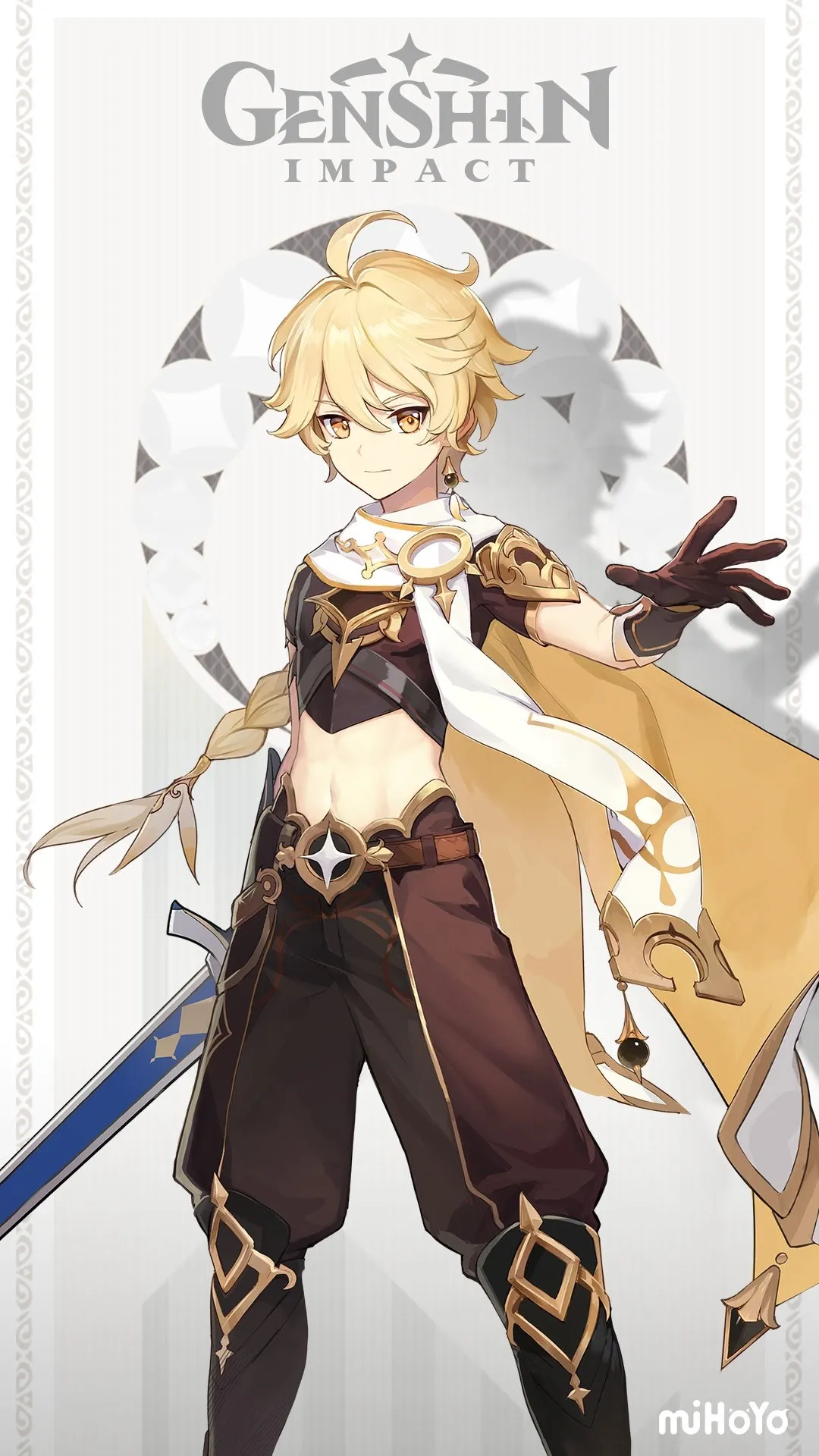

The protagonist. Aether if you picked male, Lumine if you picked female; the other twin is your missing sibling, the one you're trying to reach. The Traveler is the player's window into Teyvat, and, per Nahida's late-Sumeru scenes, the Fourth Descender.
Origins (such as we know them):
- The Traveler and their sibling came from outside Teyvat. The opening cinematic shows the two of them in a star-field beyond the world; they were already adventuring together long before they reached this particular planet.
- Their ship was forced to crash-land at Nod-Krai before the Sibling's later life in Khaenri'ah. After the Cataclysm began, the Sibling returned to the crash site, woke the Traveler, and tried to leave Teyvat with them. Asmoday, the Sustainer of Heavenly Principles, intercepted that departure attempt and separated the twins; she did not cause the earlier crash.
- The Traveler woke up in the post-Cataclysm world with no memory of why they'd been asleep, and no idea where the sibling was. The first three Archon Quests are largely about catching up.
What makes the Traveler unusual mechanically:
- They have no Vision. They wield every element they encounter (Anemo by default in Mondstadt, Geo from Liyue's terrain, Electro from Inazuma, and so on). In Chapter VII they currently resonate with Cryo through Snezhnaya's Statue of The Seven; that is the present regional resonance, not a Vision or a permanent single-element identity. [17] [18] [21]
- They can reach into Irminsul. Nahida discovers in the Sumeru finale that the Traveler can interact directly with Teyvat's memory-tree, an ability normally reserved for Archons.
- The Sustainer's Cataclysm-era intervention targeted the twins' attempted departure. Released canon does not state why Asmoday stopped them or whether she acted under specific authorization.
What sets the Outlander apart
The Outlander differs from every being native to Teyvat in four deep-set properties. Each comes from its own primary-text source, and the Traveler meta-page gathers them.
- Immunity to the Vision system. The Traveler holds no Vision issued by Celestia and is not locked to a single element. They draw whatever elemental authority they need from the local Archon's substrate, so the Vision system does not apply to them. (AQ Prologue and AQ I, where the game introduces element switching between Mondstadt and Liyue.)
- Irminsul-edit immunity. Irminsul edits do not reach the Traveler's memory. In AQ III Act 5, after Nahida removes Rukkhadevata from Irminsul, everyone else forgets her but the Traveler does not. [39] In the Interlude Chapter Act III, Inversion of Genesis, Scaramouche erases himself from Irminsul before he becomes the Wanderer, and Nahida explains that the Traveler comes from beyond Teyvat, so "any changes to Irminsul wouldn't affect" them. [40] (AQ III Act 5; Inversion of Genesis.)
- Opacity to Teyvat astrology. In the Mona Astrolabos Chapter, Mona explains that "Teyvat's stars can only display the fates and truths of 'this world,'" and tells the Outlander, "Anything related to you becomes like a fog that even I cannot penetrate." [41] (Mona Astrolabos Chapter.)
- Recognising the Sibling's residue by scent. The Traveler recognises the Sibling's residue in the Bough Keeper: Dainsleif dandelion scene. The bond is observed; the scene does not assign the Sibling a Descender number. (Bough Keeper: Dainsleif WQ.)
Together these set the Outlander apart from every kind of being native to Teyvat: Archons, Sovereigns, Allogenes, and the cursed Khaenri'ahns. The meta-page draws them together; this page grounds each property in its source.
The Sustainer who separated the twins
The Final Judgment identifies the Sustainer as Asmoday, Ruler of Space among the Four Shades. The opening cinematic depicts the separation. The earlier Nod-Krai crash and the Sibling's Khaenri'ahn life come from later released material, not from The Final Judgment; that later account places the crash before Asmoday intercepted their departure. [6] [7]
In the same quest, Melanta asks Asmoday why she chose her or him, with the pronoun following the unchosen twin. Read beside Ronova's "new master" line, this strongly implies the Traveler's Sibling is Asmoday's new master, but canon does not state the relationship's terms or motive. [6]
The dream-recognition channel
Per the Xianyun Grus Serena Chapter, the Outlander recognises the Sibling in dreams through the Suspensus Somnium Mechanism. This dream-walking device, built with adeptal arts, lets the two perceive each other across the barrier that sets them apart, without being physically close and without any communication inside Teyvat. It is one of two ways the twins recognise each other; the other is the dandelion scent from the Bough Keeper: Dainsleif WQ. Together they support the reading that a cosmological bond keeps the twins in recognition contact across the 500-year gap, even when neither knows the other's location.
What the Welkin Moon arc added (Acts VI to IX)
Song of the Welkin Moon (patches 5.8 to 6.6, in scope here through Act IX) is the densest run of primary text about the Outlander's nature since Nahida named the Fourth Descender in AQ III Act V. Four events bear on what sets the Outlander apart. Per the Traveler meta-page and the Descenders page, they add one new property (Act VI, the fifth: time-freeze immunity) and three further developments (Acts VII to IX) to the earlier framework of four properties. [29] [30]
Act VI: time-freeze immunity (the fifth property)
In Welkin Moon Act VI Return to the Moon, Dottore's stacked "variables" reach even Hyperborean phantoms "he never met"; he harnesses what they tell him "to truly create a 'false moon,'" and, in Arlecchino's words, "had already amassed the power of all three moons." Then he freezes time. Afterwards the Traveler realises, "The Doctor froze time, which is why only I could move freely," and wonders, "Is it because I'm a Descender?" That adds a fifth distinguishing property, immunity to the time-freeze. Everyone racing to the platform (Paimon, Arlecchino, Lauma, Varka, Flins, Durin, and Wanderer) is frozen in place. Only the Outlander can still fight, while the caged Columbina uses her remaining power to open a Moon Gate. [45] [48] This time the distinction holds against time itself, treated as something that can be bound at a cosmological level, and not only against the four Teyvat systems already on the list. [12]
The Traveler has now demonstrated five unusual interactions: Vision access without a standard Vision, immunity to Irminsul edits, opacity to Teyvat astrology, recognition of the Sibling's residue, and movement during a time-freeze. These are observations about the Traveler, not universal tests for a Descender. Nahida names only the player-character Fourth; the Sibling remains unclassified. Saarelainen is the strongly implied Third candidate, not an explicitly named identity.
Act VII: Dottore's Descender-restoration offer
In Welkin Moon Act VII A Traveler on a Winter's Night, Dottore captures the Outlander and slows their time: "A whole month passed before you opened your eyes again." His time-manipulation is still imperfect, since he meant the effect to last only a short while: "Clearly, some finesse is required to wield the authority over Time as I wish." He tells the Outlander, "I wonder if you don't understand humans all that well," says their "long life and unique origins make you fundamentally different from them," asks how long before people "treat you like the alien you are," and adds, "You have been treated most unfairly." Then he offers to "give you back the status you rightly deserve as a Descender." [46]
Two readings land here:
- Dottore recognises the Outlander's nature as the Fourth Descender. The offer presupposes that restrictions imposed inside Teyvat have demoted the Outlander from their rightful position as a Descender. It reads the restrictions on Vision distribution, Irminsul edits, astrology, and the time axis (the properties that set the Outlander apart before this arc) as things that could be manipulated. Dottore frames those restrictions as a change of status rather than as part of what the Outlander is.
- The Harbingers as a group know the Outlander is a Descender. In Act VII Arlecchino says, "Traveler is Teyvat's Fourth Descender," adds that "all harbingers are aware of this," and judges that since Dottore "took such pains to capture Traveler, he is unlikely to kill him/her right away." The line establishes that the Harbingers know the Traveler's number; it says nothing conclusive about the total count or the Sibling's slot. [46]
When Dottore renews the offer in Act VIII ("the second chance I extended to you still stands"), the Traveler answers with silence, and he remarks, "Not in the mood to talk? As you wish." [47] He is defeated before acting on it. The scene establishes only Dottore's claim that the Traveler's status could be restored, not a general Descender mechanism. [13] [30]
Act VIII: Columbina's gift and the Frost Moon spaceship
Welkin Moon Act VIII True Moon adds two things in the Welkin Moon's Homecoming subquest, at the Frost Moon site where the chapter resolves.
First, Columbina relaxes the Outlander's elemental restrictions. After the chapter resolves and the Trilune Goddess descends, Columbina is restored as the Trilune Goddess with the full Trilunar Authority of all Three Moon Sisters. She tells the Outlander, "But you and your friends taught me what a true home should look like," and lists what she has given: "I've given the Eternal Moon's marrow to Lauma, and the Iridescent Moon's Marrow to Arlecchino. And now, I shall return my kuuvahki to Nod-Krai again, that it may continue to protect my chosen home." Then she lifts "some of the restrictions this world placed on you," and the Traveler feels it: "I can use the elements more freely now..." [47]
Since the AQ Prologue, immunity to the Vision system has been a negative distinction. Celestia issues no Vision, and the Outlander borrows elemental authority through the Statues of the Seven. Columbina's gift adjusts it in a positive direction. The Trilune Goddess, who now holds "the authority over all three moons," lifts "some of the restrictions this world placed on you," not the distinction itself. [47] The Outlander is not granted a Vision, which would contradict their no-Vision nature; they are given freer access to the elemental system the Statues already make borrowable. It supplements the Vision-immunity property rather than overturning it. [14]
Second, the Frost Moon spaceship and its placement by the Heavenly Principles. In the same subquest the Outlander reaches the Frost Moon spaceship, the crashed vessel the AQ Prologue cinematic implied existed somewhere but had never shown. Two disclosures land in sequence:
- Columbina says the spaceship "has been hidden on the Frost Moon, which lay beyond the sky," by "the Heavenly Principles," and can only guess why: "I don't know. Perhaps your ship contains something that is incompatible with Teyvat. Or something that cannot be known." By her account, the prohibition mechanism of the Heavenly Principles (binding doctrine #3) reaches the Outlander's physical artefacts as well as Teyvat's Vision, Irminsul, and astrology systems. This supplements, rather than contradicts, the earlier reading that the Heavenly Principles' restrictions touch only mechanisms native to Teyvat.
- The flight log records the twins' two approaches to Teyvat. The Traveler reads it as showing that the ship "flew over the skies of Teyvat once before. A long, long time ago," and "barely came to a stop before flying on again." With some data corrupted, they suspect "it kept flying for thousands of years" before it "made a forced landing in Nod-Krai." The return ended in the Nod-Krai crash before the Sibling's Khaenri'ahn life; Asmoday intervened later, only when the twins attempted to leave after the Cataclysm began. If the Traveler's estimate holds, the twins' first approach came well before the 500-year Cataclysm.
After reading the flight log, the Outlander reflects: "I remember Lumine/Aether telling me that when she/he first arrived in Khaenri'ah, she/he could not recall the past... So this might be something that even she/he doesn't know..." That frames the past before Teyvat as possibly unknown to both twins. The trajectory is not knowledge the Sibling has withheld for 500 years; it can be discovered through the Frost Moon flight log. That reading, in which the twins discover it together, sits beside the motive given in Welkin Moon Act I by a figure in the Sibling's form: "What happened to us in the past, how we came to Teyvat, why our spaceship crashed here... There are things I want to know too." The figure was Rerir in disguise: in Act II Nefer says he "came in disguise to obtain the Moon Marrow," and Fandom lists him that way. [14] [47] [43] [44] [49]
Act IX: the Irminsul anomaly and the Apep operation
Welkin Moon Act IX As All Falls to Emptiness has two events that bear on the Outlander's nature as the chapter extends into Sumeru cosmology.
First, immunity to Irminsul edits is confirmed again, this time against a live anomaly. In Where Flowers Awaken, Nahida connects herself directly to Irminsul to take over its recording and processing, a task Cyrus says "would instantly fry any human mind," and she collapses. In A Divergence Leading to Oneself, the Outlander scouts on past the point where Sekkura warns that "delusions will start afflicting your mind," reasoning, "Nahida once said that Irminsul doesn't contain any information about me... So theoretically, I shouldn't be affected by such anomalies." That extends the immunity to retroactive edits (shown in AQ III Act V, when Nahida removes Rukkhadevata from Irminsul, and in Inversion of Genesis, when Scaramouche erases himself before he becomes the Wanderer) to an anomaly in the present. The same distinction protects against Irminsul's live effects, not just against retroactive edits. [42]
Second, the Outlander and Apep cooperate at the Heart of Oasis. The Outlander takes Nahida to Apep at the Heart of Oasis for life-force restoration. Apep is already expecting them ("Hah. I had a feeling your kind might come calling.") and agrees, since "to receive aid without repaying it would likewise tarnish a dragon's dignity." After Act IX, the Outlander's standing as a peer is grounded with both a Trilune Goddess (Columbina, in the Act VIII adjustment to Vision immunity) and a Dendro Sovereign (Apep, in the Act IX life-force restoration). Per the Seven Sovereigns page, Apep delivers in the same scene the cosmological disclosure that opens the arc in which the Sovereigns reclaim their Authority. Irminsul existed before the Heavenly Principles, the Ley Lines carried Light Realm power from before the Heavenly Principles, the dragons will reclaim Teyvat, and Apep has sensed the Hydro Dragon Neuvillette reclaim his Authority and plot revenge. She gives it in answer to the Outlander's own question, "Do you know much about Irminsul?" [15] [42]
Chapter VII: death, memory, and belonging
In Wraith's Nocturne, Ronova explains that physical death is incomplete until the soul returns to the Ley Lines. Her power can temporarily separate the Traveler's soul from their body, but Teyvat's Ley Lines will not accept the Traveler; their soul also remains anchored to their body by their will. Ronova therefore says that this Descender can die only through the direct destruction of either body or soul. The scene tests the Traveler, not every Descender. [19] [20] [22]
After the group returns to physical reality, Odette and the others initially lose their memories of the afterlife. Mitya infers that the invisible mark was carved into his soul and preserved his memory; when he asks whether the Traveler remembers because they are a Descender, the Traveler answers that this is essentially correct. Reading this beside the existing exception for Irminsul and the Ley Lines is an editorial synthesis; in-game text does not define a sixth universal mark. [19] [22]
The same act gives the Traveler a rare subjective account of their bond with Teyvat. They say they used to feel like a spectator, perhaps because they are a Descender, and describe Paimon's presence and authenticity as what gradually made the world feel real and strengthened their connection to it. Their lingering detachment is personal self-description, not a new cosmological test; Paimon is the relationship through which the Traveler says they are learning to overcome it. [19] [20] [22]
Chapter VII Act III: the audience at Zapolyarny Palace
In White Night, Like a Dream Upon Waking, Tartaglia files the Traveler's application to meet the Tsaritsa. Before the audience, Danica tests them at Podvorye Restaurant and asks what they think of the Tsaritsa. They admit the two sides may not share a path in the long term. "But here and now... I think it's essential that we work together. Ronova threatened my closest travel partner, and I will not stand for that." Afterward the Traveler looks back on a journey over which the Fatui "cast their shadow over every stage," and resolves to bear witness first: "After that... I must choose where I stand." [23] [25]
At court the next morning, the Tsaritsa calls the Traveler "a formidable adversary, worthy of my respect," orders that all investigations into them cease, and grants them "unrestricted access to Zapolyarny Palace." In private she has one question: where is the Pyro Gnosis, "the only one of the seven Gnoses whose whereabouts are unknown," which "reportedly, you were the last to see"? The Traveler answers that it was reduced to ashes when Irminsul burned and that, according to Mavuika, it has returned to the Ley Lines. She then explains why she collects the Gnoses, shows them the seal the Third Descender left, and names her own authority as "love," which she will not use. [23] [27]
Chapter VII Act IV: stalling the Ruler of Death
In A Rekviem for the Underworld, the Traveler glimpses Pierro's memories of Hroptatyr, and Pierro later tells them something he had never mentioned: "When I summoned Paimon from Celestia, Hroptatyr summoned someone else at the same time... It was none other than your sister/brother." The same quest gives the Traveler's own account of how their purpose has shifted: "All I wanted to do in Teyvat was find my sister/brother. But somewhere along the line, I began to care about this world." [24]
Pierro, who admits even he does not know the full plan against Ronova, gives the Traveler a single instruction for the day the Tsaritsa receives the Ruler of Life: "Wait until Ronova appears and kills everyone... then, stall her. Do not let her leave the scene." At Rankova Zorya, Ronova arrives earlier than expected and kills everyone present, the Traveler included. The quest narration says that Vesna used "the 'Authority of Life' at the very last moment," and a Seal of Life formed from the Traveler's memories carries them out of the afterlife. They wake among the dead. "Back so soon?" Ronova says. "Hmph, you're getting awfully comfortable with death." [24] [26]
The Traveler keeps her talking. Ronova warns that the Heavenly Principles' tolerance has limits, pointing to "the Third Descender's remains" as "the playthings of the gods for centuries now." The Traveler answers that Paimon, whom Ronova talks of reclaiming like "a mere object," "is writing her own destiny," while Ronova is "just someone else's tool... a set of shackles used by the Heavenly Principles to keep humanity under control." The Traveler privately admits that may have gone "a little too far." [24]
When Ronova notices that the resurrection she is waiting for has not begun and tries to leave, the cutscene shows Dainsleif pinning her in place and Pierro arriving with a new Delusion, the "Eye of the Fatui." Sent back to the afterlife once more, the Traveler races out, calls on all their elements together, and destroys Ronova's escape portal. Celestia meanwhile reclaims Ronova's Authority of Death, and the three fight on until Pierro's final strike. [26] [28] Pierro judges that unless she escaped undetected, Ronova "will have sustained fatal and irreversible damage"; whether she survived is not settled. The Traveler concludes that her Curse of Death, never authorized by the Heavenly Principles, was undone along with her authority. [24] [26]
Chapter VII Acts V and VI: a witness for Teyvat
In Hour of Ruin the Traveler puts the question to the Esoptron in the Temple of Space: "How to stop the Holy Soil phenomenon?" Asked for "sufficient grounds," they answer with their sibling first: "I promised Lumine/Aether that we would meet again at the end of this journey... I don't want that to be in the ruins of a broken world." Then with Teyvat: "Along the way, I've grown to love this world of Teyvat. I've made a lot of new friends here, and many precious memories." And last: "Speaking as a living witness to this world, I believe it has a right to a continued existence. I want to protect it... That is my wish." The terminal rules "Sufficient grounds established" and reports six Trials of Usurpation still to complete. [50] [52]
In A Yesterday Sent From Beyond the Traveler and Paimon follow Nahida into Sumeru's Nail and end up in what seems to be the same chamber without seeing her. The Esoptron there registers them as an anomaly: "Unexpected target entering processing area. Attempting to connect to core database..." Its core database does not respond, it falls back on a default protocol, and it manages only "Welcome... to the... world..." Paimon wonders whether the trouble was "The fact that we weren't gods?" The act does not explain it. [51]
In Celestia, Nukvah recalls asking at the Temple of Space "why you wished to undertake these trials and save the world," and offers, as "a reward that best meets your terms," to preserve one allogene chosen by each representative before Teyvat is reset. The Traveler rejects that reading of their words: "What I told you was that I love this world because of all the friends I've made and the precious memories it's given me." "Teyvat is essential to me — it's like a second home. You've flagrantly misrepresented my terms! How dare you!" Later they add, "The fate of the world should not be yours to decide." [51] [53]
The act's last spoken line is "I have already traveled through this world once. Once you reach the end of your journey as I did, you will see for yourself the true nature of this world." Yatta's record labels it with the Traveler; Fandom's transcription gives it to the Traveler's Sibling. The Traveler's closing thoughts follow: "(All of a sudden, Teyvat is to me what Khaenri'ah is to her/him...)" and "(I understand now, Lumine/Aether. What a lonely thing it would be if memories were all that was left of this world...)" [51] [54]
How the Outlander relates to Teyvat's peoples
The eighteen race pages give more words for the order that the Outlander, as the Fourth Descender, stands outside of. Per the five-property framework on the Traveler meta-page, the foundations Teyvat is built around simply do not apply to the Outlander. The cross-references below set the Outlander, after emerging from stasis, against that apparatus.
Humans and hilichurls
The Humans page groups Vision distribution, the Archon hierarchy and Irminsul's recording of memory as one apparatus through which the Heavenly Principles manage humans; that grouping is the page's own reading, since Fandom credits each of the three to the Heavenly Principles separately. The Outlander sits outside that apparatus through Vision immunity (the first of the five). That sets them apart from the ordinary humans they travel alongside (companions, allies, and regional Vision-holders), though they are not eligible for the apparatus themselves. Their allies in each region are drawn from those humans, yet the Outlander never enters the system that manages them. [31]
Per the Hilichurls page, the population that the Khaenri'ahn curse of wilderness and immortality produced from rebellious humans after the Cataclysm is the rank and file of the Abyss Order (ordinary hilichurls, samachurls, mitachurls, and lawachurls). They are under the Sibling's leadership, in the Prince/Princess of the Abyss role described on the Sibling's page. The Outlander meets them in the field, clearing hilichurl camps across every region, without joining any faction. The opposition between the Twins shows here. The Sibling leads them, and the Outlander fights their operations in each region. [32]
Aranara: the Irminsul-erasure exemption
Per the Aranara page, the Irminsul rewrite after AQ III Act V, which turned Queen Aranyani into the Lord of Verdure, reshaped the memory of every ordinary Sumeru resident except the Outlander. That is the second property of the framework, Irminsul-edit immunity, and its first worked example at the level of a whole people. Scaramouche's erasure of himself in the later Interlude Chapter Act III Inversion of Genesis shows the same property for a single character. The Outlander keeps the memory of Queen Aranyani from before the rewrite, while ordinary Sumeru residents keep only the Lord of Verdure framing. [33]
Sovereigns, vishaps, and melusines
Per the Seven Sovereigns page, the pre-Archon dragon-kin hold a position older than the Heavenly Principles. In Welkin Moon Act IX the Outlander and Apep cooperate at the Heart of Oasis. It is the first time on screen that the Outlander and a Sovereign work together as peers, and it grounds the Outlander's standing as a peer of the Sovereigns. That cooperation builds across the arc. Apep had wanted to vaporise the Outlander before AQ III Act V resolved, reconciled with them afterwards, and re-confirmed the partnership at the Heart of Oasis in Welkin Moon Act IX. The Sovereigns' position runs parallel to the Outlander's but predates the Heavenly Principles. [34]
Per the Bathysmal Vishaps and Melusines pages, vishaps, Sovereigns, and Melusines form a continuum, and the Sovereign line is fluid across these peoples. The worked example is Pahsiv (a Primordial Bathysmal Vishap) shapeshifting into Melusine form. The Outlander meets them throughout the regional encounters of Fontaine's AQ IV (Sigewinne and the Marechaussee Hunter Melusines, and the Bathysmal Vishaps of Pahsiv's kin in the sea-cycle areas) without joining their apparatus. The Outlander passes through the continuum in the field, under the same framework of Vision immunity and a distinct nature. [36] [35]
Ruin Machines
Per the Ruin Machines page, the reactivation of Ruin Machines in the present day splits across three actors: the Abyss Order under the Sibling, Sandrone's Marionette regiment, and independent reactivation through the Ley Lines. The Outlander meets reactivated Ruin Machines as an opposing force, in combat at archaeological sites across Mondstadt, Liyue, Inazuma, and Sumeru. The Sibling reactivates the Ruin Machines as leader of the Abyss Order; the Outlander fights the same machines in the field. This is the second worked example of the Twins' opposition, after the hilichurls, with one twin leading the reactivation and the other fighting it region by region. [37]
Crimson-Moon-blooded
Per the Crimson-Moon-blooded page, that bloodline is a pre-Cataclysm group the Sibling operates alongside, per the Welkin Moon Act VIII disclosure about Tholindis and the Vinster-King (see the Sibling's page). That page covers the Khaenri'ahn descendants of the Crimson Moon Dynasty and is distinct from the Crimson Moon Dynasty page, which covers the dynasty itself.
The Outlander does not share the pre-Cataclysm Khaenri'ahn history the Sibling has; the Outlander spent 500 years in stasis, sealed through the Cataclysm, and emerged only recently (AQ Prologue Act I). After emerging, the Outlander instead meets the Crimson-Moon-blooded through one descendant, Arlecchino (Peruere), in Fontaine's AQ IV. The same bloodline runs through different groups: the Fatui Harbingers through Arlecchino, and the pre-Cataclysm group the Sibling operated alongside. [38]
In summary
As the Fourth Descender, the Outlander is set against six of Teyvat's peoples at once. They travel alongside the humans the Heavenly Principles manage but stay distinct from them. They fight the survivors of the Khaenri'ahn curse whom the Sibling leads (the hilichurls). They stay immune to Irminsul's edits and rewrites (the aranara case). They cooperate with the Sovereigns, who predate the Heavenly Principles, and with the fluid continuum of vishaps, Sovereigns, and Melusines. They fight the Abyss Order's Ruin Machines, which the Sibling leads. And after emerging from stasis, they meet the Crimson-Moon-blooded through one descendant in Fontaine's AQ IV. That nature comes from before Teyvat and before its apparatus. The Outlander passes through the whole system without ever taking part in running it.
What you should know about the relationship with the sibling:
- They were close. The flashbacks portray a partnership that worked.
- They disagreed sharply at the Cataclysm, about whether to stay involved with Teyvat at all and about whether the Heavenly Principles' destruction of Khaenri'ah was justified.
- The sibling sided with the Khaenri'ahn survivors and, eventually, the Abyss Order. The Traveler did not.
- They are still trying to reach each other, but with a thousand years of historical grievances and at least one cosmological catastrophe in between.
The casual version: you are the Traveler. You came from a star, lost your sibling at the Cataclysm, woke up not knowing why, and have spent the entire game trying to figure out what Teyvat is and what you're supposed to do about it.