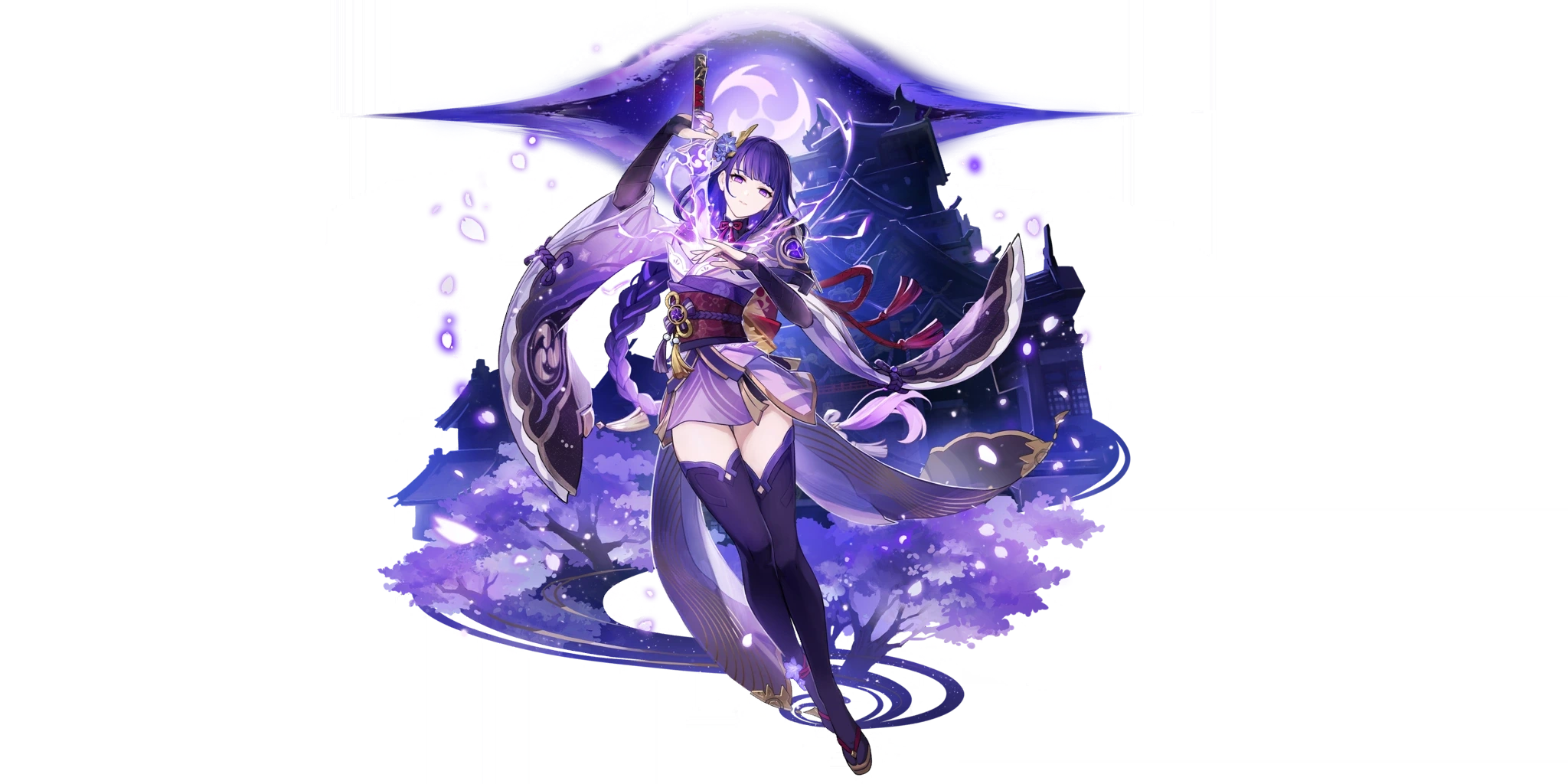

The Electro Archon is a complicated person, partly because she's actually two people.
The figure on the Tenshukaku throne, the one who issued the Vision Hunt Decree, who duels the Traveler with that one-shot katana and barely speaks, is the Raiden Shogun. She is a puppet body Ei built for herself five hundred years ago and then mostly stopped piloting. Inside it runs a strict directive: preserve eternity, protect Inazuma, expel anything that changes. The puppet follows that order with no humour and no give, which is why Inazuma nearly tore itself apart.
The person who actually holds the title Beelzebul, Electro Archon, Raiden Ei, sits in a meditative dream-space called the Plane of Euthymia, sword-fighting an imaginary enemy and trying not to feel grief. She had been there for centuries. The Traveler reaches her at the end of the Inazuma Archon Quest by punching a way into the Plane and arguing, politely at first and then less so, that the puppet's "eternity" is killing the very people Ei set out to preserve.
Ei wakes up. The Decree falls. Inazuma reopens its borders. She takes the throne again, sometimes through the puppet, sometimes, in private, as herself.
A few clarifying facts:
- Raiden Makoto, Ei's sister, was the original Electro Archon, beloved across Inazuma. She died in the Cataclysm 500 years ago, and Ei's grief over that loss drives everything that went wrong afterward.
- The Musou no Hitotachi, the one-shot katana the puppet wields, is Ei's signature attack. The slash cuts off your Vision and your future, and it is meant as a final word.
- Ei had already entrusted the Electro Gnosis to Yae Miko before withdrawing into the Plane of Euthymia. Yae later exchanged it with Scaramouche to save the Traveler; after Scaramouche's defeat in Sumeru, Nahida recovered it and transferred it to Dottore. Signora never carried the Electro Gnosis. [4]
- Ei's puppet body is a marionette of her own making. In private, with people she trusts, such as her tengu bodyguard Kujou Sara and the wandering Yae Miko, she is direct, dryly funny, and unmistakably alive.
The yokai, the Archon seat, and Snezhnaya
Ei's story sits on three layers.
The first is Inazuma's yokai and oni. Before the Cataclysm, Ei's standing rested on personal friendships with the Mt. Yougou yokai, who gathered under the Kitsune Saiguu, the Hakushin Kitsune and High Priestess of the Grand Narukami Shrine. The Great Tengu Sasayuri was acquainted with Ei and was killed in battle when Orobashi, for reasons never explained, invaded Shogunate islands. Another Great Tengu, Reizenbou, the Saiguu's protector, was gifted the Thundering Pulse by the Shogun, though the lore does not say whether Makoto or Ei gave it. Per Yae Miko's Character Story 4, Inazuma itself was founded by yokai and humans together on Narukami Island, the inheritance Ei has presided over for the ~500 years since Makoto died. The deepest wound of the era is the corruption of Ei's oni friend Mikoshi Chiyo, the "oni maiden with a face as lovely as the moon" of the Hakushin Ring weapon text, also called Torachiyo in distorted folk memory. A beast of sin corrupted Chiyo, and she rebelled against the Shogunate. Ei cut off her sword-arm and one horn but spared her life, and she fled into the forests. That mercy 500 years ago sits beneath the near-extinction of full-blooded oni today: Arataki Itto is the last of the Arataki Crimson line, and Takuya is the Blue Oni survivor rediscovered during Itto's Taurus Iracundus Chapter.
Above that sits the rank of the Seven Archons. Ei holds the Electro seat, Inazuma's, with its ideal of Eternity, as one of five who replaced the originals after the Cataclysm. Only Barbatos and Morax remain from the first 2,000-year-old set, and Ei inherited Electro when her sister Makoto died. Ei entrusted the Gnosis to Yae; Yae traded it to Scaramouche, Nahida later recovered it, and Dottore ultimately acquired it. It is now one of five other Archons' Gnoses confirmed in Fatui possession: Anemo, Geo, Electro, Dendro, and Hydro. The Pyro Gnosis later disappeared without a trace after the operation that burned Irminsul in Sumeru, and its present location is unknown. [4]
Last is Snezhnaya and the Tsaritsa. After the Welkin Moon arc Ei remains the sitting Electro Archon. She is not an active Harbinger in that arc, her role as Archon does not change, and she is on no Harbinger roster. In Welkin Moon's Homecoming, Columbina warns the Outlander to be careful of Jester (Pierro), Regrator (Pantalone), and Rooster (Pulcinella), the likely internal threats that the material leading up to Snezhnaya flags. Arlecchino is not on that list, and neither is Childe. Ei's return to personal rule and her reopened borders fit the broader pattern of surviving Archons quietly turning against Heaven. Through Version 7.1 she took no part in the Tsaritsa's operation. Version 7.2 brings her to the Tsaritsa's table against the Holy Soil phenomenon, and from there to Celestia (see the Chapter VII section below).
How the Electro seat passed down, and the slaying of Orobashi
The Sovereign-to-Archon transition deep-dive tells this as two great events a long age apart: the Primordial One's forty-year war that beat the Seven Sovereigns, and the Archon War the Heavenly Principles set off much later, once the war of funerary flame had hurt them too badly to rule Teyvat directly. The Archon system was a patch the wounded Heavenly Principles assembled, not their first plan, and the Divine Thrones were crafted out of pieces of the Dragon Sovereigns' powers partway through the Archon War. That earlier war against the Sovereigns is called When the Doves Held Branches, a forty-year campaign during which the Four Shades were made. The Electro seat Makoto first held, and Ei holds now, comes from the later war, many times more recent than that one.
Electro is one of the four seats, with Anemo, Geo, and Cryo, where the Sovereign is missing. None of these saw a recorded handover from Sovereign to Archon of the Pyro kind, where Xbalanque slew Xiuhcoatl. No released line names an Electro Sovereign. Before Version 7.2 the likeliest candidates were the Bathysmal Vishaps of Orobashi's line, the Bolteater Electro strain bred through the trait-selection method in the Bathysmal Vishap Experimental Records Vol. 4, but no Electro Sovereign event was on record, and Orobashi himself was not a Sovereign. He was a lesser deity, the Watatsumi Omikami, whom Ei calls simply "The Serpent" in Version 7.2. Makoto (Baal) was the first Electro Archon out of the Archon War. Ei (Beelzebul) succeeded her after Makoto died in the Cataclysm, a twin handing the seat to her twin, which is what ties Ei into the Inazuma Shogunate that followed. [20]
Version 7.2 adds a dragon to Ei's own past without settling the seat. In Act VI she says she "once slew a great Thunderbird on the island of Seirai," a creature she introduces under "the concept of 'elemental dragons'," and that she "sealed the primordial Electro element away" when it died. Paimon and the Traveler call it the Electro Dragon, and Neuvillette, heading home to Fontaine, says he will visit Inazuma again "to pay my respects to the new Electro Dragon." No line in the act gives it a personal name, and none calls it a Sovereign. [21] Fandom's Seven Sovereigns table now lists it as Kapatcir, the "Original Electro Dragon," alive as of Act VI with its essence in the Shogun and its consciousness in the Plane of Euthymia. [26]
The event that places Ei inside the Archon War is the slaying of Orobashi at Yashiori Island. She killed Orobashi there toward the end of Inazuma's Archon War, roughly 2,000 years ago, not during the Cataclysm 500 years ago. The lore is explicit: "the duty of slaying such foes during the Archon War fell upon Ei, rather than the Electro Archon." The scar of that killing blow is Musoujin Gorge, and Orobashi's lingering divine hatred is the Tatarigami that still haunts the island. The Sangonomiya clan still leads Watatsumi's worship of Orobashi as Watatsumi Omikami, and it was under that banner that Watatsumi led the resistance against the Shogunate during the Vision Hunt Decree. Ei's later trust in Yae explains why she left the Gnosis with her, but the Gnosis then passed through Scaramouche and Nahida before Dottore acquired it. [4]
Throne versus Gnosis: what Ei actually gave up
The Celestia and the Divine Thrones deep-dive treats each Archon seat as two things that can be separated. The Throne is the power source, a Sovereign's Authority reshaped by the Heavenly Principles into an office during the Archon War. The Gnosis is a separate focus made from a Descender's remains. Ei severed her connection to Celestia and entrusted the Gnosis to Yae without destroying the Electro Throne. Yae later exchanged it with Scaramouche at the Delusion Factory; Nahida recovered it after his Sumeru defeat, and Dottore acquired it from her. The only Throne destroyed on screen since the Cataclysm is the Hydro one in the Fontaine arc; the Electro Throne is intact. [4] [15]
Skirk says the Electro Gnosis, like the other six, was made from the Third Descender's remains. Hymns of the Far North separately says Saarelainen was carved into seven pieces. That makes Saarelainen the strongly implied candidate, not an explicitly named Third. The making of the Gnoses belongs after the War of Funerary Flame and before the Archon War. [16]
Above all that, per the Asmoday deep-dive, the figure who enforces the whole arrangement is Asmoday, who holds the role of Sustainer of Heavenly Principles, not a separate rank standing over the four Shades. The Sustainer is simply Asmoday's office among the Shades, and the silver-haired figure who blocked the Traveler twins five hundred years ago is that same god, not the Primordial One stepping in directly. The Gnosis chain is separately documented: Ei to Yae, Yae to Scaramouche, Scaramouche to Nahida, and Nahida to Dottore. The Electro Gnosis is one of five other Archons' Gnoses confirmed in Fatui possession; the Pyro Gnosis is missing after the operation that burned Irminsul, with no current holder confirmed. [4] [17]
Before the Cataclysm: the Mikawa Flower Festival
The Akitsu Kimodameshi world quest opens up an older layer beneath Ei's present rule: the Hyakkiyakou era, when Inazuma was filled with youkai and the Kitsune Saiguu held open yokai gatherings, the hyakumonogatari daikai or Night Parade of a Hundred Demons, that humans were free to attend. Records tied to Yae Miko's Divina Vulpes Chapter note that many youkai lost their lives in the Cataclysm, and their bloodlines only grew thinner over time. By the present day, the Hyakkiyakou had not been held for centuries. The era ended in the same Cataclysm that killed Makoto and broke Ei. [18]
Makoto and Ei attended the original Mikawa Flower Festival together. In Ei's account during the Akitsu Kimodameshi event, the yokai held festivals called the Mikawa Flower Festival which Ei and Makoto attended together, and Makoto enjoyed playing Akitsu Hazura, the hagoita-and-ball game that was the festival's highlight. The record of the festival confirms it: the Mikawa Flower Festival dates back over five hundred years. Historically, many prominent youkai, as well as both Ei and Makoto, attended the festival. This matters for Ei's timeline, because Makoto otherwise appears only in flashback. The festival is one of the few fixed points we have for the sister Ei has spent 500 years mourning. [18]
Akitsu Hazura is the festival tradition the modern Akitsu Kimodameshi event carries forward. The old Akitsu Hazura (also Akitsu Haneasobi) was the hagoita-and-ball game played at Mikawa Flower Festivals in the Hyakkiyakou era, and the modern Akitsu Yuugei beach-stall game is its faithful descendant, which Ei recognises as such. The three little yokai who built the new stall, Hitotsume Kozou, Kappa, and Youko, saw it as continuing what their elders did in the Hyakkiyakou era. The same Mt. Yougou yokai and Kitsune Saiguu gatherings that Ei's own past rests on are still legible to her now. Her history reaches forward into how she rules today, not only backward into the lore of the yokai. [18]
The Yashiro Commission backs this revival under Kamisato Ayato. After the event he explains that he learned of the three yokai's plan to revive the Mikawa Flower Festival, judged that advertising it directly would over-hype it, and instead used the Commission's Test of Courage as cover, drawing tourists who would then stumble onto the real yokai festival. Yae Miko ran the Grand Narukami Shrine side, choosing the Kamai-and-Yanagibashi pair of hagoita as the third-round prize so the test could be built around Hanyuuda Chizuru's confrontation with her past. Ei's Shogunate government works comfortably alongside this. Her return to personal rule does not get in the way, and the Yashiro Commission's support for yokai culture under Ayato and Yae carries the old Mt. Yougou and Hyakkiyakou traditions into the present. All of it runs through the Tri-Commission, Inazuma's three governing bodies, Yashiro, Tenryou, and Kanjou, under the Raiden Shogun's formal authority. [18]
The Raiden Shogun who tried to ban Visions was a puppet on autopilot. The real Electro Archon is a grieving strategist who has, after almost a thousand years of trying not to, finally chosen to keep living.
Chapter VII: the trial of Eternity
Ei attends the Tsaritsa's meeting of the nations' leaders at Zapolyarny Palace in Act V, with Sangonomiya Kokomi also speaking for Inazuma. She says little. Once the Tsaritsa has apologized for the Fatui's methods, Ei sets the old grievances aside: "Worldly affairs are transient as clouds, forming and vanishing in the boundless sky. Let go of these, and all that prevails is this present moment, in which we are of one mind." When Kokomi describes Watatsumi's ritual for awakening Sangacorexes, Ei names its limit ("The Serpent is dead, and few Sangacorexes remain"). When Nahida proposes testing one nation's trial first, she offers her own: "Inazuma should take the lead. It is to face perils such as this that I mastered the martial arts." News that Liyue's trial is already complete ends the debate. [20] [22]
Act VI gives her Inazuma's trial, whose subject Thoma expects to be "Eternity." Her answer is settled: "Eternity is what I promised to my people. My commitment to it is what I must display to the Heavenly Principles." She still needs "some other evidence," and a thunderstorm she does not command supplies it. Before this, she says, "every bolt of lightning, every thunderous roar, had been under my control." Long ago she "slew a great Thunderbird on the island of Seirai," and because a dragon's energy "surges on incessantly, eventually giving rise to a new dragon," she "severed the connection between the primordial Electro energy and time itself." The Hallowing, which "has the power to reset everything it touches," is undoing that seal. Ei calls what is returning "one last remnant of the old Eternity" and decides to release it as her proof. The old enmity between dragons and gods is changing, she argues; even Neuvillette, "who openly declares the gods to be usurpers, is offering them his help now that we have a common enemy." [21]
That is where the puppet comes back in. The released power will need "a long incubation period before it can take shape as a conscious lifeform," so she plans "to use the Shogun's body as a vessel in which to store it." The Shogun "was, of course, designed to bear god-level Electro energy from the outset," but a second source of that size calls for an upgrade. Ei brings in Xilonen, on Mavuika's recommendation, and Neuvillette, "the Hydro Dragon himself." Explaining "the working principles of the Shogun puppet," she admits that "There was a limit to how much Khaenri'ah'n technology I could uncover." After a night's work, "the puppet is operating as robustly as ever." [21]
On Seirai Island she tries out "this newly upgraded body" on the monsters Kujou Sara's troops are holding back, then climbs to the island's highest point (Amakumo Peak, in Fandom's quest steps). There the Thunderbird appears in "its original form," and she feels "the boundless resentment and rage within the pulsing primordial Electro energy." She subdues it and takes its power into her body, after which a manifestation of the Thunderbird appears in the Plane of Euthymia and fights on. "I tried to convey with my blade that I meant it no harm," she says, and she expects "hundreds more such battles to come." [21] [24]
Then she goes to Tsurumi Island alone. The trial itself is a cinematic that the dialogue record does not transcribe. Afterwards she explains that she "felt that there was no need for me to say anything to the Heavenly Principles," and that "I struck with the force of my own power combined with primordial Electro energy. I believe that the rune sensed this, and that is why it disappeared." Kujou Kamaji, who saw it, likens the strike to "the one that formed Musoujin Gorge," the scar of her old blow against Orobashi. She does not expect it to end there: "I do not believe that the destruction sent our way by the Heavenly Principles will simply be withdrawn without further incident." [21]
When the trials are done, Ei goes through the door in Chenyu Vale into Celestia as Inazuma's representative, calm while Paimon frets ("When the conscience is clear, the mind does not succumb to panic"). Nukvah says Teyvat must still be reset, offers to preserve one allogene chosen by each of them, and gives them 42 days. Ei's verdict is short: "This entity cannot be reasoned with." Outside she calls the proposal "completely unacceptable," and when the Tsaritsa concludes that their "sole remaining option is to fight until our last breath," Ei answers, "Agreed." In optional dialogue that Fandom records, she tells the Tsaritsa that "The authority of the ancient moons has returned to the world, and I hear that the being who wields this power was once a harbinger under your command," and that "we must draw on every resource we have available." The Tsaritsa will "send a messenger to inform her of what we learned today." Neither names the former Harbinger. [21] [23] [25]
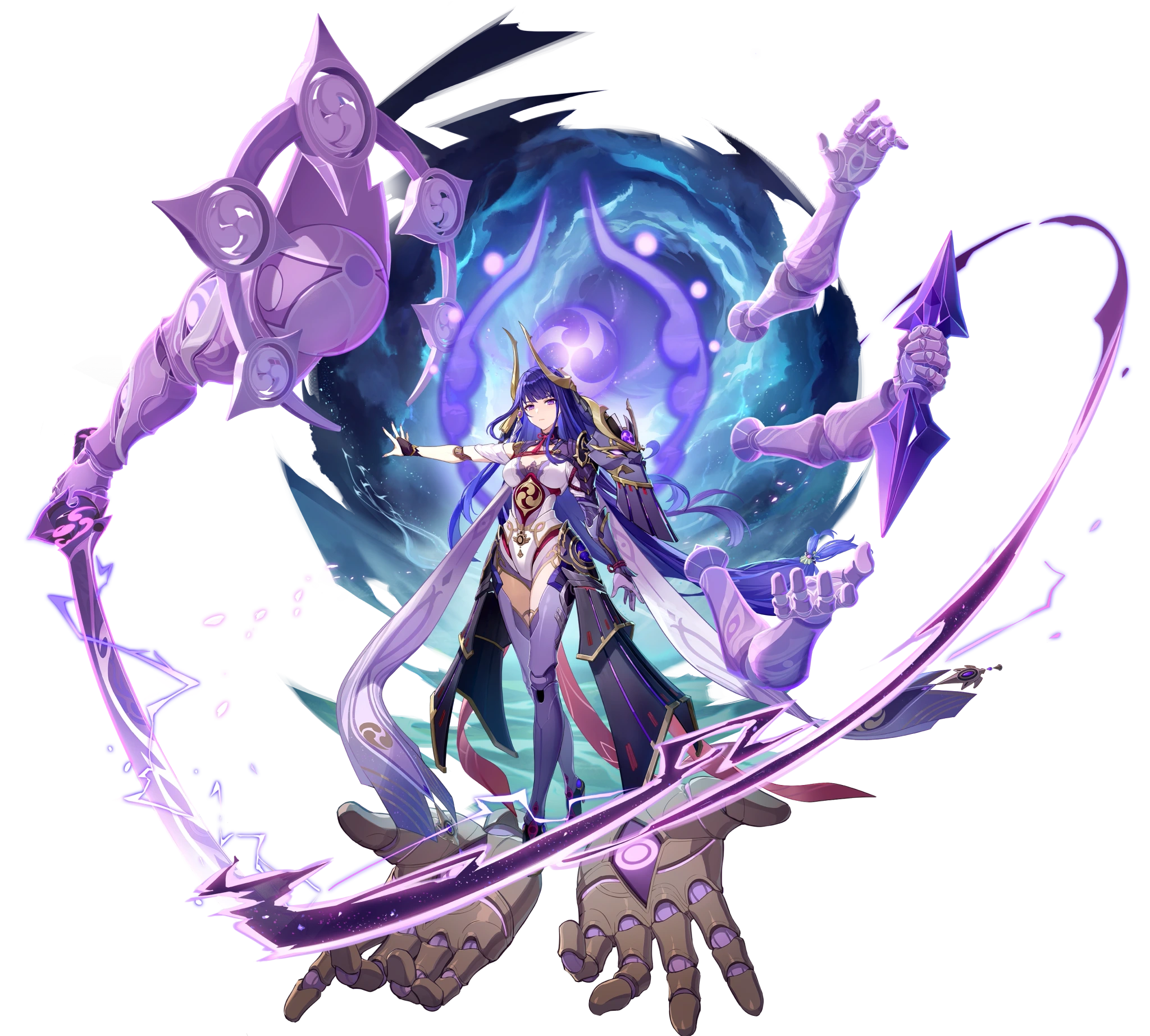
Boss form
The Raiden Shogun's combat identity is the weekly boss Magatsu Mitake Narukami no Mikoto, the throne-puppet rather than Ei herself, taken to its combat extreme. Ei built the body about 500 years ago and largely stopped piloting it, leaving it to run a strict directive: preserve eternity, protect Inazuma, expel anything that changes. That is the antagonist of the Inazuma Archon Quest, the enforcer of the Vision Hunt Decree, who duels the Traveler with the one-shot katana Musou no Hitotachi, a slash meant to cut off a Vision and a future as a final word. When the Traveler reaches Ei in the Plane of Euthymia and the Decree falls, she takes the throne again, sometimes through this puppet, sometimes as herself. [19]