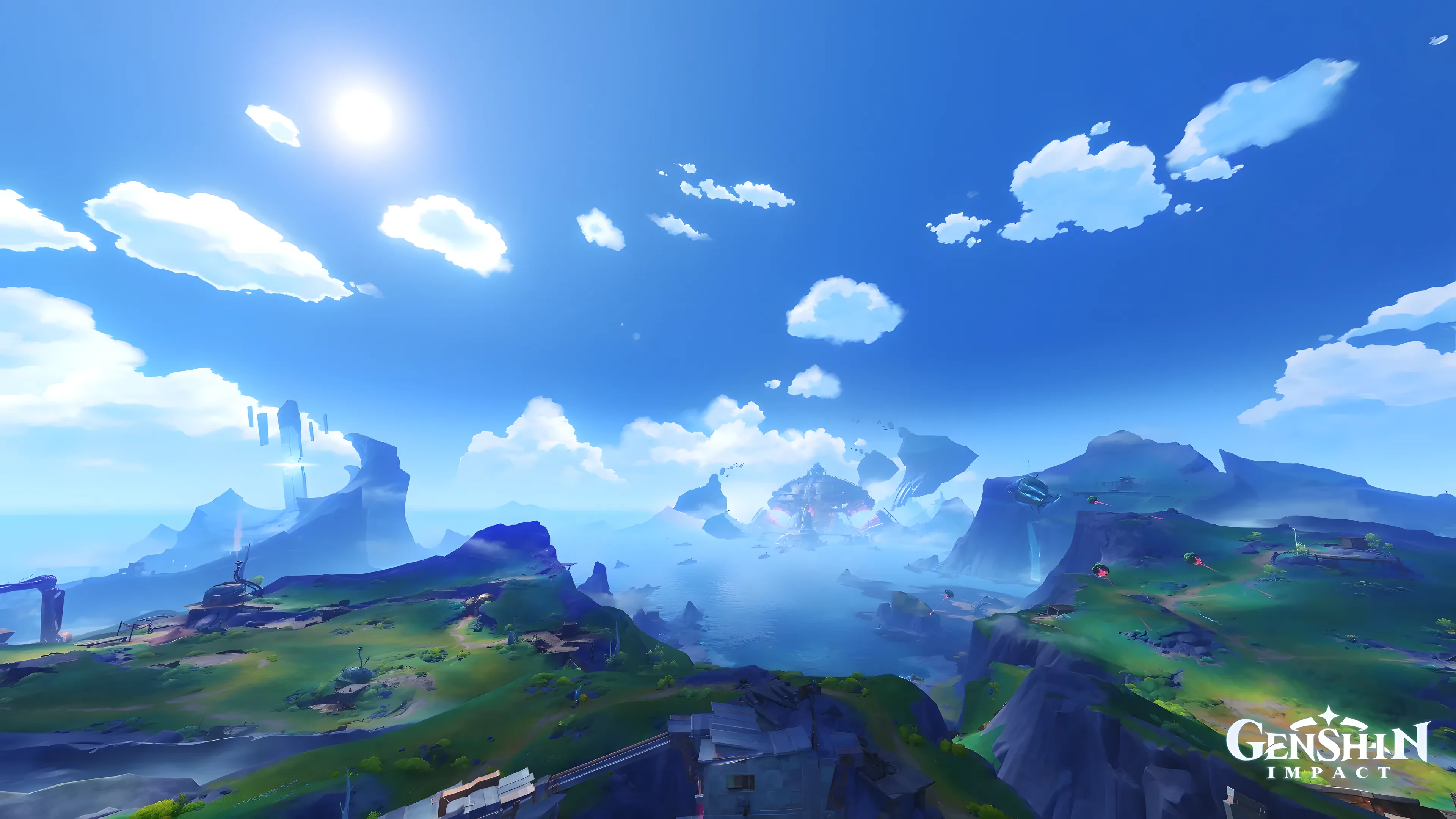
The Luna arc is Song of the Welkin Moon, set in Nod-Krai, a frozen northern region between Snezhnaya and the Sea of Stars. The chapter shipped across patches 5.8 to 6.6 (the Prelude in 5.8, then Luna I-VII) as a Prelude plus ten acts. Act IX As All Falls to Emptiness and Act X Truth Amongst the Pages of Purana (which opens under the title Of Myriad Paths, Flux, and Dissolution) both shipped in Luna VII (May 2026). This historical recap covers the arc through Act IX, adds a short note on Act X, and does not fold later chapters back into that stopping point.
Nod-Krai's older name is Nephilheim. Nibelung raised the Three Moons from Teyvat's planetary crust there, and the region was formed from material left over after their creation. [11] [12] A community reading also casts Nod-Krai as the remnant of a failed fourth moon attempted after the original three fell, but no in-game text says a fourth moon was ever attempted. The arc's disclosures are the closest the main story has yet come to the cosmology from before the Heavenly Principles, and by Act IX the dragons themselves confirm it.
What was always there: the Three Moons cosmology
Before the Heavenly Principles arrived and remade the world, Teyvat ran on something else. [20] Where the present seven elements came from is uncertain. Fandom's Seven Sovereigns page has the Sovereigns holding "the seven elemental Authorities" before the Heavenly Principles came and "partially stole the Authorities," while in Natlan Yohualtecuhtin says, "The Heavenly Principles used phlogiston as a basis for the creation of Elemental energy." [21] [22] The Three Moons governed the sky, and their underlying power was kuuvahki, an older, pre-elemental energy that predates the seven Visions/Gnoses system. The Three Moons were raised by Nibelung, the Dragon King who ruled Teyvat before the Primordial One arrived; he created them as Teyvat's stewards before journeying into the Sea of Stars and eventually being killed in the War of Funerary Flame; Fandom counts him as the Second Descender.
The Three Moons fell in that war, destroyed save for the Frost Moon, from which a new Moon Goddess (the successor Kuutar) was later born. The pre-Snezhnayan inhabitants of Nod-Krai are the Frostmoon Scions, who have maintained the Three Moons mythology in oral history and, after Kuutar's birth, worshipped her as the Frost Moon's successor. [14] The idea that a fourth moon was attempted afterward and failed, leaving Nephilheim / Nod-Krai as its remnant, is a community reading; the game never states it.
In Act IX, Apep discloses the deeper structure. Irminsul, she says, "existed before they ever arrived in Teyvat," meaning the Heavenly Principles. In those days "The Ley Lines flowed with an abundance of a familiar, primitive form of elemental energy... You may know it as the power of the Light Realm," and "The Heavenly Principles usurped and refashioned Irminsul, made it serve humanity, and used it to anchor the fate of the world." She expects a day "when we reclaim this world for ourselves," and says she can already sense that "the Hydro Dragon has wrested his authority from the hands of the usurpers," that is, Neuvillette, whose Authority came back in Fontaine. [15]
The Three Moon Goddesses, named 3/3
The original Three Moon Goddesses, Nibelung's creations, shadows of the planet, born to wield Nibelung's authority and oversee the world on his behalf, were imprisoned by Nibelung in a moon's-reflection prison before disappearing from history. Act VIII True Moon reveals all three. Canon is the Frost Moon Goddess, the original, and the anchor of Columbina's succession (Columbina has the same power as Canon). Sonnet is the Iridescent Moon Goddess, the youngest of the three. Aria is the Eternal Moon Goddess, whose remains became the Moon Marrow the Welkin Moon arc fights over (the Eternal Moon Marrow per Act VIII).
The Frost Moon's line runs from Canon, the original goddess, whom the Frostmoon Scions call Huurrekuutar, to Kuutar / Columbina, the present-day successor born in Nod-Krai as the Frost Moon's new goddess. [13] Together the three goddesses are also called the Three Moon Sisters. [11]
Columbina, the Trilune Goddess
The Third Fatui Harbinger, the singer with no obvious portfolio and an unexplained presence across centuries, is Kuutar, the successor Frost Moon Goddess walking around as a Harbinger. Her true name is Columbina Hyposelenia, "born beneath the moon," revealed in Act VI. Her arc runs across the chapter. She defects from the Fatui in Act V, when her remaining power can no longer keep her anchored to Teyvat without a true name. In Act VI she sacrifices her chance to return to the moon to deny Dottore the use of all three moons' power. Act VII wakes her alive in the moon's reflection, travelling backwards in time, where she resolves the Act II thread of the dome shield over Hiisi Island (it was her own future self) and the reveal of Luonnotar in the Empty Courtyard in Act VI (Luonnotar being a soul-fragment she made to trail the Outlander). In Act VIII she meets the Three Moon Sisters in their prison and borrows their authorities, at the cost that they become mortal and return to their own point in the timeline to face the War of Funerary Flame together.
She descends as the Trilune Goddess when Arlecchino, Varka, and Nicole pull the Frost Moon into Teyvat: her corpus (the moonlight over Nod-Krai), her spirit (transmitted to Luonnotar), and the Trilunar Authority hidden on the Frost Moon merge, she opens her eyes for the first time, and she descends to the battlefield (Act VIII). At the end of Act VIII the Tsaritsa revokes the Palestar Edict (Columbina's arrest warrant, which Fandom calls "the highest of Anastasya's commands"), formally acknowledging her departure, and Columbina takes Lauma's invitation to live with the Frostmoon Scions on Hiisi Island at Silvermoon Hall. [24]
Saarelainen, the strongly implied candidate
Hymns of the Far North says Saarelainen was carved into seven pieces. Skirk separately says the Gnoses use the Third Descender's remains. No primary line explicitly connects them, so Saarelainen is the strongly implied candidate. The Gnoses were created after the War of Funerary Flame and before the Archon War.
The player-character Traveler is the named Fourth. The Sibling remains unclassified; shared arrival does not establish a shared Fourth slot. The Traveler's unusual Vision, Irminsul, astrology, residue, and time interactions are observations about that character, not universal tests for Descenders.
How the Five Sinners came together
The Five Sinners, whom Dainsleif had already named in Chapter IV Act VI, Bedtime Story (Version 4.7), get their origin story: Rhinedottir, Vedrfolnir, Surtalogi, Hroptatyr, and Rerir. [10] They first came together in Act IV An Elegy for Faded Moonlight, where Dainsleif, the non-Sinner organiser, Vedrfolnir's younger brother and a Captain of the Royal Guard pre-Cataclysm, convenes the group to storm King Irmin's palace and rescue Vedrfolnir from his cell. Dainsleif and Surtalogi fought the royal guards, Rhinedottir and Hroptatyr disabled palace security, and Rerir broke Vedrfolnir out.
Each Sinner heard the same voice independently before coalescing. After the assault, the Sinners stole 5/6 of the Abyssal power Irmin had been amassing through the Sibling, who served as his Khaenri'ahn vessel for the Abyss, with the remaining 1/6 staying with the Sibling. That sets the chain that causes the Cataclysm: Irmin uses the Sibling as a vessel for the Abyss, the Sinners steal his power, Rhinedottir's creations attack Khaenri'ah and the Seven Nations, and the Heavenly Principles intervene. That sequence is the spine of the whole backstory.
Rerir had a different trajectory. Not high-ranking like the other four, he was an intelligence officer under King Irmin with a secret duty to purge Crimson Moon Dynasty descendants. He fell in love with Tholindis, a descendant of a distant sub-branch of the Crimson Moon and the researcher at the Moon Marrow lab who discovered the moon's reflection as a dimension where time flows backwards. After Tholindis self-sacrificed through her own Moon Gate, Rerir accepted the voice's offer of power to find her, and his body was torn into countless fragments scattered across Nod-Krai. The Wild Hunt is Rerir's distributed corpse, the operational muscle behind the Sumeru-back arc's palace assault.
At the close of Act IV, Albedo, Mini-Durin, Columbina, and Dainsleif banish Rerir through a Moon Gate to seal him in the moon's-reflection. In Act VIII Columbina encounters him there, sane and redeemed, having rejected the Abyss, with the voices in his head silenced. Dottore had resurrected him after long collecting fragments of his body, and the two, in Rerir's words, "were aligned as far as hunting the moons and recovering my strength were concerned." [23] He asks Columbina to take a message to Tholindis, whose soul-remnant survives further along the moon's-reflection; his closing line is "Don't die, Moon Goddess."
Dottore vaporised, Sandrone's Act VIII death, a subordinate appears
Act VIII True Moon brings down the chapter's villain. Dottore assumes a new form as the Heretic of the False Moon, tears a gash in the false sky he had earlier replaced the Frost Moon with, and teleports the group to a massive cloud arena. Sandrone intercepts Dottore's killing spike at the Outlander, takes it through the abdomen, smiles at Dottore, says "go to hell," and dies as Dottore fries her heart.
But Sandrone's world-formula had been a self-sacrificial deception: the real formula was hidden inside Pulonia all along, processed by Wanderer's Irminsul core, which he had offered to Sandrone to compute her equation straight into the Ley Lines, knowing he could be reset or even lost forever. Arlecchino, Varka, and Nicole pull the Frost Moon into Teyvat, the false sky shatters, the Trilune Goddess descends, and Columbina vaporises Dottore with a massive beam of lunar energy that overcomes his artificial Moon Marrow.
In Act IX a Fatui commander who calls himself Dottore's subordinate meets the Outlander in Gurabad. "Our commander, Dottore, died in Nod-Krai," he says. "But there are things that do not end with his departure." Of Dottore and himself he adds, "Neither he nor I are tolerated by the rules of this world." [15] Act X reveals him as Pantalone, the Ninth Harbinger. [16]
What Act IX changes: the Sumeru pivot and Apep's disclosure
Act IX As All Falls to Emptiness pivots the chapter from Nod-Krai to Sumeru. Collei receives a prophetic dream, and Nahida connects herself directly to Irminsul to investigate, then collapses (Cyrus warns that "All that information flooding in at once would instantly fry any human mind"). The Outlander takes Nahida to Apep at the Heart of Oasis in the Desert of Hadramaveth, and Apep agrees to host her recovery because "to receive aid without repaying it would likewise tarnish a dragon's dignity." [15]
Apep then delivers the chapter's biggest cosmological disclosure (the Three Moons, Heavenly Principles, and Sovereigns all in one paragraph, covered above). She also senses outside disturbances and sends the Outlander back to the surface, where several things land. A barrier appears around Sumeru preventing entry or exit, which Nicole suspects is "a defense mechanism within Irminsul itself." The Seven Pillars of King Deshret are coordinated 7/7 (Thoth, the "Ibis King"; Heryshaf and Sobek, whom Thoth calls Goatie and Croco; Shesepankh; Bennu; Hermanubis through his representative; and Apep, the seventh Pillar, at the Heart of Oasis); the path to Aaru is opened with all seven in agreement, and among the souls released from Aaru is Jebrael, Jeht's father. Nicole Reeyn reveals that the god remains the Fatui injected into Collei as a child came from the Goddess of Flowers: "Those were the remains of Nabu Malikata... the Goddess of Flowers." She adds that Collei's dream was that goddess's warning. [15] And the roster of the Akademiya Six Darshans is updated to the slate of Azar's successors after the Sumeru AQ (Naphis and Baladhuri as old guard, plus Alkindi for Spantamad, Firnas for Kshahrewar, Shakir for Rtawahist, and Rushd for Harvatat).
Other material the arc lands
Lunar Reactions and kuuvahki: the Three Moons' underlying energy becomes a class of elemental reactions the player can use, introduced in Nod-Krai. Lunar Reactions are three times as effective against the Deepdark Shields of Abyssal creatures, which suggests the moons were originally a counter-system against the Abyss, against what Nibelung brought back from the Sea of Stars.
The Pillar of Embla and the Tower of Inversion: a Phanes-related artifact is destroyed mid-arc (Luna V), and the Tower of Inversion remains behind. The connection to the Primordial One is on-screen, but the longer cosmological implication is still unfolding.
Skirk is Surtalogi's offworld pupil. Surtalogi is a Khaenri'ahn Sinner, and Skirk's Cryo appearance is a Seven-Shifting Serpent disguise over Abyssal power, not the surviving Authority of the Cryo Sovereign. The original Cryo Dragon Sovereign is unnamed and dead; no current successor is known. [9]
The spaceship is on the Frost Moon. Per Act VIII subquest 3, the Outlander's spaceship was placed on the Frost Moon by the Heavenly Principles. Columbina does not know why: "Perhaps your ship contains something that is incompatible with Teyvat. Or something that cannot be known." Its flight logs show the ship "flew over the skies of Teyvat once before. A long, long time ago," then flew on, the Outlander suspects "for thousands of years," before it "made a forced landing in Nod-Krai..." [23]
A new League is formed in Nod-Krai after Dottore's defeat. Flins lists its members as "the Moonchanter of the Frostmoon Scions, the Boss of the Curatorium of Secrets, a representative of the Voynich Guild, and even someone from the adorable Krumkake Craftshop...", and Illuga takes the Lightkeepers' seat. [23] And the Snezhnaya disclosures, via Columbina, note that every city in Snezhnaya is built around a heat source called Kresnik's Torch, and name three Harbingers: "There's Regrator, The Rooster... and The Jester." She says nothing more about the Jester; the Rooster and the Regrator "often appeared to get along on the surface, while working against each other in secret..." Of the Tsaritsa she says, "Ice-cold... and sharp. Crystal clear in some ways, yet profoundly unfathomable in others." [23]
What was ahead after Act IX
Act X, Truth Amongst the Pages of Purana, shipped with Act IX as the Luna VII / 6.6 update and closes the Sumeru story. The intruder in Irminsul is Dottore, the half of his soul kept in a Northland Bank vault while the other half went to Nod-Krai, and his partner is Pantalone. Mavuika gives Sumeru the Pyro Gnosis, Sumeru shuts Irminsul down by overloading it through Akasha Terminals, and Nahida burns the corrupted tree with the Gnosis. Dottore dies in the fire, and Aaru takes over Irminsul's role. [17] [18] [19]
Chapter VII had not yet released at this recap's stopping point. The Tsaritsa's still unrevealed target and mechanism, Asmoday's absence and implied alignment with the Sibling, and the prophecy that the dragons will reclaim Teyvat were the longer arcs Song of the Welkin Moon left open.
The Sovereigns visibly reclaiming their place include Neuvillette and Apep. The original Cryo Sovereign is dead and the current successor unknown; Skirk and Surtalogi belong to the separate chain of the Sinners and the Abyss. The Five Sinners are a third faction with goals divergent from the Tsaritsa and the Outlander. [9]
Since then
Sandrone's Act VIII death remains part of this historical recap, but she was later reactivated and returned to active Fatui service in Luna VIII. Version 7.0 has released Chapter VII Act I, Everwinter Without Mercy and Act II, Wraith's Nocturne, Version 7.1 Act III, White Night, Like a Dream Upon Waking and Act IV, A Rekviem for the Underworld, and Version 7.2 Act V, Hour of Ruin and Act VI, A Yesterday Sent From Beyond; continue with Snezhnaya opens in 5 minutes. [5] [6] [7] [25] [26] [27] [28] [8]
The timeline entry The Hallowing - Six Trials of Usurpation and an Invitation from the Heavens covers Acts V and VI, in which the Nails of Retribution set off the Hallowing across Teyvat and six nations pass Trials of Usurpation to suspend it. Nod-Krai has no trial of its own. In the World Quest Companions on the Frost Road, the Fatui evacuate Snezhnayans "to the less-affected parts of Nod-Krai" with the Frostmoon Scions working beside them, and Lauma explains that "Hiisi Island remains unaffected because the aftershocks of the Hallowing have been absorbed by lands beyond ours." [29] [30]
Where to go next
The arc's cosmology is unpacked at Three Moons and Descenders, and Columbina has her own profile. For the cross-region story through the same historical cutoff, see Everything so far, in 15 minutes. For act-by-act primary-text coverage, the Song of the Welkin Moon chapter and Acts I-X pages carry every claim cited above.