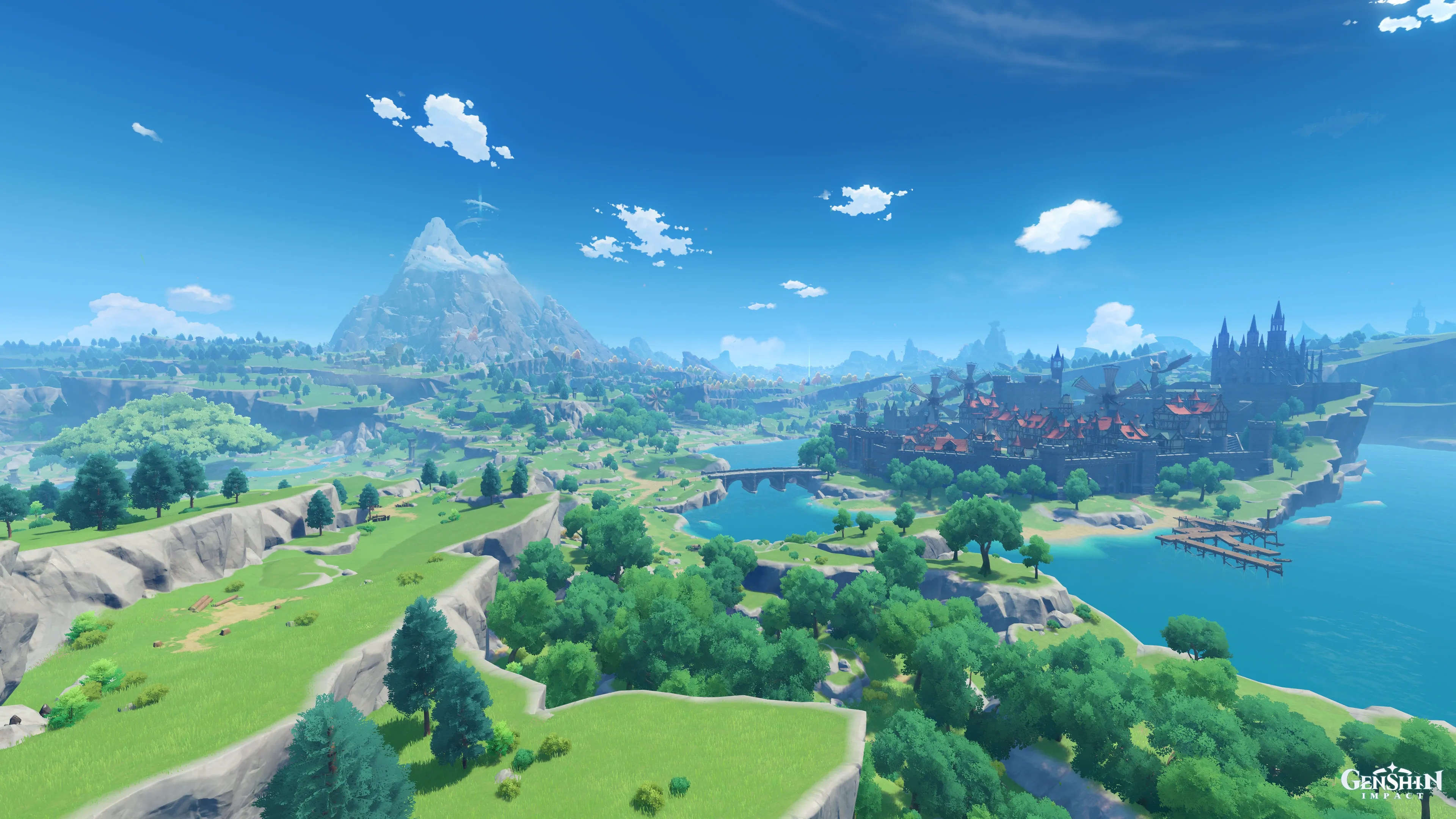
You finished the Mondstadt prologue, so you know Venti is the Anemo Archon Barbatos, you helped free Dvalin (the Anemo dragon corrupted into the Stormterror form), and right at the end La Signora of the Fatui arrived, depowered Venti, and took his Anemo Gnosis to deliver to the Tsaritsa, the Cryo Archon of Snezhnaya.
That theft is the first move of a multi-region plan. Each of the five chapters since Mondstadt repeats one broad shape: the Tsaritsa's people, the Fatui Harbingers, work each nation's Archon Gnosis loose by whatever that nation requires, sometimes a willing handoff, sometimes coercion or theft. By the end of Natlan (5.x) the collection is mostly complete and the reason for it is finally on screen. She is preparing to confront the Heavenly Principles, the cosmic order above the Archons, which has been dormant since the Cataclysm 500 years ago.
Liyue (1.1 – 1.5): Chapter I - "Farewell, Archaic Lord"
Liyue is the gold-and-ledger nation in the south. The Geo Archon, Morax (publicly Rex Lapis, in daily life Zhongli), is more than six thousand years old and the eldest of the Seven, and Liyue has been under his rule since he founded it with the adepti 3,700 years ago. [28] [29] Chapter I opens with a public ceremony where Rex Lapis appears to die. The Fatui are the immediate suspects, and Childe, the Eleventh Harbinger and the Fatui's local representative, becomes the antagonist.
The truth is that Zhongli faked his own death. He had decided to retire and hand his Geo Gnosis to the Tsaritsa as part of a long-running arrangement, and the staged death was a final test of whether the Liyue Qixing, Liyue's mortal council of seven, could govern without him. Childe was not in on the full plan. Mid-arc he goes off-script, attacks Liyue Harbor, and unseals Osial, an ancient god and sea monster that Morax had pinned beneath the waves at Guyun Stone Forest centuries earlier. [28] The Adepti and the Traveler re-seal it. Childe then fights the Traveler personally in his Foul Legacy form, an Abyss-touched combat technique he learned from a swordswoman named Skirk during a childhood incident in the Abyss-beyond-the-Abyss, which becomes important much later.
After the dust settles, Zhongli reveals himself, voluntarily surrenders his Gnosis to La Signora (acting as the Tsaritsa's courier), and walks away from divine politics. Childe is reprimanded but spared. Zhongli stays in Liyue as a consultant at the Wangsheng Funeral Parlor.
Chapter I nails down three premises. The Archons hold Gnoses, and the Gnoses are the real chess pieces of the Tsaritsa's plan. The Tsaritsa is herself an active Archon with a plan of her own, not a distant background threat. And an Archon can retire on terms, with Zhongli as the proof of concept.
Inazuma (2.0 – 2.8): Chapter II - "Omnipresence Over Mortals"
Inazuma is the closed-borders island nation in the east. The Electro Archon is Raiden Ei, but for 500 years she has been sealed inside the Plane of Euthymia, a meditative inner-realm she retreated into after her elder twin Makoto (the original, more diplomatic Raiden Archon) died around the Cataclysm. While Ei meditates on her vision of "Eternity," the day-to-day ruler of Inazuma is the Raiden Shogun, a puppet body Ei built for herself before the seal, now operating semi-autonomously.
Without Ei correcting it, the puppet's pursuit of Eternity has hardened into the Sakoku Decree (closed borders) and the Vision Hunt Decree (confiscate every Vision in the nation). The chapter is a small civil war, the Tenryou-aligned Shogunate against the Watatsumi-led Resistance, with the Traveler joining the Resistance, defeating the Shogun in single combat, then crossing into the Plane of Euthymia to persuade Ei that her policy is destroying her people. Ei reawakens, repeals the decrees, and settles on a softer reading of Eternity.
The Tsaritsa's people are there too. La Signora, the Eighth Harbinger, is at Tenshukaku seeking the Electro Gnosis when the Traveler barges in. She was Rosalyne-Kruzchka Lohefalter, a woman of Mondstadt whose lover died in the Cataclysm 500 years ago; her grief made her, by strong implication, the monster-burning Crimson Witch of Flame, until Pierro recruited her and gave her a Cryo Delusion to hold her flames in check. [19] The Traveler challenges her to a duel before the throne; she loses, and the Raiden Shogun executes her under the duel's rules, so Signora is the first Harbinger to die in the story. Ei had entrusted the Electro Gnosis to Yae Miko before withdrawing; at the Delusion Factory, Yae exchanges it with Scaramouche for the Traveler's safety. Signora never carries it, Yae never delivers it directly to Pierro, and no Gnosis handoff occurs at Tenshukaku. [16] [18]
The chapter also opens up Enkanomiya, an underwater civilization that existed under Inazuma before the current Sun was placed in the sky, the first hint that Teyvat has had previous suns and that the Heavenly Principles installed the current cosmological setup rather than the original one. You also meet Wanderer here, a 500-year-old puppet built by Ei before the Shogun, who became unstable, was abandoned, and was eventually recruited by the Fatui as the Sixth Harbinger ("Scaramouche"). His arc finishes in the next chapter.
Sumeru (3.0 – 3.8): Chapter III - "Akasha Pulses, the Kalpa Flame Rises"
Sumeru is the rainforest-and-desert nation in the south, ruled in name by the Dendro Archon Nahida. Nahida is the youngest Archon: the previous Dendro Archon, Greater Lord Rukkhadevata, died sealing the Forbidden Knowledge plague at the Cataclysm, and Nahida is what Rukkhadevata wrote into Irminsul (the world's tree-of-memory) to take her place. Most of Sumeru does not know she exists. The Akademiya's six Sages have kept her imprisoned in the Sanctuary of Surasthana for roughly 500 years, ruling the country themselves through the Akasha, a network that quietly siphons the population's thoughts.
The chapter has two halves.
The first is the coup. The Sages run Sumeru without an Archon, and they build Shouki no Kami by fusing the Wanderer with the Electro Gnosis he received from Yae at the Delusion Factory. The Second Harbinger Il Dottore collaborates with them. The Traveler, Nahida, and their allies free Nahida and defeat the new god. Nahida recovers the Gnosis and transfers it to Dottore in exchange for the destruction of his other segments; she separately transfers her Dendro Gnosis for information about Teyvat's false sky. [17] Wanderer then asks Nahida to use Irminsul to delete his past actions from the world.
The second half is the Apep arc. Apep, the surviving Dendro Sovereign, has been holding the Forbidden Knowledge plague inside her body in a desert oasis since the Cataclysm. She emerges, weakened, and explains the full cosmological backstory to the Traveler. Teyvat had Seven Sovereigns, primordial dragon-beings, one per element, who held authority before the Heavenly Principles arrived from beyond the sky. The Heavenly Principles defeated them and redistributed their elemental authority into the seven Visions/Gnoses system that runs Teyvat today, and they also installed the seven Archons. Apep survives, partially purged. The Gnosis negotiations already occurred directly between Nahida and Dottore, not through Pierro.
Chapter III's sixth act, Caribert, follows the Traveler and Dainsleif as they uncover how the Abyss Order began: a Khaenri'ahn father, Chlothar Alberich, turned to the Abyss to save his cursed son, and the Traveler's sibling's turn toward the Abyss takes shape here. The wider Sumeru arc confirms the Heavenly Principles ordered Khaenri'ah's destruction and the Archons were complicit, and by this point the Tsaritsa's collection plan is openly framed as a war on Heaven. (Arlecchino's own past, sometimes confused with this, is told separately in her Story Quest.)
Fontaine (4.0 – 4.8): Chapter IV - "Masquerade of the Guilty"
Fontaine is the water-and-court nation in the west. Furina performs the Hydro Archon publicly, while Focalors secretly holds the office until destroying its Divine Throne. Neuvillette is Fontaine's Iudex and the Hydro Sovereign in human form, never the Hydro Archon.
The arc's central twist is that Furina is not the Hydro Archon and never has been. The first Hydro Archon was Egeria, Focalors's predecessor; she was not one of the Sovereigns, and the Hydro Sovereign is Neuvillette. Egeria died during the Cataclysm, and it was Focalors, after taking the throne, who separated her divinity from her body and spirit; the human counterpart she left behind is Furina, who played the Archon in public for five centuries while keeping secret that she was not one. Neuvillette, separately, is the Hydro Dragon reborn in human form.
Focalors's 500-year project was a legal one. She used the time to engineer a trial in Fontaine's own court in which Furina is judged for impersonating an Archon. The court and the Oratrice find Furina guilty, and the Oratrice's death sentence falls on the Hydro Archon: Focalors uses the power stored in the Oratrice to execute herself and destroy the Hydro Archon's throne, which returns full authority over Hydro to Neuvillette. Neuvillette then uses that authority to absolve the people of Fontaine of their "original sin," turning them into true humans who no longer dissolve in the Primordial Sea's water. Furina survives but is now permanently mortal. The Hydro Gnosis is collected by Arlecchino, the Fourth Harbinger, who runs an orphanage-and-spy network called the House of the Hearth. She is one of the cleaner-handed Harbingers, and her arc continues afterward.
After the dust settles, Neuvillette tells the Traveler that the Heavenly Principles have not been actively functioning since the Cataclysm. Later released canon identifies the "Sustainer" from the opening departure interception as Asmoday, one of the Heavenly Principles' Four Shades, and Fandom reads her absence as a defection (see Heavenly Principles). [33] It does not say she impersonates Heaven, occupies the Primordial One's chair as a regent, acts without authorization, or is the Tsaritsa's actual target. In Masquerade of the Guilty, Neuvillette and the Traveler fought the All-Devouring Narwhal, not Asmoday.
You also learn the Traveler is a Descender, an outsider who entered Teyvat from beyond the sky. The Heavenly Principles themselves were the First Descender. Fandom counts Nibelung, who originally ruled Teyvat as the "Dragon King" before the Heavenly Principles arrived, as the Second. [24] The Third, unnamed in the game, is the one whose remains became the seven Gnoses; in Chapter VII Act IV Rhinedottir says he "consented to have his remains be split into seven pieces." [25] You are the Fourth.
A short late-arc interlude has Childe rescued from the rising Primordial Sea by Skirk, his old swordmaster and Surtalogi's offworld pupil. Her Cryo presentation is a Seven-Shifting Serpent disguise over Abyssal power. Version 7.0 separately establishes that the unnamed original Cryo Sovereign is dead and leaves the current successor unknown.
Natlan (5.0 – 5.8): Chapter V - "Incandescent Ode of Resurrection"
Natlan is the volcanic six-tribes nation in the south-west, the place the Cataclysm-survivors retreated to. The Pyro Archon is Mavuika, who gave her life five hundred years ago for the chance to be reborn in this era, placing it within the Sacred Flame, and she returns at the start of Chapter V. [20] Natlan is fighting an ongoing siege from the Abyssal incursion, the corrosive front of the Abyss that has been pushing into the nation for 500 years.
The arc's antagonist is Il Capitano, holder of the First numbered Harbinger seat, an armored soldier whom Ronova cursed with immortality during the Cataclysm, his body decaying under it for centuries, who has been working to obtain the Pyro Gnosis. [21] The chapter is structured as a war. Capitano first fights Mavuika for the Gnosis, but in Act 4 he agrees to her plan and the Fatui join the alliance against the Abyss, as the last of the six tribal heroes are found. [22] In Act 5, Mavuika and the Traveler destroy Gosoythoth in the Night Kingdom, and Ronova then demands Mavuika's death as the price for using her power. Capitano takes her place. Because Ronova had cursed him with immortality, his death would create a paradox, so she keeps the curse, and he fuses his life force with the Lord of the Night. Capitano dies, and Mavuika survives. [9] [20]
At the close of Natlan Act V, the Pyro Gnosis could still be read as retained by Mavuika or affected by the sacrifice. Later material superseded that binary: Nahida used it for the Irminsul-burning operation in Sumeru, after which it disappeared without a trace. Its current location is unknown. No text says the sacrifice consumed it, Nahida's search after the burning found "not even any trace of it burning to ash," and neither Mavuika nor the Fatui/Tsaritsa is confirmed to hold it. [23] Chapter VII Acts I-II withhold that location and the Gnoses' exact role. [18] [12] In Act III (Version 7.1) the Traveler tells the Tsaritsa it was reduced to ashes with Irminsul and, according to Mavuika, "has returned to the Ley Lines"; she calls it "the only one of the seven Gnoses whose whereabouts are unknown." She says the Gnoses amplify their bearers' power, and in Act IV the six she holds help her slow time. [13] [14]
The Five Sinners of Khaenri'ah, the ancient Khaenri'ahn cabal that survived the Cataclysm, are already named by the time Natlan opens. Dainsleif lists all five in Chapter IV Act VI, Bedtime Story (Version 4.7): Rhinedottir (Gold), Vedrfolnir, Surtalogi (The Foul), Hroptatyr, and Rerir (Rächer of Solnari). [8] [7] They are not aligned with the Tsaritsa, the Abyss Order, or the Traveler. They are their own faction, and their goals diverge from everyone else's.
Nod-Krai (6.0–6.6): Song of the Welkin Moon
At this recap's stopping point, Song of the Welkin Moon had taken the story to Nod-Krai, a frozen northern region between Snezhnaya and the Sea of Stars. Patches 6.0–6.6 set up an older religious system, the Three Moon Sisters, a pre-Archon cosmology, and a coalition of Cataclysm-era survivors called the Wild Hunt. A few major reveals stand out.
Columbina / Kuutar is the successor who receives authority from the original Moon Goddesses Sonnet, Canon, and Aria, not one of them in disguise. Hymns of the Far North says Saarelainen was carved into seven pieces; Skirk separately says the Gnoses use the Third Descender's remains. That makes Saarelainen the strongly implied candidate, without supplying an exact date or divine office. The Gnoses predate the Archon War and long predate the Cataclysm. The Wild Hunt's structure also clarifies: Rerir is banished, and leadership passes to Rotwang and an Abyss-made imitation of Roland.
Skirk arrives playable in 5.7 and gets her major arc setup in 6.x as Surtalogi's offworld pupil. Her Cryo presentation is a disguise over Abyssal power; no source aligns her with the Tsaritsa. The original Cryo Sovereign is unnamed and dead, and no current successor is known.
The chapter's last two acts, shipped together in 6.6, return to Sumeru. In Act X, Truth Amongst the Pages of Purana, the intruder in Irminsul is Dottore, the half of his soul kept in a Northland Bank vault while the other half went to Nod-Krai, and his partner is Pantalone, the Ninth Harbinger. Mavuika gives Sumeru the Pyro Gnosis, Sumeru shuts Irminsul down by overloading it through Akasha Terminals, and Nahida burns the corrupted tree with the Gnosis. Dottore dies in the fire, and Aaru takes over Irminsul's role. [26] [27] [23]
Since then
Sandrone returned to active Fatui service in Luna VIII after the Act VIII death recorded in Song of the Welkin Moon. Version 7.0 has released Chapter VII Act I, Everwinter Without Mercy and Act II, Wraith's Nocturne, Version 7.1 Act III, White Night, Like a Dream Upon Waking and Act IV, A Rekviem for the Underworld, and Version 7.2 Act V, Hour of Ruin and Act VI, A Yesterday Sent From Beyond; continue with Snezhnaya opens in 5 minutes. [10] [11] [12] [13] [14] [30] [31] [15]
Version 7.2 brings the story home to Mondstadt. The Nails of Retribution set off the Hallowing, which Pierro calls Celestia's final punishment for a transgressing civilization, and the Tsaritsa invites the leaders of every nation to Snezhnaya. Venti goes for Mondstadt with Varka, the Knights' Grand Master, back from his long expedition. There the Tsaritsa admits that even with archons who supported them, the Fatui had to "stage a performance" to collect the Gnoses. Venti's only reply is "Hehe..." [30]
Every nation with a Nail of Retribution then has to pass a Trial of Usurpation. Mondstadt's is the Skyfrost Nail at the top of Dragonspine, far enough from the city to give the Knights time, though they still draft a plan to evacuate it "up north to Dornman Port." The trial's subject is "Freedom." Varka means to ride the wind up to the Nail himself, but he lets "Lord Barbatos" go instead, and Venti passes it. Once all six trials are done, Venti speaks for Mondstadt in Celestia. Nukvah tells the nations that the Hallowing is suspended but Teyvat must still be reset, offers to raise one allogene chosen by each of them to Celestia, and, when Venti asks, shows where Vennessa, founder of the Knights of Favonius, is "stored." The nations have 42 days, and nobody knows where the Pyro Gnosis is. [31] [32]
What to read next
For one page that ties the cosmology together, Heavenly Principles is the entry point: it covers the Sustainer-as-Asmoday reading, the Four Shades, and the dormant-Heaven framing. From there, Descenders explains who the Traveler is in the larger picture, The Seven Sovereigns explains the dragon cosmology that predates the Archons, and The Eleven Fatui Harbingers is the roster of the Tsaritsa's people.
If you are returning to play through it, the Archon Quest from Liyue forward is unbroken and the level-gating is gentle. Liyue and Fontaine are the two best-written chapters, and everything since has built on them.